
Democrats were favored to flip the House from the jump.
The party in power historically loses 28 seats in an average midterm, and Democrats needed to net just three seats to take control of the chamber. With President Trump’s approval rating nearly 20 points underwater and voters’ outlook on the economy increasingly pessimistic in the closing weeks of the campaign, Democrats were poised for a good night.
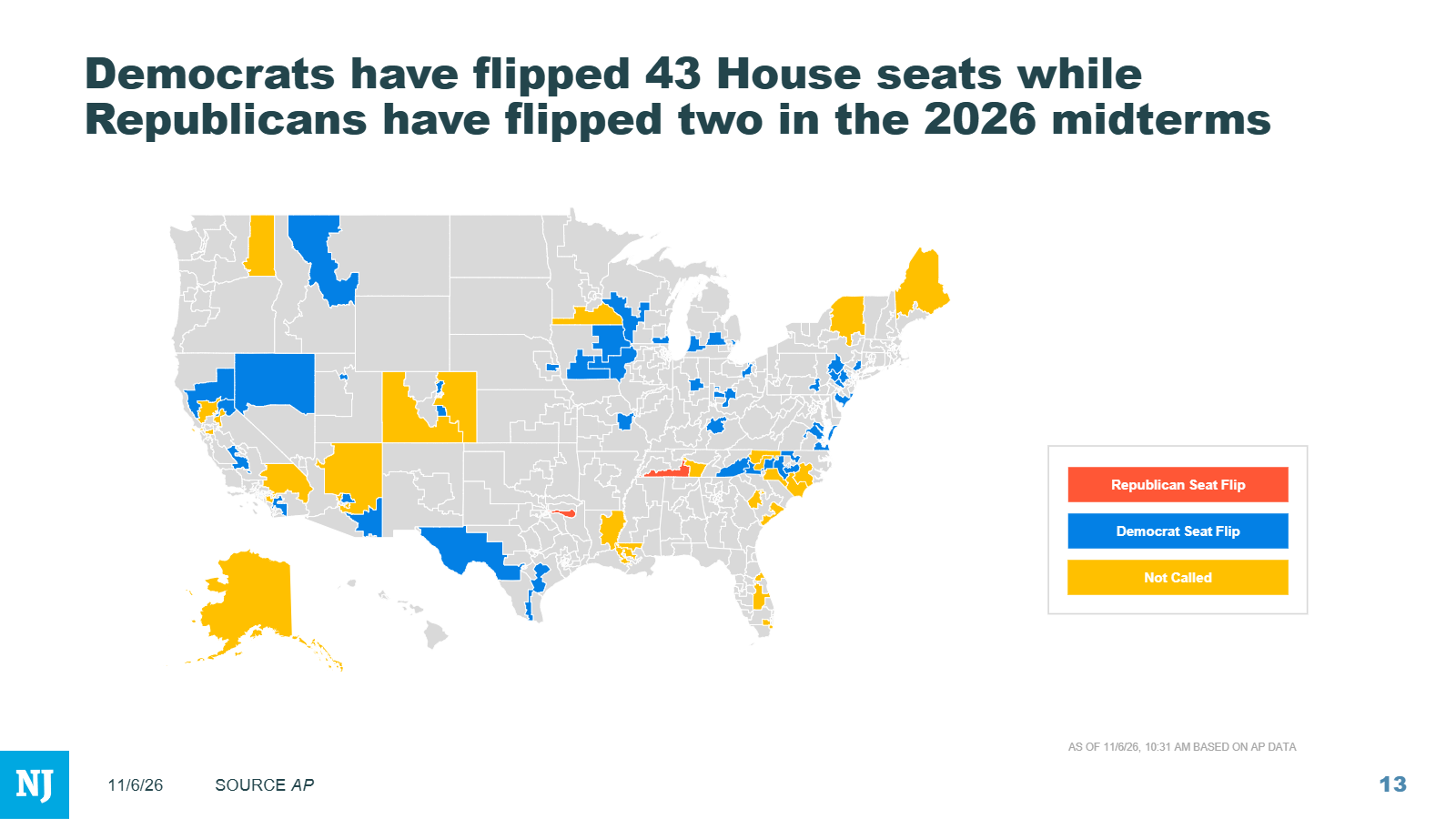
But no one could predict the historic romp Democrats are enjoying. With some races still uncalled, they're projected to flip more than 40 seats, potentially reelect all their incumbents, and win the largest majority in more than 30 years. This does not just happen overnight.
The Democratic Congressional Campaign Committee detailed how Democrats laid the groundwork for a historic shellackin’ in a new memo obtained exclusively by Hotline. The committee built its historic victory on three legs: early candidate recruits in battleground districts and beyond, successfully counteracting Republican attempts to change the maps and finance rules, and outrunning the top of the ticket the last two cycles.
“House Democrats won because of our laser focus on lowering costs and holding Republicans accountable for their corruption; methodically expanding the battlefield, even while many were saying we were going too far; and a nimble strategy that allowed us to outmaneuver whatever Republicans threw our way as they attempted to rig the midterms in their favor,” DCCC communications director Courtney Rice said in a statement.
The groundwork for the House majority was laid in 2024. While Democrats lost the White House and the Senate last cycle, they netted a single seat in the House, cutting Republicans’ majority to three. Democratic candidates outran former Vice President Kamala Harris by 2.7 points on average, putting them in prime position to flip the House this cycle. The party said its roster of overperformers allowed it to cycle money from well-positioned Democrats to deeper battleground seats quickly.
Trump’s historically low approval rating helped Democrats easily flip the low-hanging fruit this cycle and expand the battlefield deep into GOP-controlled territory. Democrats easily knocked out the three Republicans representing districts that Harris carried and ran up the score.
With 16 races left to call, Democrats “have so far won 44 of the DCCC’s 66 Districts in Play, which includes 34 of 46 Red to Blue races," according to the memo. Trump carried those 66 districts by an average of more than 17 points, according to a Hotline analysis of election data. The future Democratic majority is so deep that the bluest district in the country held by a Republican isn’t that blue at all—Maine's 2nd District was formerly the reddest district in the country held by a Democrat, and Trump carried it by 9 points in 2024.
To win in these deep-red races, the DCCC focused on “recruiting candidates who had deep roots in their communities,” according to the memo. The best performers of this cycle—candidates like former firefighter Bob Brooks in Pennsylvania's 7th District, musician Bobby Pulido in Texas’ 15th, and attorney Shannon Taylor in Virginia’s 1st—all had deep ties to their constituents before they ran for office.
They paired these candidates with a message focused on affordability, combating corruption, and health care: “DCCC internal focus groups of the House battlefield from February 2026 noted that ‘fighting to lower costs on groceries, housing, and health care’ was the top reason to vote for a Democrat.”
Democrats also had to overcome a financial disadvantage and an ever-evolving map. Last July, Trump pressured Republicans to redraw Texas’ congressional lines in their party’s favor, kicking off a bitter mid-cycle redistricting brawl. Democrats in California quickly countered with their own gerrymander, but Republicans then redrew lines in Alabama, Florida, Louisiana, North Carolina, Ohio, and Tennessee.
“Democrats did not ask for this fight but, under the leadership of soon-to-be Speaker Jeffries and in partnership with Eric Holder’s [National Democratic Redistricting Committee], we refused to sit idly by—we decided to fight fire with fire,” the memo says.
The DCCC’s report details how Republicans then went on to spend more than $137 million in the districts they had redrawn in their favor, only to lose a vast majority of them. When the dust finally settles, Republicans might end up winning just two additional seats, while Democrats flipped the GOP’s 10-4 majority in North Carolina to a 4-10 margin in their favor. Democrats gained seats in Ohio and Texas and held the status quo in Florida.
They overcame the gerrymander in large part through a dramatic shift of Hispanic and Latino voters back toward Democrats. The memo states that in Democrats’ “contested majority-Latino districts, DCCC candidates are averaging a +27 point shift from 2024 congressional races.”
“In the end," Rice said, "Republicans f’d around and they found out what happens when they put themselves ahead of the American people."
With 254 races already called in their favor, Democrats are poised to win the biggest majority this century and the largest margin since the early 1990s.