Oct. 28, 2026, 5 a.m.
Backs against the wall, Republicans threw out the rulebook to hold onto their slim House majority.
Regardless of next week’s results, this midterm cycle might be remembered for forever changing how House campaigns traditionally unfold. Goaded by the White House, Republicans sparked an unprecedented redistricting war and successfully sued to remove limits on coordinated committee spending, empowering partisan state legislatures and national committees in the battle for legislative control.
These unprecedented moves may not be enough to beat back the blue wave. Democrats appear set to retake the House—potentially by a wide margin—but the GOP’s aggression likely lessened the blow.
Democrats accuse Republicans of attempting to “rig the midterms,” while Republicans point out that courts approved many of their maneuvers after tense litigation. House campaign cycles have hardly ever been stable, but the wrangling of the 2026 cycle has lurched the battlefield back and forth, leaving strategists and voters still searching for their footing.
In 2026, there’s “definitely been a different element of adaptation,” Republican strategist Mark Bednar told National Journal. These tactics will reverberate long after the final ballot is counted on Nov. 3 and could permanently alter the race for the House for years to come.
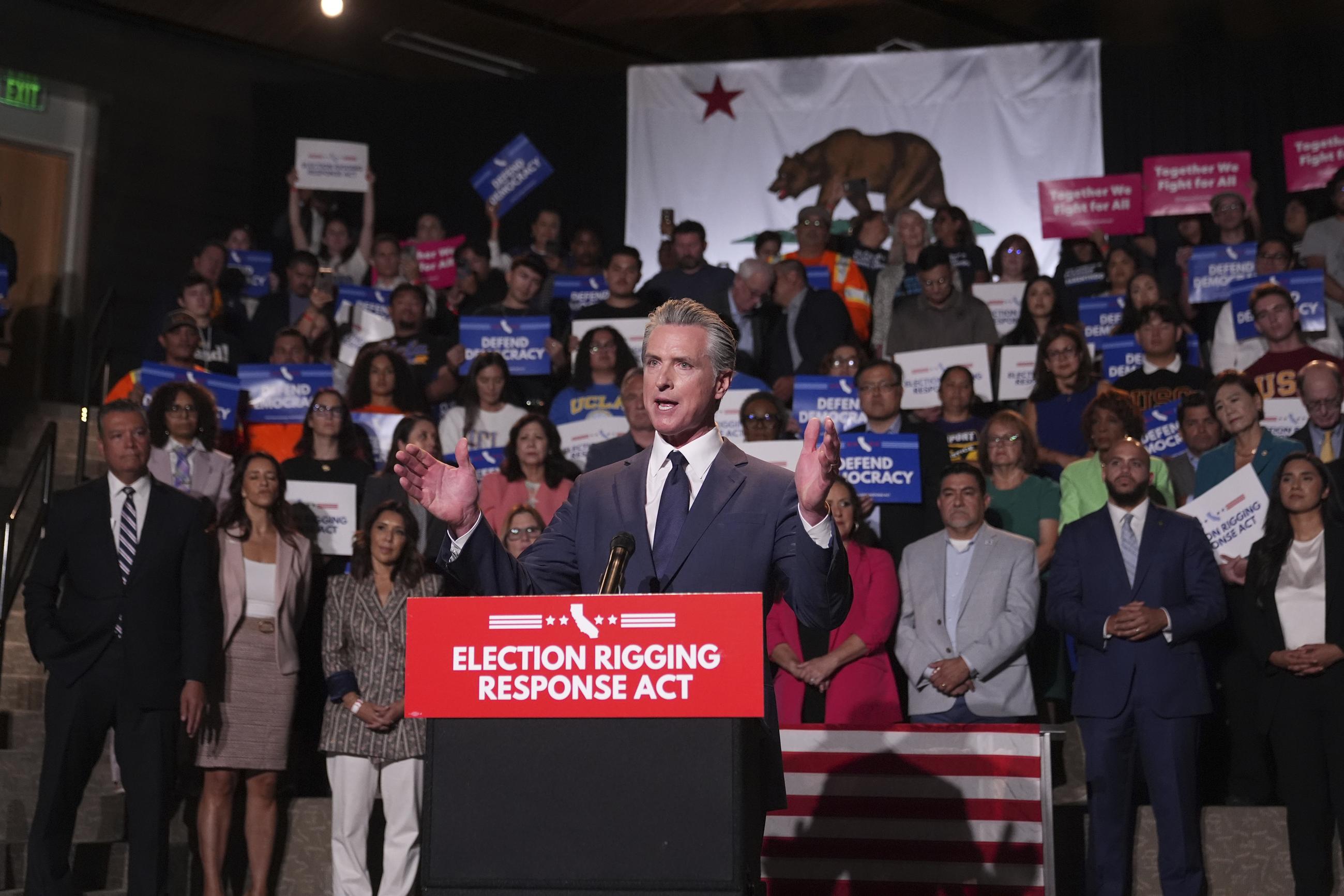
California Gov. Gavin Newsom speaks during a news conference in Los Angeles on Aug. 14, 2025. (AP Photo/Marcio Jose Sanchez)
ASSOCIATED PRESS
The red seawall
President Trump and his allies twisted arms—and sometimes ended careers—in statehouses across the country to redraw congressional maps in Republicans’ favor. Seven GOP-led states redrew their maps, and Republicans could pick up multiple seats in Texas and Florida as a result.
Trump’s push set off a corresponding scramble in Democratic states, like California, where a voter-approved map will net Democrats three to five seats. Democrats say the Trump-led redistricting effort was a signal of weakness, given the GOP’s narrow majority and the pattern of the president’s party losing seats in midterm elections.
“You don't sit there and try to rig the election starting in July of the off year with mid-decade redistricting—which has never been done before—unless you are confident, as confident as we were even back then, that they were going to lose the majority,” Democratic Congressional Campaign Committee Deputy Executive Director Will Van Nuys told National Journal.
The new maps will almost certainly help stifle the blow of any blue wave that might arrive. The Cook Political Report with Amy Walter reports that redistricting could net Republicans as many as eight seats, though in a blue tsunami, the results could be a wash.
A fortuitous court ruling in Virginia, which struck down a map that would have netted Democrats up to four seats, helped Republicans keep that edge. At the same time, the redraw movement's hectic pace led to GOP defeats in Indiana and Missouri—the fight over Missouri’s map didn’t fully settle until late September, when mail-in voting had already begun.
“Mathematically, it's clear that it does open some pathways for Republicans,” Bednar said. “You know, there were a couple lucky breaks. The Virginia element, that could have gone differently.”
Strategists from both parties hesitate to speculate on potential 2028 redistricting before the 2026 elections are even over, but the battle in the states has already begun. Voters in Missouri and Maryland will decide on ballot initiatives that would allow Republican and Democratic majorities to redraw congressional maps in their respective states. New York and Georgia are among the states to take steps toward drawing new congressional maps for 2028.
Van Nuys said Democrats developed a three-pronged strategy for handling the redistricting war: Recruit strong candidates in districts with even a slim chance of becoming competitive; fight the process in states like Indiana, where the push fell short; and go on the offense in states like Utah and Missouri, where legal action helped Democrats save seats.
“Those three areas are what future partners [and] the future DCCC will be able to take as the blueprint,” he said.
National Republican Congressional Committee Communications Director Will Kiley, meanwhile, didn’t dwell on what future House cycles might hold, citing potential legal battles and environmental changes.
“Only time will tell if the maps keep changing. Our responsibility is to build an operation that can compete as the landscape changes, with strong recruitment, sustained investment, and candidates who understand their districts,” he said in a statement.
The U.S. Supreme Court (AP Photo/Rahmat Gul)
AP Photo/Rahmat Gul
The green wave
In another series of legal battles, national GOP committees successfully lifted limits on how much money they could spend on coordinated campaigns with their nominees. Prior campaign finance law set limits on how much national committees like the NRCC could spend in collaboration with campaigns: between $65,000 and $130,000 depending on the House district. The Supreme Court ruling removed those limits, allowing Republicans to spend an additional $126 million in coordinated spending and Democrats an additional $46 million, according to Reuters.
Republicans also won access to discounted TV ad rates that used to solely belong to candidates. The rulings shook up the campaign finance world, giving Republicans the chance to more efficiently spend the national cash advantage they’d accrued over the years.
The GOP’s cash advantage within its national committees allowed the party to allocate more money than Democrats. In September, the NRCC spent $46.9 million on coordinated spending, more than 80 percent of its total disbursements. The DCCC spent $27.6 million on coordinated buys in September, about 60 percent of its total spending.
“The ruling was a decisive First Amendment victory and a major win for the integrity of our political system,” Kiley said in a statement.
The NRCC and the DCCC diverged on how to approach coordinated spending. Republicans spent big and early, letting campaigns take care of late-stage spending themselves. Democrats saved much of their coordinated cash for late in the game, September and October.
Bednar said this type of spending is especially useful after redistricting, as many nominees, even those in safe seats, must introduce themselves to their new voters.
“If you were to do redistricting without that air cover, without that ability to introduce yourself to voters … then it's a much steeper climb,” Bednar said. “But because you had that financial advantage, I think that's a really good one.”
Van Nuys said Democrats are prepared to take advantage of the coordinated-spending rulings and are focusing those efforts on the final weeks of the election. He said the GOP’s impetus for the lawsuit came because of strong fundraising by Democratic candidates over the years.
“I think the piece that a lot of people missed in this is the Republican committees were doing this because our Democratic candidates across the battlefield for a number of cycles, going back to 2018, have outraised their Republican opponents by jaw-dropping amounts cycle after cycle,” Van Nuys said.
Regardless, the ruling served as a boon for national Republicans—Bednar called the GOP’s cash advantage “a real delight.”
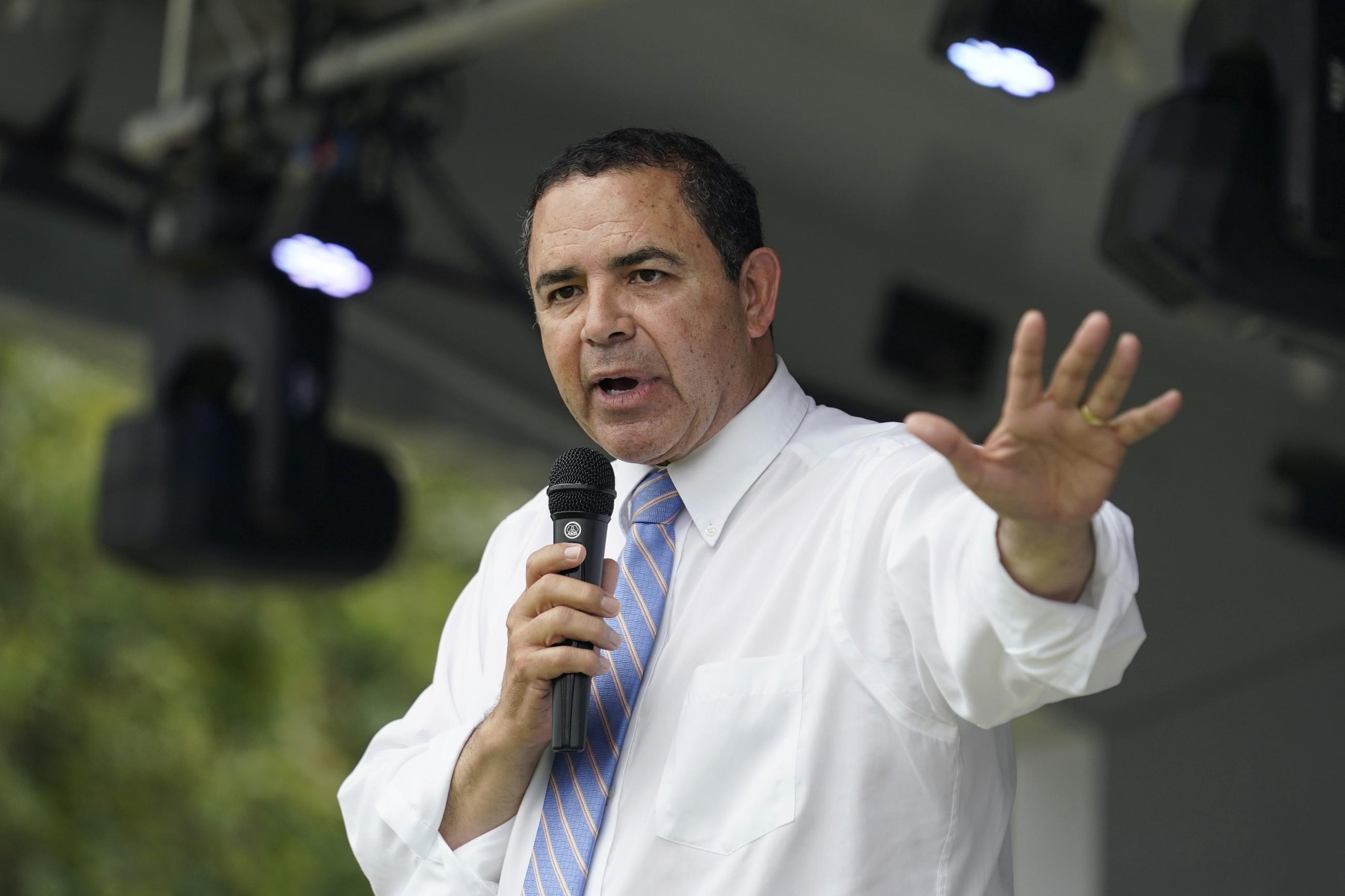
Rep. Henry Cuellar (AP Photo/Eric Gay, File)
ASSOCIATED PRESS
The blue wave?
Despite the GOP’s efforts, Democrats appear set to retake the House. Polling shows Democrats leading in key swing districts, and prognosticators continue to shift their race ratings leftward. Democrats may have retaken the majority no matter what, given the political environment, but Republicans nonetheless may be leaving seats on the table.
Trump’s unpopularity and concerns over the cost of living have led to a clear Democratic edge, and a Democratic majority in the House is widely expected. The election may be so lopsided, in fact, that redistricting efforts in states like Texas could fall short.
In the Laredo-based 28th District, Republicans pulled millions of dollars meant to unseat Democratic Rep. Henry Cuellar, a signal that he’s moved ahead. The GOP meant to make it harder for him to keep his seat—Trump won the newly drawn district by about 10 points in 2024. But, according to Politico, Cuellar’s team found that House Democrats had actually earned more votes in the redrawn district than in his prior seat, potentially giving him a boon. Now, Cuellar, who had appeared to feign a party switch to secure a presidential pardon as he faced bribery charges, is in the driver’s seat for reelection.
Similar stories are playing out across Texas, where mapmakers hoped Latino voters would stay with Republicans after their big 2024 swings rightward.
“We have dealt with the most Republican attempts to rig the midterms, and we are playing in the most districts across the most states in the country, and we have been the most aggressive in fighting back on them,” Van Nuys said. “[We] can guarantee that not only have we been successful on that front, but we will win the majority on Election Day.”