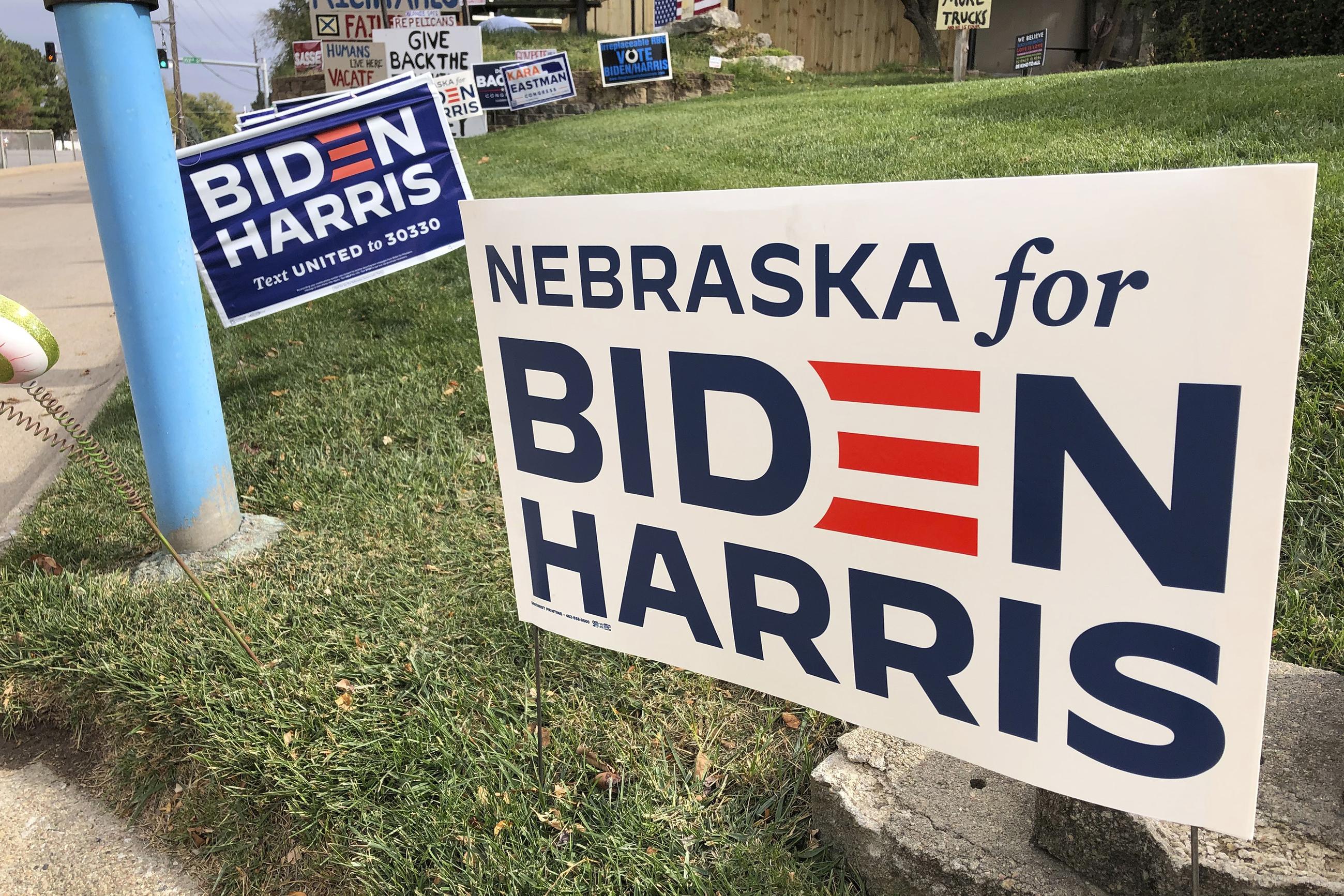
In a must-flip district for Democrats, more than just the congressional seat may be on the line.
Nebraska is one of just two states that allocates its Electoral College votes by congressional district, while every other state allocates its electoral votes to the statewide popular-vote winner. For the past several election cycles, Democrats have carried the liberal-leaning Omaha district and its single electoral vote, while the rest of the state goes Republican.
Since the state implemented the system in 1992, Republicans in Nebraska’s unicameral legislature have tried to undo it and revert to winner-take-all to no avail. Now, Democrats in the congressional primary warn that a potential vacancy in the unicameral could give Republicans a path to successfully do away with Omaha's famous blue dot.
Some of the Democrats running in Nebraska’s 2nd District argue that the leading candidate in the primary, state Sen. John Cavanaugh—who holds one of the bluest seats in Nebraska’s unicameral Legislature—could hand control of the chamber to Republicans if he wins the House seat. Cavanaugh’s vacancy would allow the governor to appoint his replacement, which would shift the partisan balance of power and could endanger the blue dot.
Republicans already hold a supermajority in the unicameral, but their caucus has been divided. Last April, a vote to get rid of Nebraska’s blue dot, which needed 33 votes to end the filibuster, split 31-18.
According to Cavanaugh's Democratic opponents, Republicans could either push forward another procedural piece of legislation switching Nebraska’s electoral-vote allocations back to a winner-take-all system, or they could redraw the congressional districts—especially after the 2030 census—to dilute Democrats’ influence.
Democrats running against Cavanaugh, like Denise Powell and Douglas County District Court Clerk Crystal Rhoades, are using this argument to urge Cavanaugh out of the five-person race. They both have red boxes on their sites encouraging independent spenders in the race to highlight the threat Cavanaugh’s departure poses to the dot.
“We have a real opportunity here to flip this seat in Nebraska-02, and I think we can do that while also protecting the blue dot,” Powell told National Journal.
The Omaha seat is the bluest in the country held by a Republican, but as stalwart Rep. Don Bacon will not seek reelection, Democrats have a good shot of flipping it regardless of who wins the primary.
The state’s legislative seats may be harder for Democrats to flip. Democrats in the state are divided on how many unicameral seats are likely to flip in November. The top three pickup opportunities for Democrats in the unicameral all went for President Trump by between 2 and 9 points in 2024. Republicans also hold significant voter-registration advantages in those districts.
Cavanaugh argues that Democrats will flip seats in November, minimizing the impact of his potential departure in January.
“With strong local candidates running in key seats, historic investment from the Democratic Legislative Campaign Committee, the deep unpopularity of MAGA Republicans, and Cavanaugh running a strong campaign that will uplift legislative candidates, Democrats will pick up at least two legislative seats in November—more than making up for the loss of Cavanaugh's seat,” Katie Bartizal, Cavanaugh’s campaign manager, told National Journal in a statement. “Democrats do not have to choose between protecting the Blue Dot and flipping NE-02 blue.”
Cavanaugh, whose father held the House seat from 1977 to 1981 and whose sister is a fellow state senator, is the front-runner in the race. Internal polls for Cavanaugh have shown him leading by double digits in the primary. Republicans are running ads tying him to the MAGA movement, a sign that they see him as the strongest Democrat in the race. American Action Network, a Republican group tied to the Congressional Leadership Fund, launched an ad last week thanking Cavanaugh for "sponsoring Trump's MAGA agenda."
If Nebraska legislators do eventually implement winner-take-all in the state, its influence in the Electoral College will hit a counterweight. The single electoral vote in Nebraska’s 2nd District, which trends Democratic, is often canceled out by the single electoral vote in Maine’s 2nd District, which trends Republican. Democrats in Maine proposed legislation last year that would revert the state to a winner-take-all system contingent on Nebraska doing the same.
“As much as I would like to say the blue dot really is going to impact the outcome of an election, I don’t think that’s going to happen,” said Randall Adkins, a political science professor at the University of Nebraska Omaha.
Nonpartisan strategist Josh Putnam said the Electoral College is designed to avoid close results that could be swayed by just one electoral vote.
“We rarely get a situation like 2000 where things are that close in the Electoral College,” Putnam said.
That election, the closest in U.S. history, ended with a final electoral-vote margin of 271-266, still not close enough for a single electoral vote to have made the difference.
While it’s unclear whether the blue dot will be lost, it serves concrete benefits to Nebraskans. Presidential candidates hit the stump in Omaha, and the district serves as a rallying point for Democrats in the state because of its unique position in the Electoral College.
“I don’t think Democrats are going to win by playing scared or limiting who can run,” said Barry Rubin, a longtime Nebraska-based strategist. “Strong candidates stepping up should be a good thing, not something that Democrats shut down out of fear, so the focus should be on winning more races, not fewer.”
Democrats in Omaha organized in 2024 to deliver the district’s vote to former Vice President Kamala Harris, with blue-dotted yard signs appearing across the area. When Republicans in the unicameral legislature debated switching to winner-take-all early last year, many Nebraskans lined up to testify in defense of the blue dot.
“The blue dot really became this rallying cry and this thing that allowed Democrats to really build this sense of community,” Powell said.