Dec. 24, 2025, 12:21 p.m.
LAREDO, Texas—The separation of church and state is about as American as apple pie. In South Texas, though, you might not be able to tell the difference.
It’s a region where the number of churches might rival the number of McDonald’s and residents wear their faith on their sleeve just as easily as they wear the blue star of the Dallas Cowboys.
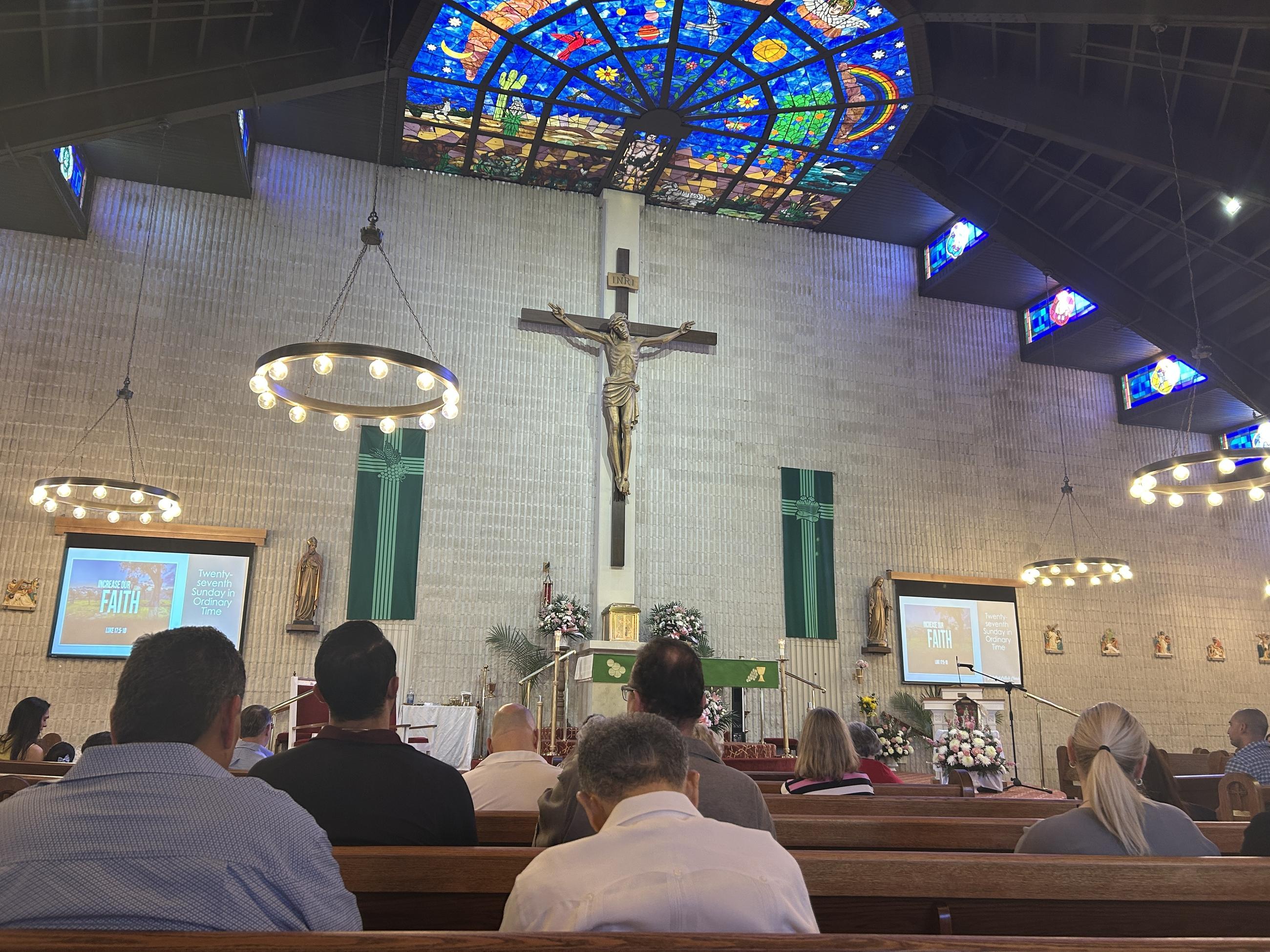
The Catholic Church has undaunted influence in South Texas, evidenced by a full house on Saturday afternoon in October vigil Mass in Laredo. I grew up in and around the faith, having attended Catholic college and been to Mass nearly every weekend since I was born. When I traveled to the Rio Grande Valley area in early October, I went out of my way to make it to church to experience the exercise of Texas religious culture. What I found was an anomaly compared to Washington, where Capital-area Catholic churches attract only a handful of parishioners on Saturday afternoons.
Outside of Laredo, the Catholic Church’s financial struggles are well documented. For individual parishes, that might be felt particularly hard, exacerbated by a steady decline in attendance over the past several years.
But here in Texas, you wouldn’t be able to sniff the Church’s financial struggles. A Ford F-150 parked outside the church waits to be given away as part of its fundraising raffle. If you’re less fortunate, you could walk away with a 2026 Honda Civic as second prize. The Church is a well-oiled machine in South Texas, and interwoven into the cultural fabric of the community.
Everybody I interviewed along the border mentioned to me just how important a role faith plays in everyday life. Each one offered a different perspective on faith in their lives, but their answers shared a common bond in expressing the Church’s influence on home life, family life, and community life.
Democrats have steadily lost ground in this socially conservative region of the country, so I ventured down to find out why its residents have turned away from the party.
At a teacher’s union in McAllen, a handful of educators told National Journal they believed abortion politics to be the reason for the intense rightward shift in the region during the 2024 election. They lamented their colleagues voting Republican primarily because of abortion even though, the teachers said, they were voting against their broader interests as educators.
Postelection survey data indicated the economy prevailed as the most important issue for Latino voters, with abortion toward the bottom, But the teachers might be on to something. Bobby Pulido, a Tejano music star now running for Congress in a McAllen-based seat, told me faith is “everything” here in the region.
“If they paint you as godless, then people will navigate to the other party that they feel is more aligned with their faith,” Pulido said.
And though it may not have been the most motivating factor in last year’s election, to say abortion is not top of mind would be a far cry from reality.
Back at the Saturday Mass, the church’s pastor delivered a homily on the sanctity of life, from “womb to tomb,” and encouraged parishioners to attend a pro-life prayer gathering in Laredo the next day. It’s not uncommon for a priest to preach about abortion; what’s considered hotly contested within political discourse stirred no controversy in this house of God. The sermon underscores the almost unbreakable bond between culture and faith in the region.
After the service, churchgoers come and greet Rep. Henry Cuellar, a longtime fixture in his parish. A line forms for the Democratic congressman, and the narthex turns into an informal meet-and-greet. He stays to meet everybody and is one of the last to leave this Saturday evening.
A parishioner, who happens to work for Customs and Border Protection, introduces two visiting nuns to the congressman. Cuellar, in turn, hands them his business card and offers to give them a tour of the border.
The nuns were a bit taken aback by the offer, underscoring the deep, and most often fraught, tension between Catholic social thought and immigration politics. My home parish in D.C. services a diverse assembly, including many Latino worshippers, and immigration conversations may arise but are hardly a mainstay. But St. Patrick Church sits a mere 15 minutes from the southern border, and the topic felt like small talk in the back of the church despite its immense gravity.
Faith is “extremely important” to South Texans, Cuellar told National Journal in an interview in his hometown. “Hispanics are … conservative, religious by nature.”
Perhaps, for Cuellar and so many others along the border, the church is no different an arena than the county fair. Here, the church is the site of political activity.
And so the endless drum of politicking beats on, even after the final blessing and exit hymn.