Nov. 19, 2026, 5:35 p.m.
If the world watched the just-concluded summits in the Philippines and China to see if President Trump’s midterm losses had in any way affected his foreign policy, the answer was pretty clear. Just as he responded back home by reiterating his hard-line domestic agenda, promoting Stephen Miller to chief of staff, his response overseas was to double down on his transactional and highly personal approach to matters of war and peace.
Even before leaving on the trip, the president reprised one of his old hits—siding with an authoritarian adversary against his own top intelligence advisers. In his 2018 Helsinki summit with Russian President Vladimir Putin, Trump rejected the unanimous verdict of the U.S. intelligence community that Russia had meddled in the 2016 U.S. election, citing Putin’s denial and saying “I don’t see any reason” to doubt the Russian president.
Eight years later, speaking to reporters before boarding Marine One, he was asked if he trusts the U.S. intelligence conclusion that Alice Huang, who had an affair with Nvidia chief executive Jensen Huang, was working for the main Chinese intelligence agency.
Denying he had ever been told that, he said, “I don’t know that she is a spy.” Yet his administration sure behaved like it knew, as it clamped down on China by issuing new rules to restrict remote access to advanced U.S. chips and servers.
In normal times, a Chinese show of pique would be expected. But it did not materialize. Instead, Chinese President Xi Jinping did something he has not done for any other leader. “Not only did the Chinese essentially not react to the new rule, but Xi Jinping still went to the airport to greet Donald Trump, something which is truly extraordinary,” said Edgard Kagan, the Freeman Chair in China Studies at the Center for Strategic and International Studies, who called it “a sign that Xi still very much values the relationship and wants it to continue.”
To say that the president was impressed by the welcome is an understatement.
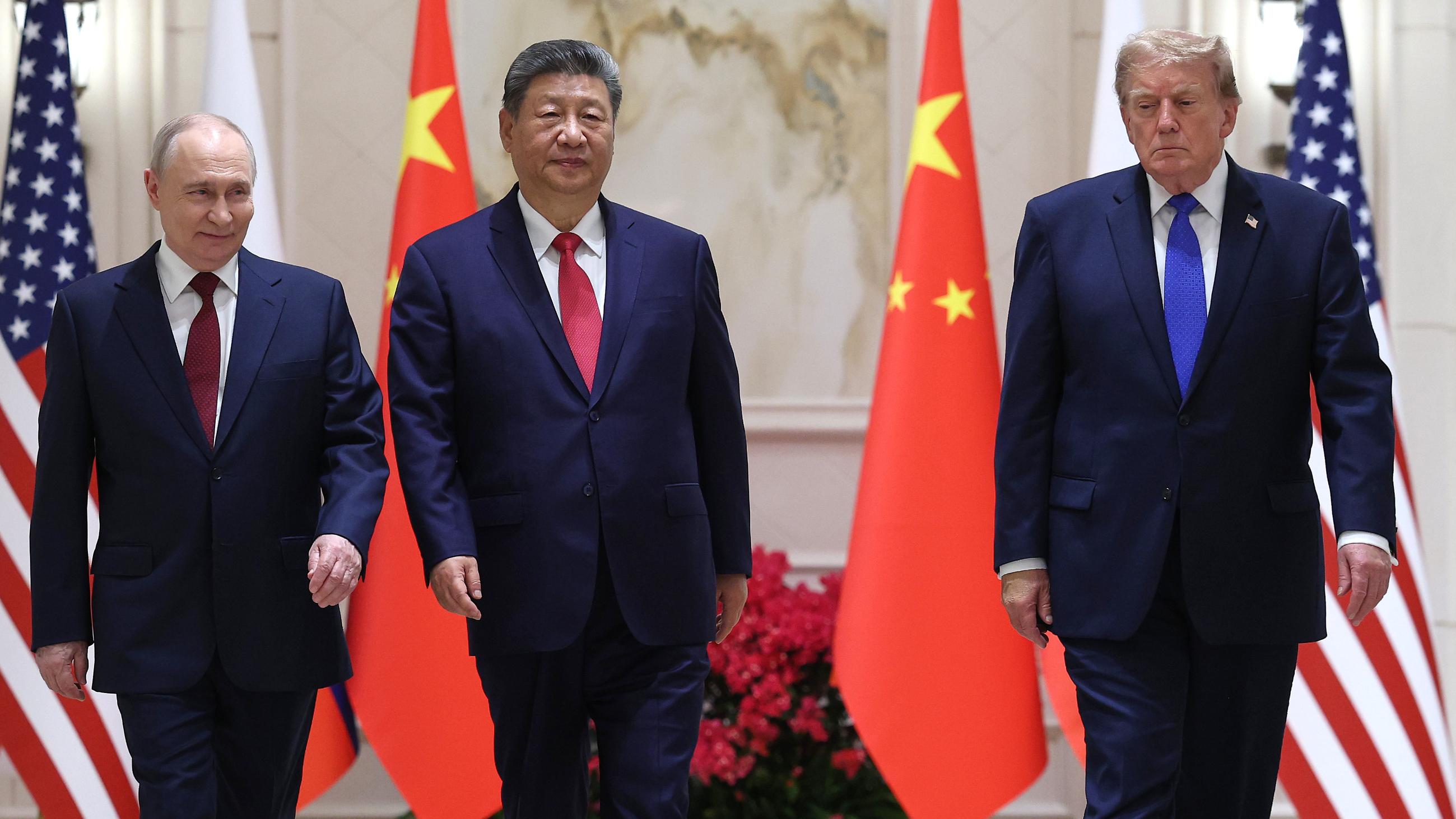
When Jacqui Heinrich of Fox News asked Trump what headline he wanted from his sit-down with Xi and Putin, he immediately cited the airport welcome.
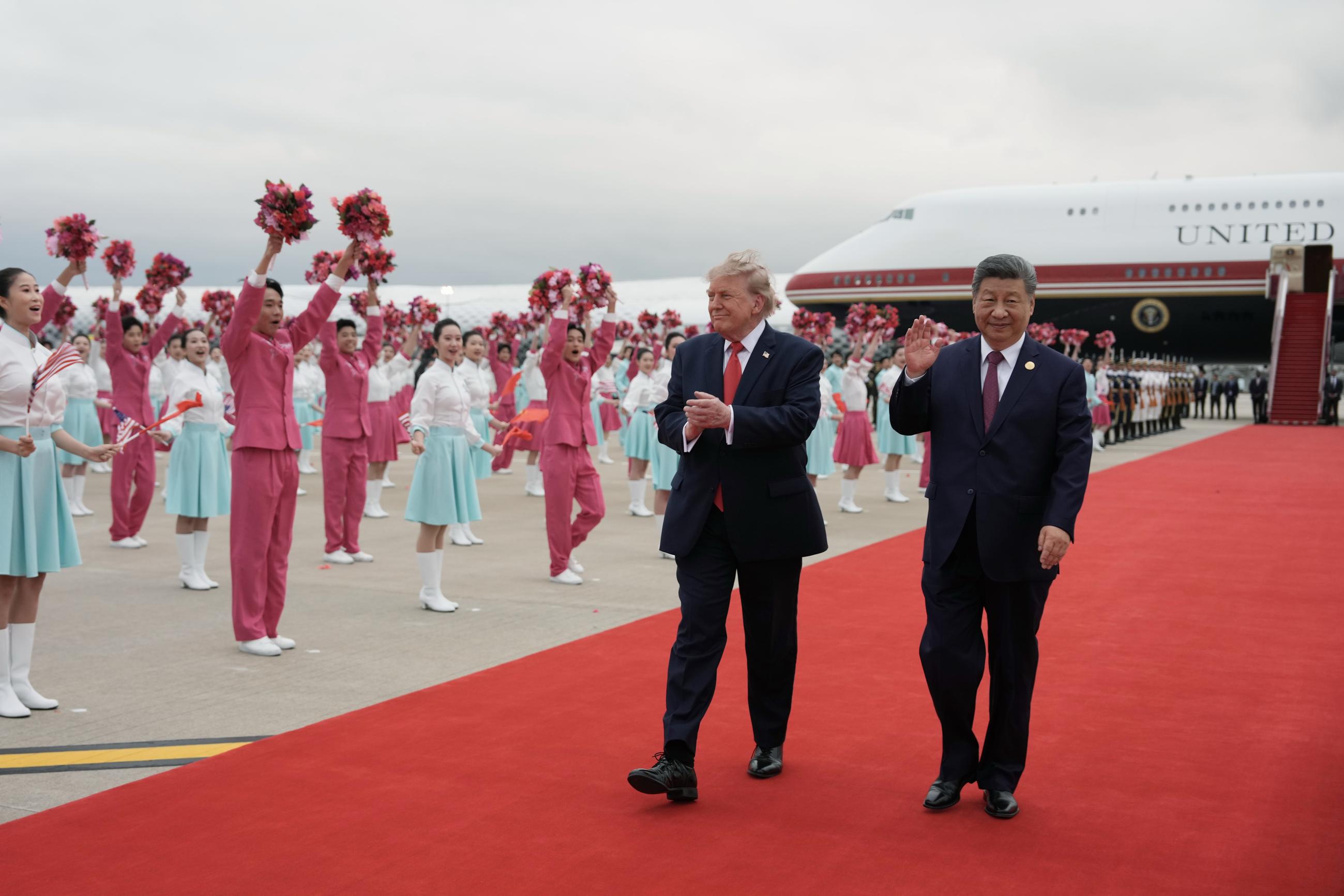
Trump walks with Xi Jinping as he arrives at Shenzhen Bao'an International Airport on Wednesday. (AP Photo/Mark Schiefelbein)
AP Photo/Mark Schiefelbein
“I’ve already gotten that headline because the relationship that I have with China is a great one,” he said. “It’s a friendship relationship; it’s a respect relationship.” He added, “You saw the greeting yesterday, which in the history of China has never happened.” He then gushed about “the fanfare, the beauty, the pageantry, the thousands of people … the young children, the soldiers, the whole thing."
"It was great respect, and I appreciate that. That’s a big win for us.”
Trump booked a modest win just by getting China to agree to a three-way summit with Putin, something Xi had resisted. And the fact that the three leaders issued a concluding statement was a surprise, particularly that Xi agreed to continue the process.
“I was shocked that there was a joint statement,” said Kagan, a veteran Foreign Service officer who served in President Obama’s State Department and President Biden's National Security Council, and was Biden and Trump’s ambassador to Malaysia. “It’s not clear to me that this will actually lead to anything substantive, but the Chinese haven’t even wanted to agree to this for 25 years.”
Trump’s insistence on elevating personal relationships over national interests was even more obvious in his remarks about Putin. Leaving the White House on Monday, he excused Putin's barbarity in Ukraine, saying, “I think he could be a lot tougher, frankly. I think he’s backing down.”
In Shenzhen, he called Putin “my friend” and beamed when he saw him. Trump’s invitation to Putin for the three-way summit was seen as a gift to a despot the Western world has tried to isolate since his invasion of Ukraine. “This trilat is Putin’s dream,” tweeted former Undersecretary of State Richard Stengel. “It restores him to the world order after his invasion of Ukraine. Shameful.”
Kagan agreed that “Putin is the biggest winner from this.” But he doubted Trump privately made big concessions on Ukraine. “If they’d gotten anything meaningful from Trump on Ukraine, they would be trumpeting that because it would demoralize the Europeans and the Ukrainians.”
Just getting the meeting was a huge win for Putin, angering European allies and frustrating Ukrainian President Volodymyr Zelensky, who was pointedly absent from the talks. In an interview with NBC’s Richard Engel, Zelensky warned against trying to impose a solution on his nation. “Big countries always think that they can make decisions the about future of all the world,” he said. “It's a huge mistake, absolutely. You can't decide about some country, even a small country, without this country.”
For Trump, though, this is how he has always operated foreign policy—flashy summits with little preparation, high comfort with authoritarians, and heavy emphasis on the ceremonial and the personal.
Speaking to NBC as he flew home on Thursday afternoon, Trump said that the summit was, “on a scale of zero to 10 … a 12."
"It was a great summit and very important. Fantastic relationships built, and you know, the meetings were good, but the final two and the final three were just amazing, amazing meetings.”
Indeed, nothing in the midterm elections seemed to have changed Trump as he raced through Asia this week. As Kagan noted, no past presidents who took a beating in the midterms—from Ronald Reagan in 1982 through first-term Trump in 2018—changed, but all hit the road.
What was on display in the Philippines and China, he said, “was very much the normal midterm playbook."
"The American public doesn’t really care about foreign policy, but foreign travel makes the president look presidential, particularly if it’s done well," Kagan said. "Doing a foreign trip is how you manage bad midterms. And the idea, particularly for Donald Trump, that it was going to change how he behaves—I just don’t buy it.”