Nov. 19, 2026, 4:30 p.m.
As prospective candidates look toward presidential runs, their first test is gathering donors and supporters in their home states. For some candidates looking at what’s shaping up to be a historically crowded field in 2028, that process may become a battle.
Sens. Mark Kelly and Ruben Gallego of Arizona have been floated as potential presidential candidates. In California, Gov. Gavin Newsom, former Vice President Kamala Harris, and Rep. Ro Khanna are also weighing White House bids. Sens. Raphael Warnock and Jon Ossoff in Georgia could soon be competing for Peach State donors. On the GOP side, past presidential candidates and Florida men Ron DeSantis and Marco Rubio could each launch runs again.
But the political environment has changed to allow for crowded presidential primary fields, including multiple candidates from one state.
“Those old sort of conversations worked whenever we didn’t have access to social media and didn’t have access to the national media like what we do now,” Brett Doster, who managed Jeb Bush’s 2016 presidential super PAC, told National Journal. “Before, it would be unheard of for more than one candidate to run from one state; you would try to keep that tamped down.”
The battle for donors, supporters, and in-state races may not matter as much as the interpersonal relationships between the candidates, which can be strained amid fierce competition, strategists told National Journal.
“If you are a state politician, like a governor or a senator, I think it’s critical because those are the donors that have propelled you,” said Jason Cabel Roe, who was the national media spokesperson for Rubio’s 2016 campaign. “If you can’t get them on board, that makes it very difficult to convince donors outside of your state that you’re viable.”
In his presidential run, Rubio faced off against a fellow Floridian, then-Gov. Jeb Bush. The two men, who were once friends, had an acrimonious relationship during the campaign that culminated in sparring during the third GOP debate.
Bush eventually endorsed Rubio after suspending his campaign, and the two reconciled.
“There may have been a little bitterness here and there, but by and large and generally, a lot of the people who supported Bush as their first choice turned around and supported Marco whenever Bush got out, because there was at least that relational connection there,” Doster said.
In 2024, two South Carolinians—former Gov. Nikki Haley and Sen. Tim Scott—faced off for the Republican nomination.
“When it came time to potentially choose sides between the two of them, it made it hard for some donors, operatives, and activists, who knew both candidates well,” said Rob Godfrey, a longtime Haley aide who also knows Scott and was neutral in the 2024 primary. “Would-be supporters may not have wanted to alienate either candidate personally, but when it came to policy or tone, they may have had a preference of one over the other and not said anything publicly.”
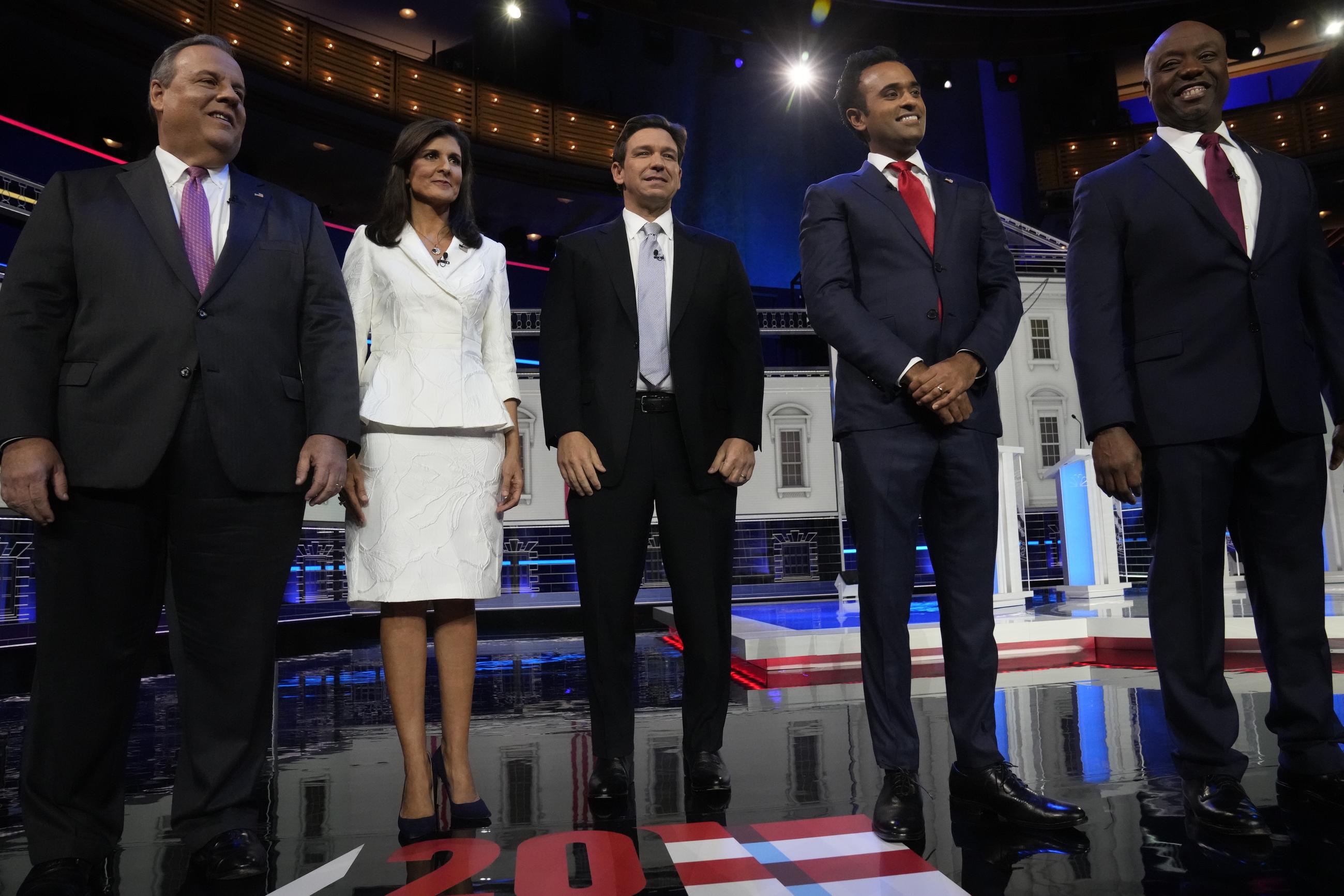
Republican presidential candidates at a debate in 2023, from left: former New Jersey Gov. Chris Christie, former South Carolina Gov. Nikki Haley, Florida Gov. Ron DeSantis, businessman Vivek Ramaswamy, and Sen. Tim Scott (AP Photo/Wilfredo Lee)
ASSOCIATED PRESS
Doster said donors don’t necessarily have to choose between candidates, and while in 2016 many donors initially supported Bush, they could easily choose to support multiple candidates from their state.
“Any donor in Florida is going to be super excited about having someone from Florida with an opportunity to be in the White House,” he said.
In recent years, the megadonors supporting presidential campaigns are no longer tied to any individual state, and any presidential candidate can vie for their support.
“The national conversation is going to be much, much more important than the state-by-state conversation,” Doster said.
Haley and Scott, like Rubio and Bush, exchanged barbs on the debate stage. Scott called out Haley’s proposed gas tax in South Carolina and accused her of approving $50,000 curtains in the U.N. ambassador’s residence. Haley told Scott to “do your homework” and said he was “scrapping.”
Democrats have not had a major in-state presidential primary matchup since 1968, when Vice President Hubert Humphrey and Sen. Eugene McCarthy, both Minnesotans, faced off after President Johnson announced he would not seek reelection. Humphrey entered the race only after Johnson stepped out, avoiding several of the first primaries.
Some potential 2028 Democrats appreciate the risk of in-state rivals. Newsom has claimed he would not run if Harris chooses to launch a campaign of her own.
“I wouldn’t do that to her. ... I wouldn’t waste everyone’s time. Who needs that?” Newsom said during a CNN interview in September.
“If either came to a conclusion that they wanted to run or were being compelled to run, I think that they would have a conversation and one of them would stand down.” ”
—Andrew Heaton, Georgia-based Dem strategist, on the presidential ambitions of Sens. Warnock and Ossoff
In Arizona, Gallego said he has not spoken with Kelly about their respective appetites for presidential campaigns.
“We're probably going to just, like, dance around it forever,” Gallego told The Arizona Republic last month. “Until, you know, one of us blinks first. And then we'll have a conversation. Come on, politicians are passive-aggressive. You know how that's going to end up.”
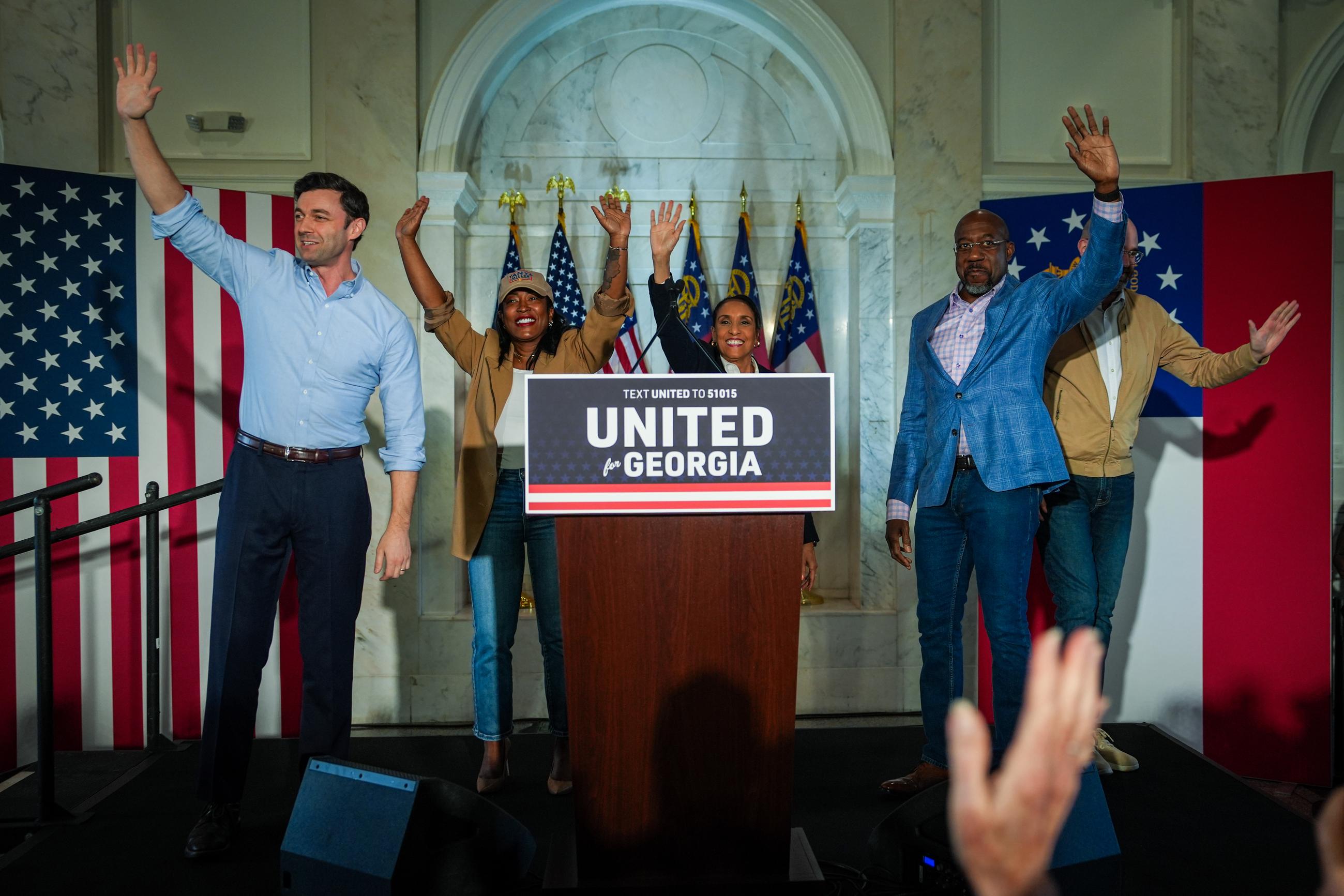
Warnock and Ossoff, who have both received 2028 buzz, came up together during the 2021 Senate runoffs, and Warnock regularly refers to Ossoff as his “brother.”
“They also just have a deep respect for each other,” Andrew Heaton, a Georgia-based Democratic strategist who worked on both of Warnock’s campaigns, told National Journal.
Heaton noted the possibility that neither senator ultimately chooses to run.
“I think they and their teams have too much sense to know that both of them running from the same state would just not be feasible,” he said. “If either came to a conclusion that they wanted to run or were being compelled to run, I think that they would have a conversation and one of them would stand down.”
But Democrats’ sweeping victories in the midterm elections could encourage Democrats on the fence to try their hands at a campaign.
"Everyone's going to hire a staff, everyone's going to start an exploratory committee, because those are easy to shut down and transfer into your federal PAC," Arizona-based Democratic strategist Sam Richard said.