Nov. 11, 2026, 5 a.m.
Democrats’ dominating performances in last week’s elections extended to statehouses across the country, allowing them to break free from over a decade-long Republican grasp on state power. The party now holds at least 28 governorships and a majority of state legislative chambers, putting statehouses at the center of the 2028 battleground.
In states where Democrats won trifectas—especially traditional battlegrounds like Arizona, Michigan, Nevada, Pennsylvania, and Wisconsin—they have the opportunity to deliver on campaign promises unencumbered by Republican opposition. Their accomplishments over the next two years will provide a test case for Democratic governance ahead of the 2028 cycle as they run for reelection and potentially the White House.
But a failure to deliver could just as quickly turn off the voting bloc who delivered them the midterms.
“In states where we have trifectas, it’s now our opportunity to show what a Democratic agenda looks like,” said Nevada-based Democratic strategist Martin Fitzgerald. “We can demonstrate putting into action what we all campaigned on. And so this is the test.”
Beyond the five swing-state trifectas, Democratic governors will also represent the other two swing states—Georgia and North Carolina—that will have a Democratic-controlled state House, and newly elected Democratic governors will lead potential new battleground states like Iowa, Ohio, and Texas.
In all, Democratic governors will represent states totaling over 375 Electoral College votes in 2028.
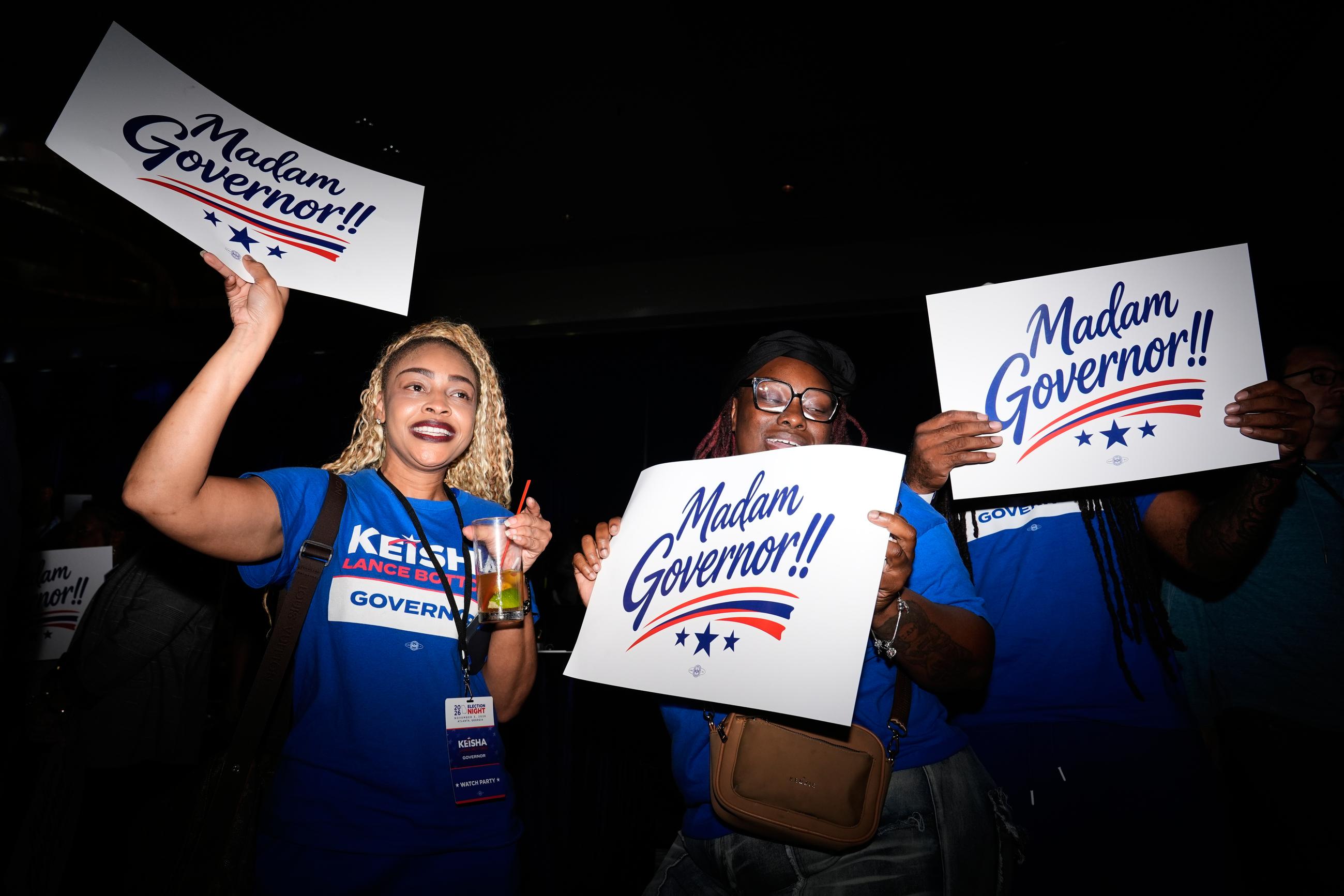
Supporters cheer while holding up signs at an Election Night event for Georgia Democratic gubernatorial candidate Keisha Lance Bottoms in Atlanta. (AP Photo/Brynn Anderson)
AP Photo/Brynn Anderson
Democratic strategists warned against viewing the midterm results, including on the state legislative level, as an endorsement of party platforms instead of a repudiation of the Trump administration.
“Democrats should not confuse the mandate from Tuesday night,” said Morgan Jackson, an adviser to Sen.-elect Roy Cooper of North Carolina. “The mandate was, 'We desperately need help, and need you to do something to make life easier and make life more affordable for families.' If Democrats can deliver on that mandate, then they stand the chance to build sustainable majorities long-term.”
Democratic trifectas will need to keep these voters aligned with them ahead of 2028, and a failure to fulfill campaign promises like lowering costs could quickly turn voters away.
“They weren't voting for us because of the D by our names. They were voting for us because they were tired of what is happening,” said Leslie Martes, chief executive officer of Forward Majority. “They're fed up with the current administration and then their states and their state government, and they want someone to do something different. I think our candidates were able to talk about something different. I don't want people to over-index and think suddenly, 'Yeah, the Democratic Party—let's go!'”
Communicating what Democrats are accomplishing in statehouses could be another hurdle. Voters are sometimes unaware of the power state legislatures have, and state-level lawmakers get a fraction of the attention of congressional delegations.
“The biggest lesson learned for Democrats across the country is when you get power, it is on you to move swiftly and assuredly to make big change happen,” said former Michigan state Rep. Mari Manoogian, now the executive director of Democratic recruiting group The Next 50. “And then once you make that big change happen, you have to go out and tell the American people that story.”
State governments are not going to be stopped by Trump's veto pen. ”
—Mandara Meyers, The States Project
Congressional Democrats now in the majority will still be susceptible to vetoes from President Trump, and in the Senate they will lack the numbers to overcome a filibuster, but that won't be the case in Democratic-controlled states.
“State governments are not going to be stopped by Trump's veto pen,” said Mandara Meyers, executive director of The States Project.
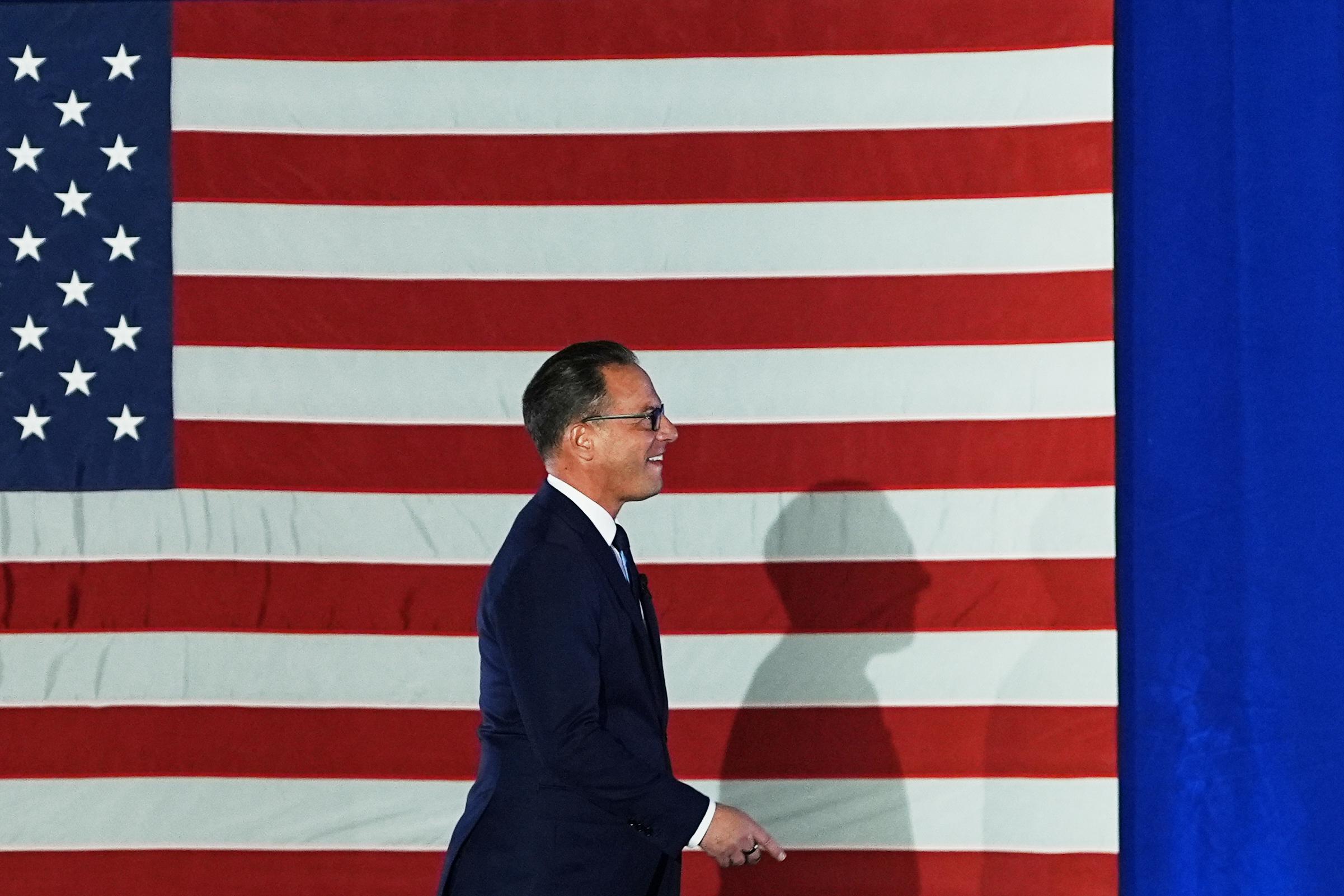
Governors and state lawmakers have already laid out lofty goals for the next legislative session. Pennsylvania Gov. Josh Shapiro, a rumored presidential candidate, vowed to raise the minimum wage and increase transit funding—Democratic priorities that had stalled in the GOP-controlled Senate.
In Michigan, House-Speaker-elect Ranjeev Puri recognized that while state Democrats can't eliminate the strain caused by Trump’s tariffs, they can try to ease the pain. To offset the spike in lumber prices, and in turn, housing costs, Puri told National Journal that lawmakers may consider easing housing regulations to make home-buying more affordable. He also said that Gov.-elect Jocelyn Benson has expressed interest in talks with Canada about potential exemptions to the counter-tariffs.
Arizona Democrats won a trifecta for the first time since 1966. In an attempt to address housing costs and concerns in the state, incoming House speaker Oscar De Los Santos is supporting another push to restrict corporations’ ability to purchase single-family homes. A similar bill died in the GOP-controlled state House last session.
Democrats may also move for structural changes that could benefit the party, including potential redistricting in Wisconsin and changes to increase access to voting. In North Carolina, Jackson said “Democrats will be looking closely” at the state’s GOP-controlled State Board of Elections, though they only hold the House and the governorship.
Prospective 2028 presidential candidates have already begun reaching out to Democratic victors in the states that hold early presidential primaries, and they’re likely to continue working with state legislative leaders who won last week. Democrats running in a potentially crowded presidential primary field may look to associate themselves with successful initiatives in key statehouses as a way of distinguishing themselves from the pack.
“With more elected Democrats and more leaders who represent different, sometimes overlapping parts of the Democratic coalition, there’s more people to endorse different candidates,” Fitzgerald of Nevada said.