Oct. 28, 2026, 5 a.m.
Carly Koppes had a problem.
Starting in 2021, some members of the public didn’t believe the Weld County, Colorado, clerk and recorder’s attempts to correct misinformation. It was just her job to say those things, they told her. Speaking with her colleagues, she reached a solution: She recruited her biggest skeptics to join the ranks of poll workers.
“I’m not afraid to have these people come in, and if they want to come in as election judges, I know within my own process I have enough checks and balances to protect if they decide they want to try and do something,” Koppes told National Journal.
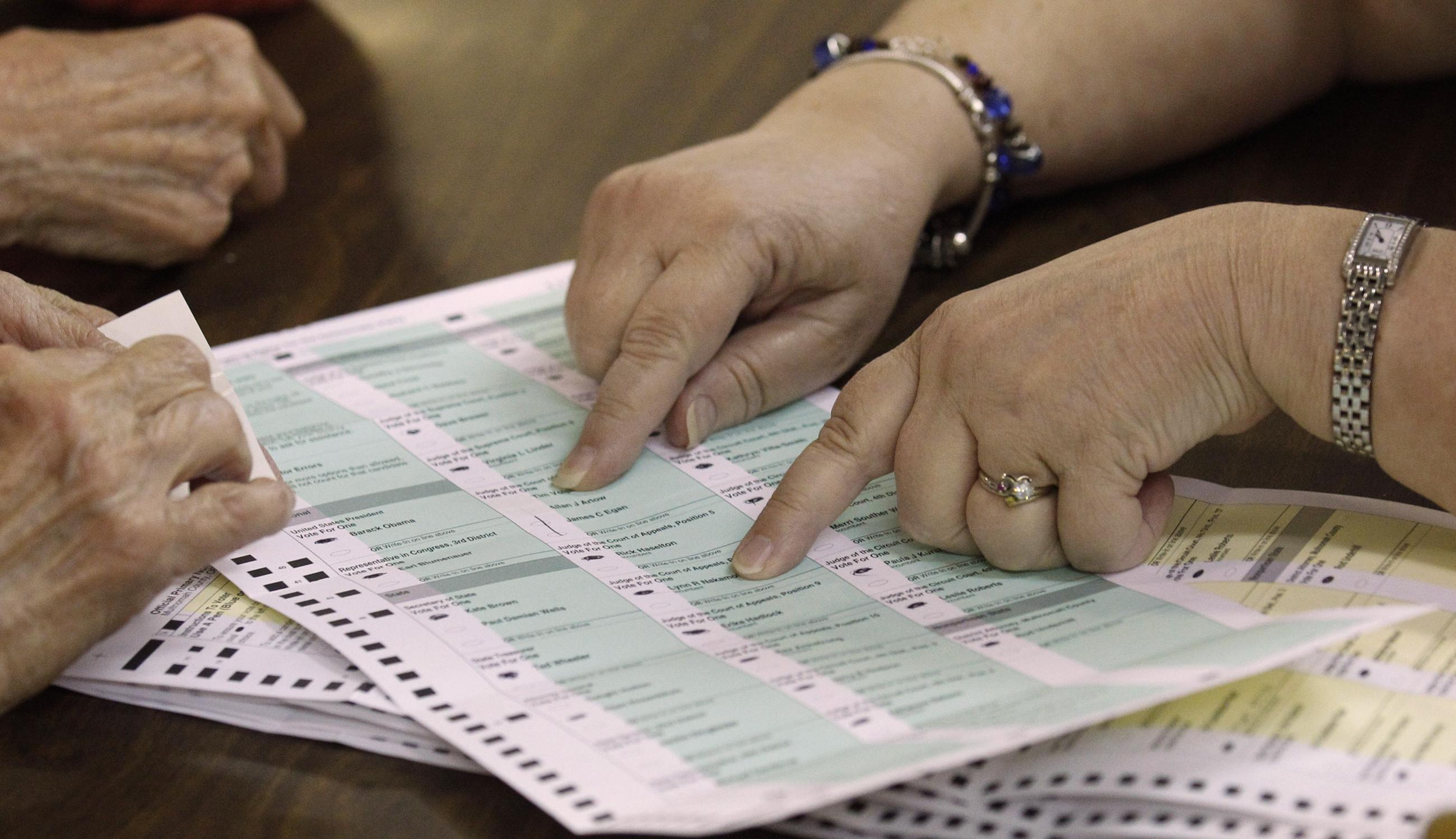
At first they were hesitant, she said. They opted to observe voting and ballot processing from the sidelines. But a few wanted to know more. Some became election judges for the next cycle, checking ballots and verifying seals, signatures, and dates.
“They saw that when I truly said that we work in a bipartisan manner, that I meant we work in a bipartisan manner and nobody is alone,” Koppes said.
Some of them still had questions about other states’ laws and procedures, which Koppes explained, but they left more comfortable with the system in Weld County, she said.
President Trump has attempted to sow doubt in election systems, calling into question the reliability of voter rolls, mail-in ballots, and voting machines. Koppes, along with other election officials across the country, hopes to ease some voters’ doubts by inviting them into the polling station to watch the process from start to finish. They hope their deliberate effort to recruit skeptics means they will share their findings with others.
“Even though I’ve only had a handful of people, well, those handful of people have been going out, and they talk to 10 people, and then those people talk to 10 more people, and then those people talk to 10 more people,” Koppes said.
In past cycles, election officials have worried that conspiracists could sign up as poll workers and use their position to meddle in elections. Those who have recruited skeptics stress that their systems have enough oversight and checks and balances to prevent anyone with ulterior motives from causing harm. Koppes said election judges are paired with someone else from a different party for the entirety of the process.
“There isn’t one singular judge doing one thing, ever,” she said.
Many voters come to officials with questions that arise out of a lack of knowledge about what can often be complex processes.
“Every year, every opportunity, we tell people, ‘If you are worried, if you are concerned about anything fishy going on in the election-administration system, come look at it,’” Michelle Kavanaugh, the clerk in Bernalillo County, New Mexico, told National Journal. “‘Come work as a poll official.’”
It’s inconvenient when you show them something that is opposite of their narrative, so they don’t come in and see it for themselves. ”
—Bernalillo County (N.M.) clerk Michelle Kavanaugh, on reaching out to election deniers
At least one man took her up on it—Clay Pryor, a Republican who ran for Bernalillo County clerk in 2024. He served as an election observer for a municipal election and attended the voter-registration board’s meetings, though he wasn’t an official board member.
“He came and he took part in just about every role that he could,” Kavanaugh said.
Pryor, a software developer, wanted to know how voters could be sure that voting machines would accurately reflect the selections they wished to make.
“I asked the election worker, ‘How do I know that my votes are being counted as I wrote them on the ballot?’ And the first answer was, ‘Well, you heard the machine ding, didn’t you?’”
He said he worried that the tests election officials use to ensure voting machines properly count ballots wouldn’t correlate to the results in an actual election.
“I realized that even though I cannot see the code, the paper ballots and what they call the post-election system check allowed us a really good chance of catching if there was any manipulation in the machine counts,” Pryor said.
Pryor watched one verification process in which officials randomly select a voter ID, take the voter’s precinct, hand-count the paper ballots in the precinct, and compare the results to the machine’s count. From there, he and two others requested a spreadsheet of the results and precincts selected and found human error that explained a discrepancy.
“In other words, there was no intentional hiding,” he said. “You could see it was an obvious human error.”
Thinking back to the response he got to his question at the polls, Pryor said, “The answer he could have given me at the time would have been probably too much for most people to handle.”
Scott Hoen, the clerk in Carson City, Nevada, said election skeptics on both sides of the aisle protested outside the state Capitol grounds when he entered office in 2023. He went out of his way to hire five or six of the most hardened skeptics on the Republican side.
“I was looking specifically for those people that would then tell their family, friends, neighbors that we run a good, solid election, and that’s what it turned out to be,” said Hoen, who was a registered Republican before taking on his nonpartisan office. “It was very worthwhile for me to do that.”
Hoen reached Lisa Partee and her husband, Dave, who had applied to work the polls following the 2018 elections. The Partees had doubted the legitimacy of the 2018 results because of Democrats’ strong performance in Nevada that cycle. After being rejected for several cycles, they began working in 2022.
“Once we got picked to work the election and we got to know Scott better, I don’t have any thoughts or concerns with how he runs anything,” Lisa Partee told National Journal.
Workers like Partee checked voters in, observed them using the ballot-marking device, and ensured they put their ballots in the tabulator.
“Just watching the staff and getting to know the staff soothed my curiosity,” she said.
For Partee and her husband, though, doubts remain. She expressed skepticism in mail-in ballots and in the processes used in more-populous Nevada counties, like Clark County and Washoe County.
Only a small number of the skeptics election officials interact with make the leap to become poll workers, election officials told National Journal. Most said the number of skeptics they’ve successfully recruited is in the single digits.
Becoming a poll worker is time consuming. Not only do workers need to be present during and after the election, they need to dedicate time to training. Election officials also offer demonstrations of voting systems that allow those with questions to see the system even if they don’t have the time or the interest to work a full election.
Often, election officials say, skeptics don’t want their questions answered.
“It’s inconvenient when you show them something that is opposite of their narrative, so they don’t come in and see it for themselves,” Kavanaugh said.