Oct. 14, 2026, 5:21 p.m.
Donald Trump spoke very little about “change” when he launched his campaign for president a decade ago, certainly much less than other challengers to the status quo such as Barack Obama, Bill Clinton, and George W. Bush.
The word never was uttered in his 6,600-word announcement after the memorable ride down the golden escalator in 2015, contrasted with the 10 times the word was used in Obama's much shorter 2007 announcement speech. Trump was much more focused on hammering home his promise to “make America great again,” which implied change from Obama’s presidency.
That, perhaps, is why it is so jarring to look back on the 11 years since that speech by candidate Trump and realize how stark the changes are that President Trump has made to this country, most strikingly in what it stands for and how it is viewed by the rest of the world.
That realization was brought home last week by the shocking announcement from the Pentagon that it will wheel a convicted mass killer before the cameras for an execution by firing squad.
While it seems that cooler heads may prevail and overrule this decision by a Defense secretary who sees himself as macho personified, live-streaming the execution of a paraplegic by firing squad would be the culmination of the most radical makeover of America's image since the United States became a global power in World War I.
“The changes that Trump has brought to the country are profound, beyond anything in my lifetime,” said Peter Wehner, a conservative driven away from the Republican Party by Trump after working in the administrations of Ronald Reagan, George H.W. Bush, and George W. Bush. The list, he said, is long, starting with his expansion of presidential power, dismissal of corruption norms, gutting of the civil service, cuts to medical research, and giving a free hand to immigration agents “killing Americans in the streets.”
Considering televising an execution is only the latest step, Wehner told National Journal. “He’s changed the country ethically, morally. The norms, the standards by which we live, what we consider to be honorable and dishonorable, whether we prize virtue or not, that has just been battered and battered and battered again. He’s reshaped the sensibilities of a lot of people.”
More broadly, he said, Trump and the figures around him are "saying things that never would have been said, even if they had been thought."
"There would have been societal pressure not to say them out loud. That’s gone now.”
Just on Tuesday, Trump posted something on Truth Social no one could imagine any other president posting—a real video of a tiger mauling a man. The man died. Trump thought it was funny.
It is the latest exhibit of what Wehner called “the coarsening of the dialogue and, really, the cruelty of the dialogue.” He added, “It’s not just coarse. It’s that people within Trump World seem to be vivified by cruelty, by seeing people in pain.”
Some changes, of course, can be reversed by the next president. Recovering from the changes Trump has brought to America’s standing in the world will be neither quick nor easy, however.
“When we emerge from this moment, we will have a whole set of new relationships globally, very different relationships,” said Heather Conley, who served in the State Department under Presidents George H.W. Bush, Bill Clinton, and George W. Bush, including as deputy assistant secretary of State for European and Eurasian Affairs. “Countries will have already instituted trade and security policies that help insulate themselves from the United States.”
Conley, now a senior fellow at the American Enterprise Institute, said “rebuilding trust and credibility with our partners and allies” will take years and multiple administrations.
That assertion is backed by polling across the globe by the Pew Research Center.
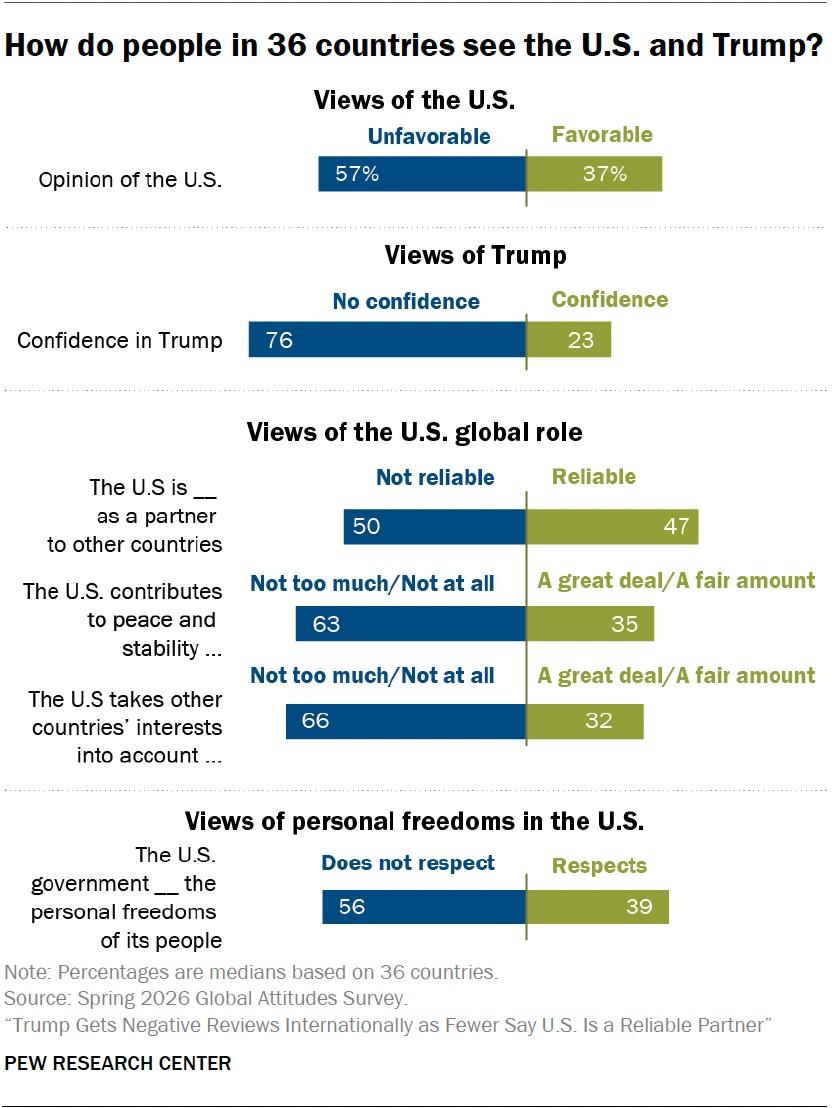
“We have 34 countries that we surveyed in both 2024 and 2026,” said Jonathan Schulman, a research associate at Pew. “And in all but two of those countries views of the U.S. fell significantly over that two-year span. The only exceptions were Hungary and Israel.” While that was significant, he said, even more telling were the responses when people were asked if the United States is a reliable partner.
“Some of the drops that we've seen over the last four years in those responses have been quite striking,” he said, citing a 48-point drop in the number of Canadians who view the United States as a reliable partner, from 83 percent to just 35 percent. He added, “Sweden, the Netherlands, Germany, Australia, Italy, Spain, France, the U.K. all have drops of 30 points or more on that same question in just a four-year span.”

Allies were just as troubled by Trump in his first term. But then, they did not also blame the country. “In Trump's first term, there were many countries that had very, very, very little confidence in Trump regarding world affairs and still had an overall positive view of the U.S.,” said Schulman, citing South Korea. “In 2017, just 16 percent of South Koreans had confidence in Trump to do the right thing regarding world affairs, and yet 74 percent still had a positive view of the U.S. Now, that combination of views is much less common. Now those two things are much more correlated.” He said that 22 percent of South Koreans now have confidence in Trump to do the right thing regarding world affairs. That is similar to 2017. “But the big change is that only 45 percent have a favorable view of the U.S., which is down from 74 percent in the beginning of Trump's first term.”
That matches what both Wehner and Conley are seeing.
“The reelection was key,” Wehner said. Allies could no longer view Trump as an American aberration. “It sent a signal to allies that 'America is no longer reliable, and we’re going to have to cut our own deals and make our own way.'”
President Biden frequently said that when he told allies “America is back,” the response was: “But for how long?”
The election gave that answer, said Wehner. “We’ve shown that we can be cruel, immoral, and amoral, and celebrate it, and we’ve done it twice.”
For Conley, it is deeper. “What America has stood for is a set of ideals and values and inspirations. That is what Reagan was capturing in the ‘city on the hill,'” she said. “That is no longer what people see, that inspirational, aspirational dimension of America. A live execution would just further tarnish that aspiration and that inspiration as a nation.”
By any metric, that is not the kind of change a president should promise.