Oct. 6, 2026, 2:19 p.m.
Despite a hyperpolarized political landscape, split Senate delegations could make a big comeback following the midterms—especially if Democrats reclaim control of the Senate.
Both Democrats and Republicans are targeting seats in states with single-party Senate delegations, potentially shaking up a slew of partisan pairings. Only three states—Maine, Pennsylvania, and Wisconsin—currently have Senate delegations split between the Democratic caucus and the Republican conference, a number that could increase next term.
“We’re not going to see any major changes in the number of split delegations by historical standards,” said Steven Smith, a professor of political science at Arizona State University. “It just so happens that we’ve gotten down to the bottom of the barrel in split delegations, and so any increase looks huge.”
In 2024, Republicans gained unified delegations in Montana, Ohio, and West Virginia. The number of split delegations decreased from five to three, a record low in congressional history since the ratification of the 17th Amendment, which established the direct election of senators.
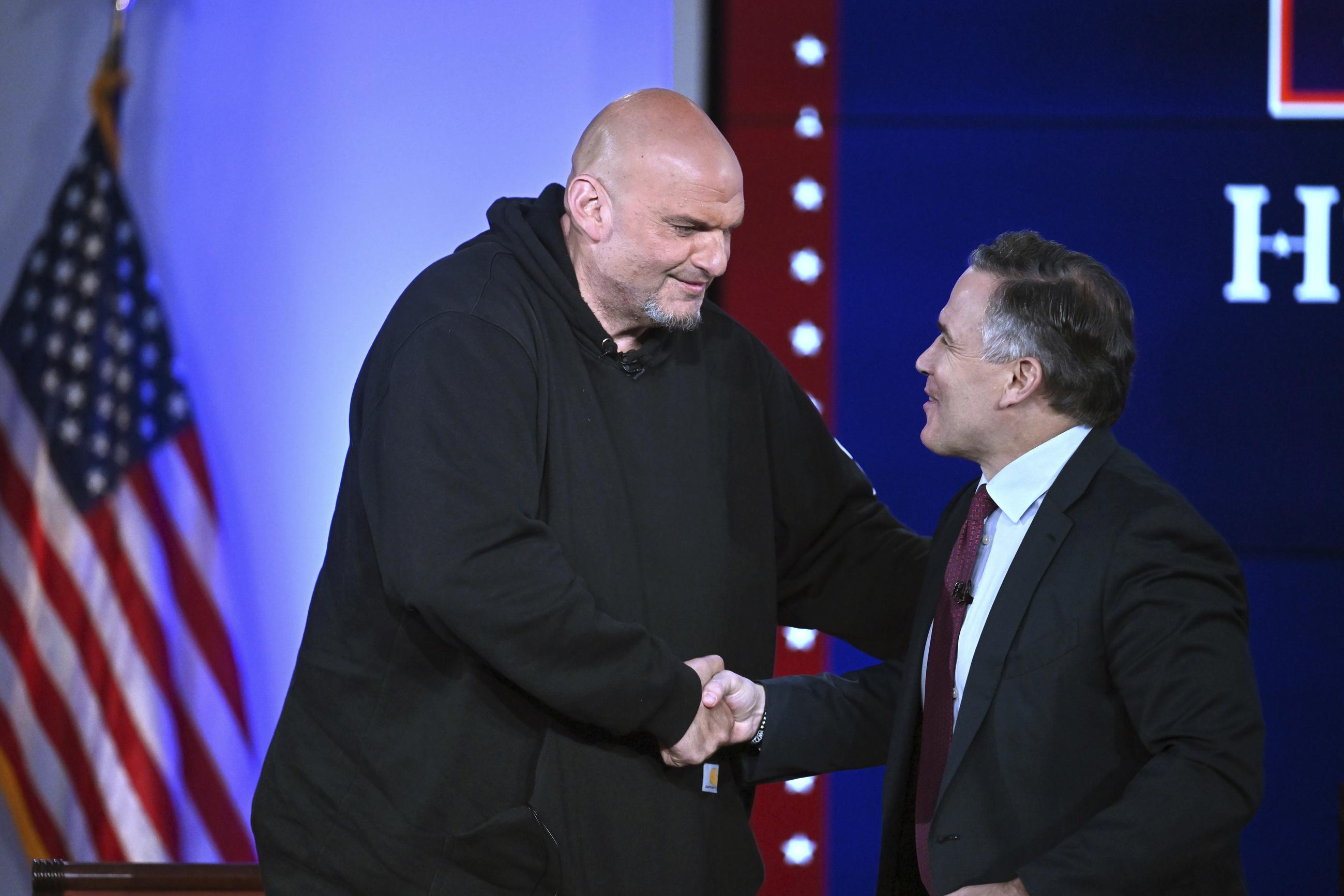
Some split delegations create unlikely partnerships. In Pennsylvania, Democratic Sen. John Fetterman and GOP Sen. Dave McCormick operate a bipartisan joint fundraising committee together. Despite having supported then-Sen. Bob Casey over McCormick during the 2024 election, Fetterman has formed a close friendship with McCormick, and he praised his GOP colleague in a video aired during Republicans’ midterm convention last month.
In Maine, independent Sen. Angus King—who caucuses with Senate Democrats—hasn’t endorsed against Republican Sen. Susan Collins, a departure from his 2014 endorsement of her but in line with his 2020 neutrality. Collins did not return the favor in 2024, encouraging a former state GOP chair to challenge King.
Other split delegations, however, have a notoriously frosty relationship. Sens. Steve Daines and Jon Tester of Montana had it out for one another when Daines ran the National Republican Senatorial Committee during the 2024 cycle with a mission to win back the majority—which meant taking out his Democratic colleague. Tester lost to now-Sen. Tim Sheehy.
In an increasingly hyperpartisan environment, room to work across the aisle can be hard to find.
In Wisconsin, Democratic Sen. Tammy Baldwin and GOP Sen. Ron Johnson occupy opposing sides on the ideological spectrum, butting heads and endorsing each other’s opponents. The two seldom collaborate, and Johnson told National Journal he isn’t buying the utility of split delegations like his.
“What ends up happening is that, because things have become so partisan, it seems more to just cancel each other's vote,” Johnson said. “I'm much more concerned about making sure that we maintain the majority so the Democrats can’t enact their disastrous policies and their disastrous pieces of legislation.”
Some potential split delegations could awkwardly feature former 2024 foes.
In Michigan, former GOP Rep. Mike Rogers is running to join Sen. Elissa Slotkin, who defeated him by 19,000 votes two years ago. Rogers called Slotkin “too radical for Michigan” during the 2024 campaign, but he has recently changed his tune. Last month, Rogers signaled he’d work with Slotkin on the issue of improving literacy rates in Michigan elementary schools.
“I have a plan to fix that,” Rogers said during a press conference in Detroit. “I think I can bring people together, including Elissa Slotkin. I have no problem with that.”
Slotkin is certainly opposed to serving with her 2024 opponent, marking her first official appearance alongside Democratic nominee Abdul El-Sayed at a Warren town hall on Saturday.
In Ohio, former Democratic Sen. Sherrod Brown is hoping for a comeback, even if he has to serve alongside Sen. Bernie Moreno, who beat Brown by roughly 4 points in 2024. Moreno is frank in his criticisms of his former opponent, deriding Brown as “Chuck Schumer’s bitch.” When asked if he could find common ground with Brown, Moreno jokingly told National Journal that the two “could both root for Ohio State to win.”
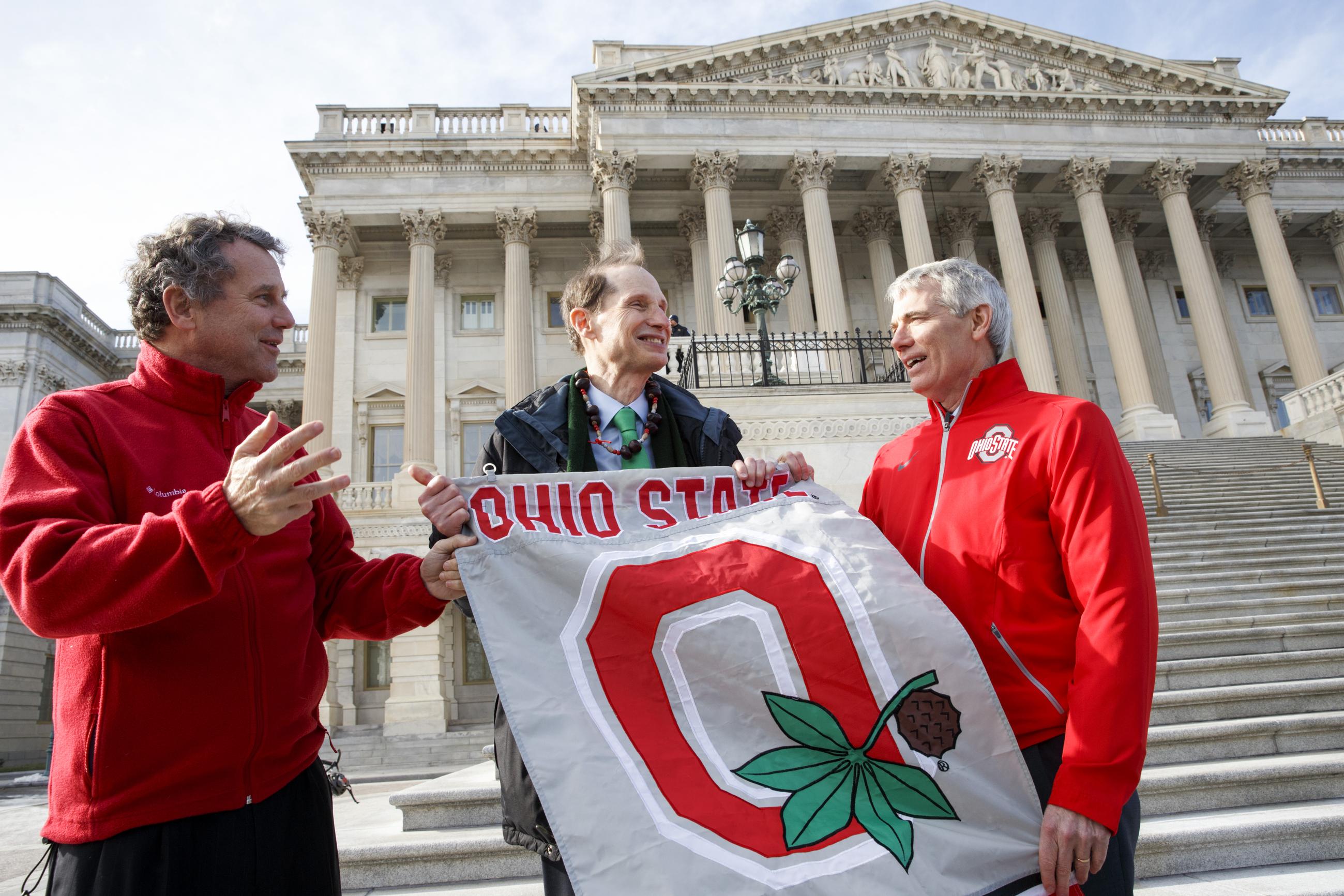
Sens. Sherrod Brown (left) and Rob Portman (right) of Ohio have some fun with Sen. Ron Wyden of Oregon (center) on the steps of the Senate on the day after Ohio State University defeated the University of Oregon in the inaugural college football playoff final in 2015. (AP Photo/J. Scott Applewhite)
ASSOCIATED PRESS
Reach across the aisle
Democrats have more than a puncher’s chance in several red states that President Trump never lost in his three presidential campaigns. To appeal to the more GOP-friendly electorate, Democrats are extending an olive branch across the aisle to their state’s out-of-cycle Republican senators.
Former Rep. Mary Peltola of Alaska already has a friendship with GOP Sen. Lisa Murkowski, dating back to their state House days. Murkowski has endorsed Sen. Dan Sullivan for reelection against Peltola, but she notably endorsed Peltola’s House bids in 2022 and 2024 and collaborated with her often during Peltola’s roughly two years in office. Murkowski even encouraged Peltola to run for governor this year, a testament to the former congresswoman’s crossover appeal.
“Alaskans know that Mary is an independent voice who will work with anyone—especially her counterparts in the Alaska delegation—to lower costs, fix the rigged system in D.C., and put Alaska first,” a Peltola campaign spokesperson told National Journal in a statement.
Iowa state Rep. Josh Turek, who models himself after former Democratic Sen. Tom Harkin, is attempting to strike a similar bipartisan chord with Republican Sen. Chuck Grassley. Grassley and Harkin served together in the Senate for three decades, prompting Grassley to get choked up in his farewell address to Harkin in 2014.
Grassley is supporting GOP Rep. Ashley Hinson to succeed retiring Sen. Joni Ernst, criticizing Turek over missed state House votes and arguing that a vote for him “hands keys over to the Democrat Socialist agenda” in the Senate.
“Every time that I have gone up to D.C. to advocate for health care or disability issues, Sen. Grassley has always been willing to meet with me face-to-face, unlike Ashley Hinson,” Turek told National Journal in a statement.
In Kansas, Democratic pastor Adam Hamilton speaks favorably about Republican Sen. Jerry Moran despite criticizing Moran's colleague, Sen. Roger Marshall, for taking similar votes. In line with his centrist pitch as he attempts to unseat Marshall, Hamilton preaches an interest in working alongside Moran in the Senate, agreeing with the senior senator on a farm bill passed by the Senate Agriculture Committee last month without Democratic votes.
“Jerry Moran, who I hear a lot of good things about—people, not everybody loves him, but a lot of people say he's doing a pretty good job,” Hamilton said at a Sept. 20 event in Lawrence. “When I need something done, I call Jerry Moran. I don't hear very many people saying 'I call Roger Marshall to get things done.'”
Moran hasn’t dipped into the Senate race much this cycle, but he still collaborates with Marshall in the Senate.
Even in Mississippi, Democratic District Attorney Scott Colom told National Journal he’d work with GOP Sen. Roger Wicker if he unseats Sen. Cindy Hyde-Smith, pointing to his support for a 2021 bipartisan infrastructure bill that Hyde-Smith opposed. Wicker notably supported Colom’s nomination to a federal judgeship under former President Biden; Hyde-Smith refused to return her blue slip, blocking Colom’s nomination.
Several senators who spoke with National Journal didn’t even entertain the question of how they’d work with the candidate of an opposing party if they were elected this November, focusing on their relationship with their current or preferred colleagues.
“He's not going to win, so I haven't spent any time thinking about it,” Sen. Raphael Warnock of Georgia told National Journal about Rep. Mike Collins, the GOP nominee against Sen. Jon Ossoff. “Mike Collins' career will end in November.”
Warnock describes Ossoff as his “brother from another mother,” heralding their “excellent” working relationship—a valuable asset for the state of Georgia, he says, considering that not even all same-party delegations work well together.

Sens. Raphael Warnock and Jon Ossoff of Georgia wave to the crowd during a Rally for our Republic gathering in Atlanta in 2025. (AP Photo/Mike Stewart)
ASSOCIATED PRESS
In redder states, out-of-cycle GOP incumbents are less willing to dip into bipartisan hypotheticals. Sen. Rick Scott of Florida didn’t mince words when describing Democratic state Rep. Angie Nixon, a Democratic Socialist challenging Sen. Ashley Moody in the Sunshine State’s special election.
“Collaboration with her?” Scott said to National Journal. “No. She's crazy. She's crazy. She's a socialist. She wants to destroy this country. There would be no way of collaboration.”
Republican Sen. Ted Budd of North Carolina didn’t directly answer whether he’d be willing to work with Democratic Gov. Roy Cooper, the favorite in the race to replace retiring Sen. Thom Tillis. Budd said that he’s supporting Republican nominee Michael Whatley, calling him a “great friend.”
“I’m always gonna be for North Carolina,” Budd said. “Let’s have that conversation November 4.”