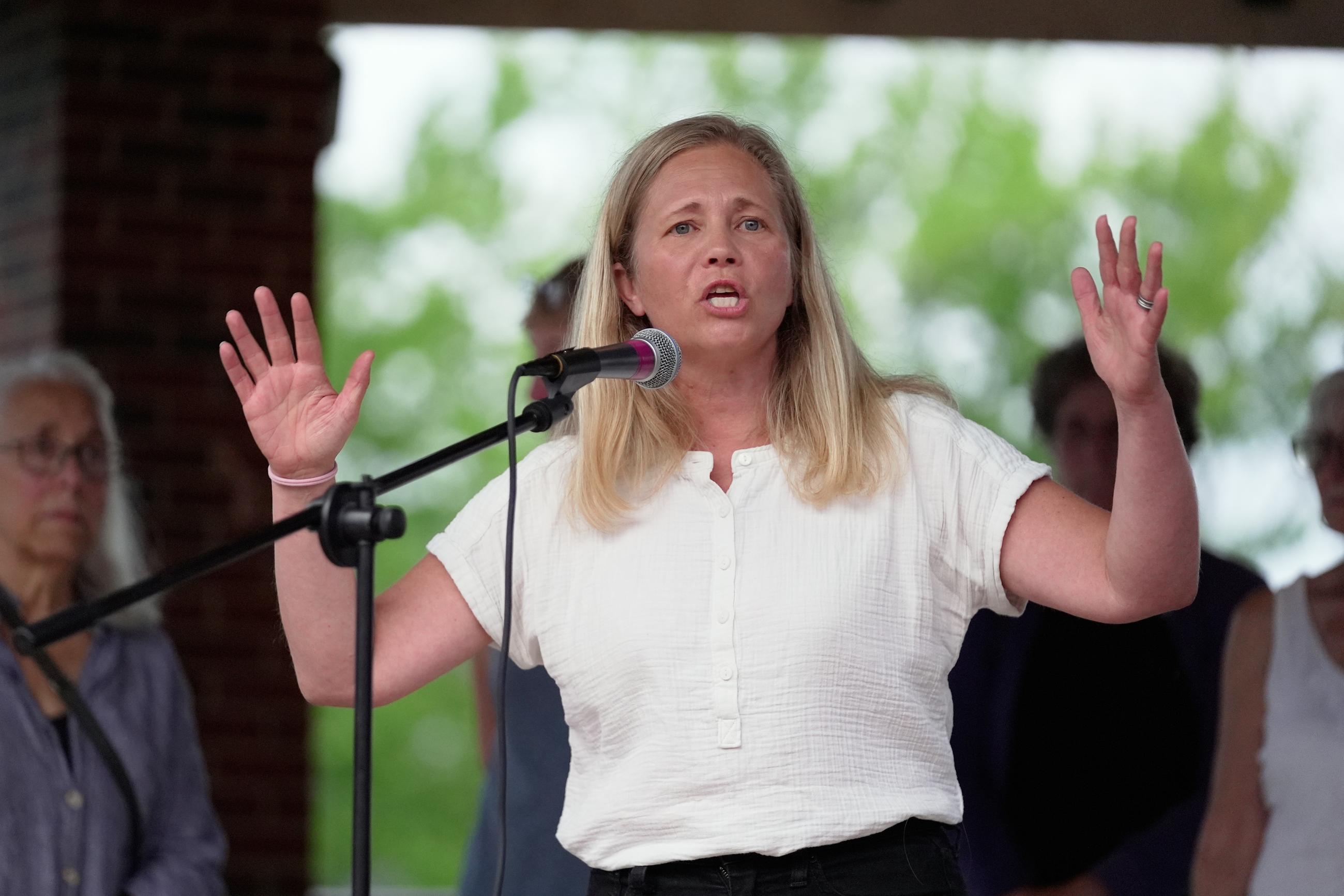

Former Maine state House Speaker Hannah Pingree has all but sealed the deal in the state's governor race, while the Senate race comes down to the wire.
Running a moderate, pragmatic campaign, she has comfortably outraised Republican Bobby Charles and independent Rick Bennett while maintaining a steady polling lead, putting her on track to succeed her old boss, Gov. Janet Mills. But, just over a month out from Election Day, she told National Journal she’s not taking this race for granted. This interview has been edited for length and clarity.
You said you would have signed the data-center moratorium that Mills vetoed. As governor, are you going to push for a moratorium similar to the 2026 bill, or seek a longer pause and guardrails?
So the legislature hasn't yet passed any kind of guardrails. There is a commission that's studying it, but I would say I think we need a moratorium in place in Maine until we can have some of the strongest laws in the country. Certainly Maine is watching what's happening in other parts of the country, with rising electricity costs, with the kinds of environmental and community impacts. I've heard very loud and clear that Mainers really want very strong protections. I think until we can have laws that protect the environment, our water, our ratepayers, and our communities, Mainers definitely don't want to see data centers in Maine.
You support a statewide ban on Flock cameras. Why do you believe that is necessary, versus instituting tighter restrictions but keeping the cameras in use?
Right now in Maine, you see multiple communities kind of understanding what a Flock camera even is, and the citizens have risen up and said, ‘We don't want to live in a surveillance state.’ Maine is a pretty, I would say, libertarian state. People, they want to be left alone. They want their privacy. And I think, especially in this time, that big tech has been working with the federal government to watch Americans, go after immigrants—I think Maine people are really concerned. We've had multiple communities ban Flock cameras that have already been installed. I have heard very loud and clear that people don't want their government to be following them in this way.
Republicans made gains in the state House and Senate in 2024. What does that tell you about where Democrats have lost ground with Maine voters?
I've been running now for about 16 months. I ran in a Democratic primary. I was campaigning for a year, and now we're in the general election. We have seen unbelievable enthusiasm, and I would say Democrats and independent voters are fired up. We had double the turnout among Democrats in the Democratic primary as compared to the Republican primary for governor, and a lot of the unenrolled voters who are allowed to vote in either primary chose to vote in the Democratic primary. Mainers are very frustrated about where the country is going. They're very worried about everything from the price of heating oil to what the huge health care cuts are going to mean for our hospitals and our health care system. We are seeing very, very strong voter engagement. So I am anticipating huge turnout. I'm anticipating large Democratic gains in the legislature.
How closely do you see your campaign and Democratic Senate nominee Troy Jackson’s campaign aligning? Where do you differ?
Troy and I both got elected to the legislature the same year. Actually, Matt Dunlap, who's also running for Congress, had already been there, so we served with Matt as well. I think we bring different approaches to governing. I think Troy and I are both out there talking about economic issues, again, health care, housing, the price of oil, and what it means for Mainers. I think we're both talking about the overreach of the federal government, women's reproductive rights, the rights of immigrants. So I think there's a fair amount in common. We have different styles, we have different personalities, but the Democratic coordinated campaign—we're working closely together to try to win races up and down the valley.

Your race has consistently shown a larger Democratic advantage than the races for Senate and the 2nd District. Why do you think your candidacy is resonating with voters differently than other Democrats on the ballot?
I'll speak to my own race and just say I think we had a very positive Democratic primary. It was a five-way, ranked-choice primary. I say there were four other very good people, including Troy, and you didn't see negative attacks. We agreed with each other on the issues. Again, with ranked-choice, you know it meant people could vote for everybody. Everybody who I ran against in the primary is now supporting me in this race for governor. I just got endorsed by Senator Angus King. I've been endorsed by other former Republicans and current Republican leaders in the state of Maine. So I'm trying to bring a bipartisan coalition that is really thinking about Maine's future and the challenges that we have, and I think that's resonated. I am running against a very conservative MAGA guy, Bobby Charles, as well as an independent in Rick Bennett who was a lifelong Republican. I think both people seem very, very aligned with Donald Trump. And I think Mainers are just tired of what Donald Trump has brought to Maine, and I think they also see in me a leader who really cares about Maine.
We've seen some crossover between you and Senator Susan Collins in the polling. What does a Pingree-Susan Collins voter look like?
I've met people who are voting for me and Susan Collins. I do think that there are a lot of women in the state of Maine who are concerned about reproductive rights, and that is an issue in which people are pretty fired up. And I will just say I think Troy has been trying to drive the message about women's reproductive rights in this country and what overturning Roe v. Wade means. I mean, I think people admire women and women leaders. ... I anticipate it's going to be a very strong Democratic year across the board.
Is there a Mills policy or an initiative that you would want to change or reverse on Day One?
I have a very different approach than the governor on tribal sovereignty. That's an issue where I would like to pass tribal sovereignty in my first 100 days in office, really rebuild the relationship that we have with the four tribal governments and nations in Maine. That's an issue that I've heard a lot about on the campaign trail, and it matters a lot to me. Maine is also a state where we've seen some declines in educational outcomes, and I think it's really important that we dig in pretty deep and ensure that we're paying close attention to kids and ensuring that they're reading and doing math at grade level, and that's going to take some work over the next couple of years.