
Sept. 30, 2026, 5:28 p.m.
That President Trump, only days before early voting begins in many states, is on political rescue missions to deep-red Oklahoma and Alabama is a stark reminder both of the daunting challenge facing Republicans and of how outlandishly odd this midterm election is. With the president’s uniquely Trumpian approach to voters, this has become an election without any clear precedent.
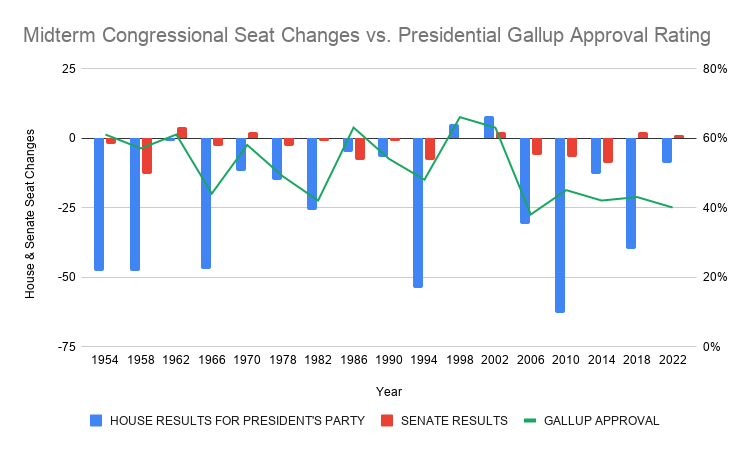
Not counting 1974, when a vice president moved into the Oval Office just three months before the election, 13 prior presidents have had to navigate 19 midterms since World War II. None—including Trump in his first term in 2018—behaved the way he is today.
None before Trump all but dared voters to make the election a referendum on his presidency. None would have said, as the president did in his address to the GOP midterm convention, “Pretend that I am on the ballot.”
President John F. Kennedy, who had perhaps the most effective midterm message, pointedly told voters in 1962, “I am not on the ballot.” But, he argued, the election of senators and members of the House was “equally important” compared to the election of a president because, under the Constitution, they “have equal power with the president.”
While slogans like Ronald Reagan’s “stay the course” in 1982 came across as passive, Kennedy cast the election in vigorous, action-oriented terms. He asked voters to elect candidates “who believe in progress, and committing … this country not to sit still, not to drift, not to rest on its oars, but to pick itself up and finish the job which so desperately needs to be done.”
Not surprisingly, Kennedy enjoyed the best outcome in any midterm other than two affected by unusual circumstances—in 1998, amid an ill-fated impeachment effort against Bill Clinton, and in 2002 after the 9/11 terror attacks. Kennedy lost only one Democrat in the House and gained four seats in the Senate.
No other president has had as well-pitched a message. Almost all others, including Trump this year, have been defensive.
One Republican strategist who advised Reagan remains irked at the 1982 strategy even four decades later, blaming the president’s pollsters for “the worst messaging advice ever in a recession.” “Stay the course” left the president trying “to convince voters that he inherited a mess and he’s on the right path," the former adviser, who asked to speak on background, told National Journal. "But that didn’t do anything for the pocketbook.” It was a particularly unfortunate slogan when the unemployment rate broke 10 percent less than three weeks before the election.
Today, the strategist added, “Trump is using the same basic message. It is a hard sell.”
Like almost all presidents leading up to the midterms, Trump clearly is exasperated that his efforts are not more appreciated and that his core voters are not more energized. Almost all have been as frustrated as President Dwight Eisenhower was in 1954 when it became clear opposition Democrats were more eager to vote. “Where is your heart?” he plaintively asked his fellow Republicans.
He said he was “astonished” at the GOP apathy he had encountered and repeatedly tried to rally them with the story of the Argentine boxer Luis Firpo, who knocked Jack Dempsey out of the ring in their famous fight in 1923. “But,” Ike said, “Dempsey crawled back in the ring and whipped the tar out of him.” The Republican Party, he pleaded, should stop “being a Firpo.”
The message didn’t take. Republicans lost both chambers in that election.
Part of the blame could go to Eisenhower’s speeches. Whereas Kennedy’s campaign pitches in 1962 were short, evocative, and powerful, Ike’s in 1954 sounded like State of the Union addresses—long and filled with policy. It is a mistake Jimmy Carter repeated in 1978. He visited 31 states, but his speeches were too long, with too much emphasis on too many policies.
Of course, contrasted with Trump and his hour-long rally speeches today, both Eisenhower and Carter were succinct and to the point. Neither covered half the topics featured at Trump's MAGA rallies. Another contrast is how all other post-World War II presidents endorsed candidates, and the way Trump embraces his fellow Republicans.
The earlier presidents made a point of appealing to independents and voters in the opposing party. They admitted to mistakes and praised those willing to stand up to them. In 1970, President Richard Nixon urged Texans to elect George H.W. Bush to the Senate because of his independence. “He is independent like most Texans,” Nixon said. “I admire him for that. And when he believes that we are wrong, he will not support us.”
In his endorsements, Trump praises only complete fealty. In endorsing Virginia congressional candidate John McGuire, he posted, “John is MAGA all the way, and has been with us from the very beginning.”
It is a painful reality for all presidents, though, that not every candidate they endorse is top-level and not every environment is conducive to victory. Sometimes, when the national tide is running against their party, even presidents and vice presidents come to realize there is little they can do to stem impending defeats.
That was the case in the 1958 midterms, when Eisenhower publicly asked California voters to elect William Knowland as governor while privately writing about him in his diary, “There seems to be no final answer to the question, ‘How stupid can you get?’”
In the same midterm, then-Vice President Nixon was the lead Republican campaigner. As recounted by former Nixon aide Herbert Klein, Nixon came to realize “that many of the Republican candidates were not up to standard.”
In his 1980 book Making It Perfectly Clear, Klein recalled an instance when Nixon was pressed “as to what he could say favorably” about a Republican senator running for reelection. Stumped, Nixon “settled for praising him lightly and urging that he be sent back to Washington because the candidate’s daughter was ‘the best baby-sitter in the capital.'”
Trump has not yet reached that level of desperation. But there's still more than a month to go.