
Sept. 29, 2026, 6:05 p.m.
The battle for control of state legislatures in Pennsylvania, Michigan, Minnesota, and Wisconsin is coming down to razor-thin margins, with races increasingly feeling the pressure from national headwinds.
Democrats have the wind at their backs this cycle to potentially flip some of these battleground chambers, especially in states buoyed by competitive governor races. Democrats hold 16 trifectas and control a total of 39 state legislative chambers.
The Democratic Legislative Campaign Committee has announced a $50 million investment, touting Democratic overperformance in legislative special elections. Republicans still hold a majority of the state legislatures thanks in part to Project REDMAP’s investment in 2010, but the Republican State Leadership Committee is warning that Democratic groups are outspending them this cycle.
“Democrats are competitive and even up, and Republicans are increasingly having to spend in places and expand their map to defend places that they haven't had to defend before,” said Sarah Curmi, executive director of States Win, a left-of-center organization backing Democratic state legislative candidates.
But despite the national environment leaning toward Democrats, there are structural factors at play giving Republicans a potential competitive edge in these chambers, from the partisan makeup of the districts to strong incumbents.
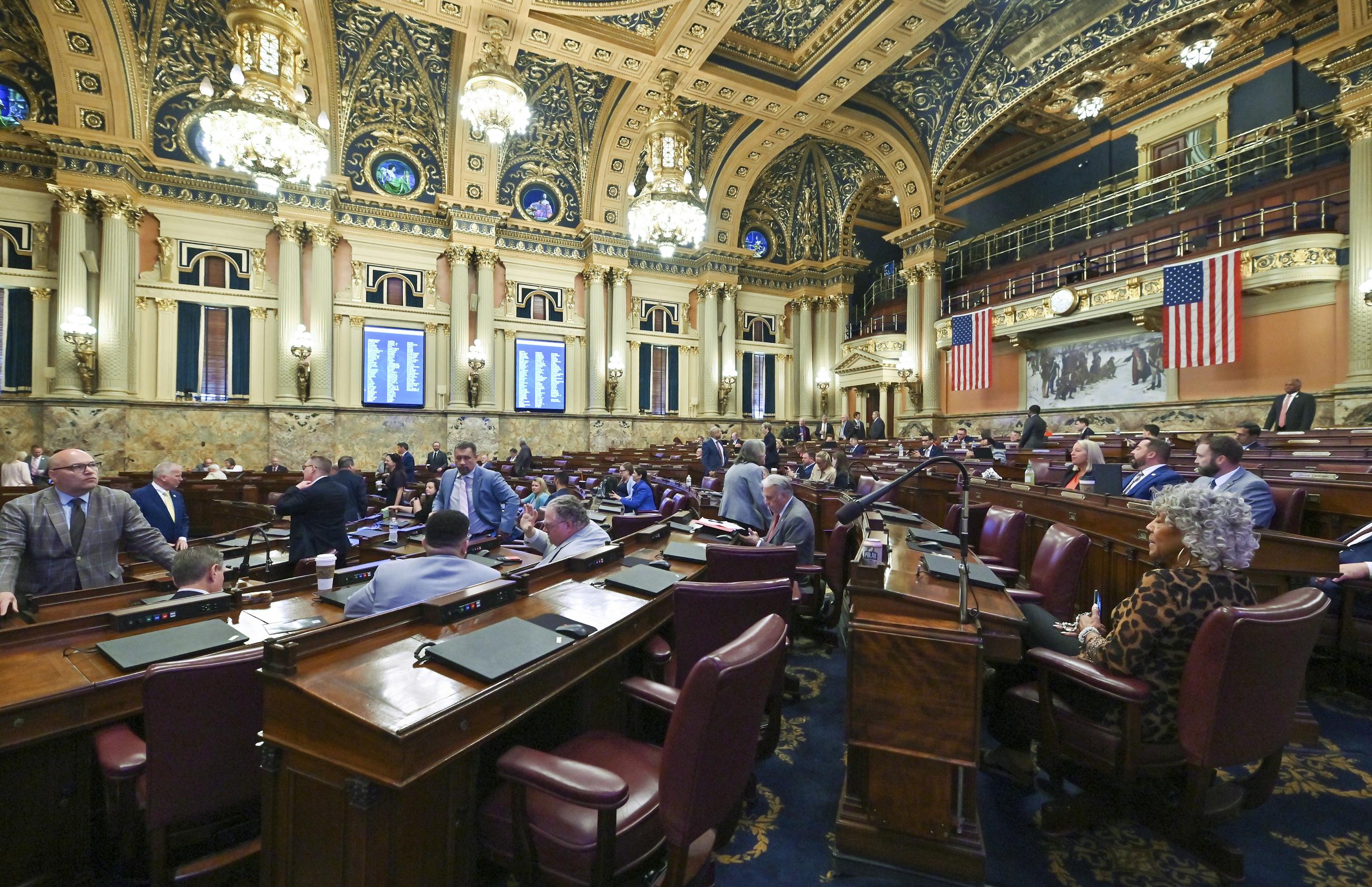
Representatives mill about the House after the Pennsylvania Legislative session in July 2025. (AP Photo/Aimee Dilger)
ASSOCIATED PRESS
PENNSYLVANIA
State House (103D-100R)
State Senate (27R-23D)
Democrats are looking to do what they haven’t done in more than 30 years in Pennsylvania: secure a trifecta. Democratic Gov. Josh Shapiro’s strong showing in his reelection race could boost his party’s chances at flipping the state Senate, but it’s an uphill battle.
Shapiro has all but put the governor’s race away, turning his focus down the ballot. He has doled out $5.7 million for downballot candidates. And his strong performance has also staved off any national Republican investment for his challenger, state Treasurer Stacy Garrity, forcing downballot Republicans to do the heavy lifting.
Democrats will have to flip three seats to secure the Senate majority. But the districts they’re targeting are all incumbent-held seats in the eastern part of the state, noted John J. Kennedy, political science professor at West Chester University.
Those four races—in SD-06, SD-16, SD-24, and SD-40—have attracted $15.7 million in ads aired or reserved ahead of Election Day. Republicans, trying to prevent the trifecta, have the clear ad-spending advantage.
State Navigate polled SD-40 (Sept. 11-13; 1,004 LVs; +/-3.1%), and found Republican state Sen. Rosemary Brown and business owner Brian Wrightson, a Democrat, statistically tied, 43 percent to 42 percent.
Democrats are on defense in a few districts, including in SD-36, a seat President Trump won by 15 points but state Sen. James Malone flipped by less than a point in a 2025 special election. A State Navigate poll (Sept. 11-13; 915 LVs; +/-3.2%) also found this race statistically tied, with Republican state Rep. Tom Jones (R) at 46 percent and Malone at 44 percent.
Democrats hold only a two-seat majority in the state House, but Kennedy said they are likely to hold the chamber. Republicans have thrown most of their money at the state Senate, airing or reserving just $369,000 in ads for state House races.
The stakes are high for Shapiro. A trifecta not only could ensure his priorities make it through the legislature, but would prove he can sweep a critical 2028 battleground state.
“That obviously sends a signal to the nation of your higher ambitions and your viability for higher office,” Kennedy said.

Michigan Gov. Gretchen Whitmer delivers her State of the State address to a joint session of the state House and Senate at the state Capitol in Lansing in 2024. (AP Photo/Al Goldis)
ASSOCIATED PRESS
MICHIGAN
State House (58R-52D)
State Senate (20D-18R)
Democrats secured a trifecta after the 2022 midterms, flipping the state House and, for the first time since 1984, the state Senate. But it was short-lived. Republicans reclaimed the state House in 2024 as Trump carried Michigan.
Matt Grossmann, a political science professor at Michigan State University who also aided the state’s redistricting commission, said the legislative maps are drawn to mirror the statewide direction.
“It really is set up that if there's a shift of 3 points, much less 8 points, then both chambers should be within that range for the seats,” Grossman said.
The governor race is leaning in Democrats' favor, but it is overshadowed by the dead-heat race for Senate between Abdul El-Sayed and Mike Rogers. On the state legislative level, Republicans are trying to portray their opponents as too progressive.
But some of the economic pitfalls being felt nationally are amplified in Michigan. The average price of gas is higher in the state than the national average, and the impact of tariffs has been greater due to the state’s proximity to Canada, Grossman said.
He added that the Democratic vote is concentrated in the districts the party already holds, pushing House Democrats to compete in emerging Democratic territory or places trending Republican.
The most competitive state House races will take place in HD-27, HD-44, HD-46, and HD-109—seats Republicans narrowly won in 2024, including some they flipped that cycle.
Democrats are on defense in the state Senate, with SD-12 as their most vulnerable seat.

Minnesota House GOP Floor Leader Harry Niska and Speaker Lisa Demuth listen to questions during a news conference at the state Capitol in St. Paul in 2025. (AP Photo/Ellen Schmidt)
ASSOCIATED PRESS
MINNESOTA
State House (Split 67D-66R, 1 vacancy)
State Senate (34D-33R)
While other states might have a small number of competitive races that could decide the legislative majority, Minnesota’s maps put dozens of races in play for either party. The North Star State is seen as blue statewide, but the Legislature is anything but settled.
The House is evenly split, headed by Republican Speaker Lisa Demuth thanks to a power-sharing agreement. The Democratic-Farmer-Labor party holds a one-seat majority in the state Senate.
Sixteen House races were decided by less than 5 points in 2024. While Democrats are feeling bullish, even small changes in turnout in these races often decided by a few hundred votes could have an outsized impact.
“They are quite competitive, and so a shift of higher Democratic turnout and a bit lower Republican turnout can have a big impact,” said Larry Jacobs, director of the Center for the Study of Politics and Governance at the University of Minnesota.
There are a handful of races to watch. The DFL is once again defending HD-54A, which the party won by just 15 votes last cycle. It is also targeting some of the seats Republicans flipped in 2024—HD-18A and HD-26A.
Republicans’ strongest campaign tactic has been trying to tie Democratic candidates to the state's social-services-fraud scandal, Jacobs said. But he added that even state legislative races have been nationalized, and Democratic enthusiasm and opposition to Trump is dominating.
Still, Republicans are in a much stronger place with Demuth at the top of the ticket, having defeated MyPillow CEO Mike Lindell in the gubernatorial primary. Sen. Amy Klobuchar would have dominated Lindell in the general election, likely costing Republicans the Legislature completely.

Wisconsin Gov. Tony Evers gives the annual State of the State address at the state Capitol in Madison in 2025. (AP Photo/Morry Gash)
ASSOCIATED PRESS
WISCONSIN
State Assembly: (54R-45D)
State Senate: (18R-15D)
Republicans came within a few seats of clinching supermajorities in the Wisconsin Assembly and Senate in 2022. Now, just four years later, after the fall of the decade-long Republican gerrymander, Democrats could flip both chambers.
One sign of how competitive it will be this year: Both Assembly Speaker Robin Vos and Senate Majority Leader Devin LeMahieu announced they would not seek reelection. Barry Burden, a political science professor at the University of Wisconsin-Madison, said it’s likely a “signal that those leaders knew something about what was likely to happen in 2026.” Leadership retirements pushed some other Republican incumbents to retire, creating open seats.
Democrats have an even better chance of flipping the state Senate, Burden said. The odd-numbered districts are up for the first time under the new maps. In 2024, under the new maps for the even-numbered seats, Democrats picked up four seats, leaving Republicans with only an 18-15 margin. Democrats need to flip just two seats to win the chamber.
The SD-17 and SD-21 races will be the most competitive. Kamala Harris won the newly drawn districts by about a point in 2024 as Trump carried the state. The open 21st district and the 17th, where Republican state Sen. Howard Marklein is seeking reelection against Democratic state Rep. Jenna Jacobson, have together attracted $9.8 million in ads aired or reserved ahead of November. Democrats have the heavy airtime advantage.
Democrats are also targeting the open SD-05, which is more favorable to Democrats in the redraw, and are on defense in SD-31.
The state Assembly is an uphill battle for Democrats to flip. All 99 seats were up in 2024 under the new maps. Democrats gained 10, but will have to flip five more to take the majority. The most competitive contests include HD-21, HD-51, HD-53, HD-61, and HD-88.
Unlike in other states like Pennsylvania, where Democrats are on a glidepath to win the governor race again, Wisconsin’s contest between Milwaukee County Executive David Crowley (D) and Rep. Tom Tiffany (R) is neck-and-neck. The coattails for Democrats, if any, will be short.
Other chambers to watch:
Although they haven’t seen the same investment as other states, Arizona's and Maine’s legislative chambers are teetering on small margins. Republicans control the Arizona House (33R-27D) and Senate (17R-13D). Republicans gained ground in Maine in 2024, but Democrats still hold the House (75D-73R) and Senate (20D-14R).