
Sept. 24, 2026, 5:33 p.m.
President Trump’s pick to lead the Food and Drug Administration faced pointed questioning from both Republicans and Democrats on the Senate health committee Thursday—complicating her path forward in the upper chamber.
The tense hearing also raised a crucial question: whether the nomination will get a committee vote before the end of the year.
Republicans and Democrats on the Health, Education, Labor, and Pensions Committee probed FDA nominee Heidi Overton over her involvement in Trump’s controversial August vaccine executive order, her views on the abortion drug mifepristone, and the current bottlenecks hampering the agency she’ll look to helm if confirmed.
In front of the panel, Overton broke with the president and Health and Human Services Secretary Robert F. Kennedy Jr.’s rhetoric on vaccines, stressing that every vaccine on the U.S. market, including the combined measles vaccine, is “safe and effective” and “not lethal.”
Her statement marked a contrast to a press conference last month in which she stood behind Trump as he called the measles vaccine “lethal” and signed an executive order separating the measles, mumps, and rubella vaccine into three separate doses.
Overton would not directly answer the question of whether she would push back against political pressure from higher officials, including the president—instead stressing she would “follow the law” and the statutory obligations of her position.
“I have worked for the president for a long time now and earned his trust because I have been part of robust discussions to bring him the best advice,” Overton said. “My job would be to follow the law and execute what is required of the commissioner of Food and Drugs, whose individual product decisions [are] based on safety and efficacy standards.”
As Trump’s deputy assistant for domestic policy, Overton has been involved in advancing the president’s marquee health policies. In addition to the administration's effort to shrink the childhood vaccine schedule, she worked behind the scenes to nail down deals with pharmaceutical companies to lower drug costs through the administration’s most-favored-nation drug-pricing policies.
Following the announcement of her nomination, HELP Committee Chair Bill Cassidy—who lost his reelection bid after Trump helped to oust him in this year’s Louisiana GOP primary—was swift in issuing a statement criticizing her involvement in shrinking the childhood vaccine schedule, calling it “almost disqualifying” in an X post last month.
At Thursday's hearing, the chairman sounded warmer to the nominee, stating that she seems “trustworthy.” Cassidy, however, cautioned that prior nominees have come before the committee and made assurances over vaccine policy before breaking them.
Cassidy, along with Democrats, pressed Overton on how she would handle political interference and pressure from other administration officials to influence agency decisions. The chairman declined to comment on whether the nominee’s responses to these questions were sufficient to win his support.
“I’d like to review what was said before I make any indication of how I feel,” he said after the hearing concluded.

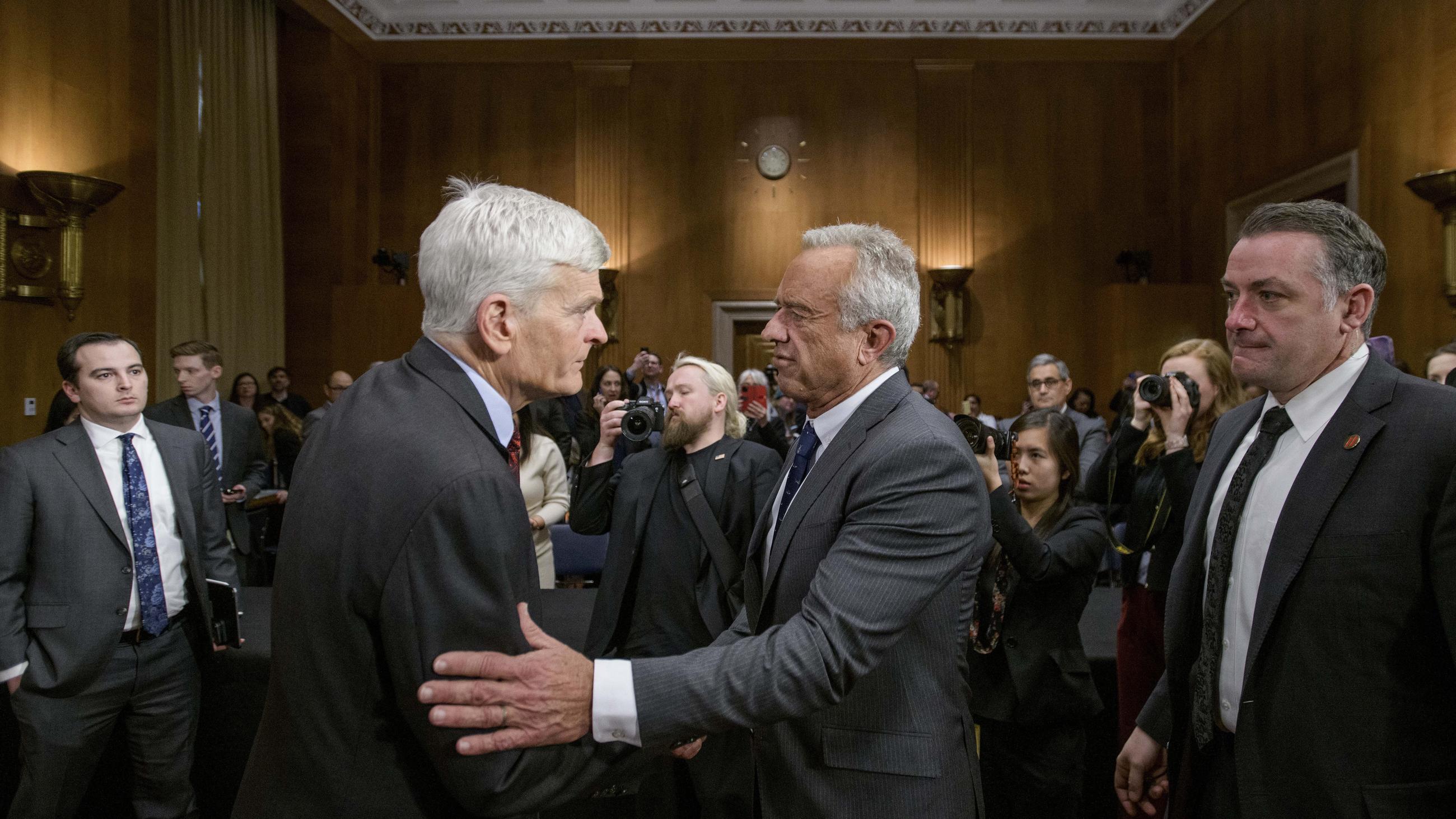
Overton talks with Senate HELP Committee Chairman Bill Cassidy before Thursday's hearing. (AP Photo/Mariam Zuhaib)
AP Photo/Mariam Zuhaib
The Louisiana Republican will be in charge of scheduling a committee vote on the nominee. With 12 Republicans and 11 Democrats on the committee, Republicans will need to remain united on Overton’s nomination if all Democrats vote against her. A simple majority is needed for the full Senate to consider the nomination.
The question of how the FDA handles a safety study on the abortion drug mifepristone may also complicate Overton's nomination. The FDA initiated a safety study on the drug earlier this year, creating a possible pathway to restrict access to the medication. If confirmed, Overton would be in charge of overseeing the safety study.
As director of the Center for a Healthy America at the Trump-aligned America First Policy Institute, Overton has advocated against the use of abortion drugs, writing that abortion “is corrosive to children, women, and society broadly because it devalues and extinguishes innocent human life.”
Following the Supreme Court’s 2022 decision to overturn Roe v. Wade, Overton celebrated the ruling, calling it a “huge victory for life.”
These views are not only likely to repel Democratic support—at least two Democrats on the committee, Sens. Patty Murray and Angela Alsobrooks, have already said they will vote against the nominee—but could make it harder to win the backing of more-moderate Republicans on the panel.
Sen. Lisa Murkowski said revoking the telehealth option for mifepristone would put rural communities in her home state of Alaska in a “challenging position.”
“My concern is, as I have shared, that there is political pressure to revisit the approval status of certain products, and I think we're seeing this with mifepristone, that have already gone through the scientific-review process [and] have been shown to be safe and effective,” Murkowski said.
Murkowski, along with Sen. Susan Collins, voted against Attorney General Todd Blanche’s confirmation after it was reported he had pledged to faith leaders that he would look to further restrict abortion access across the country.

Sen. Susan Collins responds to questions from reporters about Overton's hearing on Thursday. (AP Photo/J. Scott Applewhite)
AP Photo/J. Scott Applewhite
But on Thursday, the two didn’t look to further question Overton on her views regarding abortion or mifepristone.
Collins, who is in a tough reelection bid, didn’t mention the abortion drug in her questions, instead choosing to ask Overton about the agency’s decision to approve flavored e-cigarettes and the pace at which the FDA approves drug treatments for rare diseases.
Republican Sen. Josh Hawley—who is staunchly against abortion and has called for revoking FDA approval of mifepristone—and Democrats sought clarity over whether Overton thought the drug was safe.
Overton was careful not to comment on her personal views regarding abortion, but rather elaborated on the scope of the safety study.
“I think that we're encouraged by Dr. Overton's commitment to objectivity around the mifepristone review,” said Gavin Oxley, a spokesperson for Americans United for Life, an antiabortion group. “Not making any definitive statements may preserve her objectivity if she takes over the agency and the review.”
In her opening remarks, Overton stressed the need for faster and more efficient drug approvals to compete with foreign rivals in the biotech industry like China. The nominee also emphasized her leadership experience, as some within the pharmaceutical industry and on the Hill have questioned her managerial know-how.
While a vote still has not been scheduled, the nomination could put abortion back into the conversation as voters head to the polls in November.
“Heidi Overton has one of the most alarming anti-abortion records of any FDA nominee to date and is entirely unfit to serve as a leader in public health,” said Mini Timmaraju, president and CEO of Reproductive Freedom for All. “Senators who vote to confirm Overton will be choosing Trump over their own constituents.”