Sept. 23, 2026, 4:50 p.m.
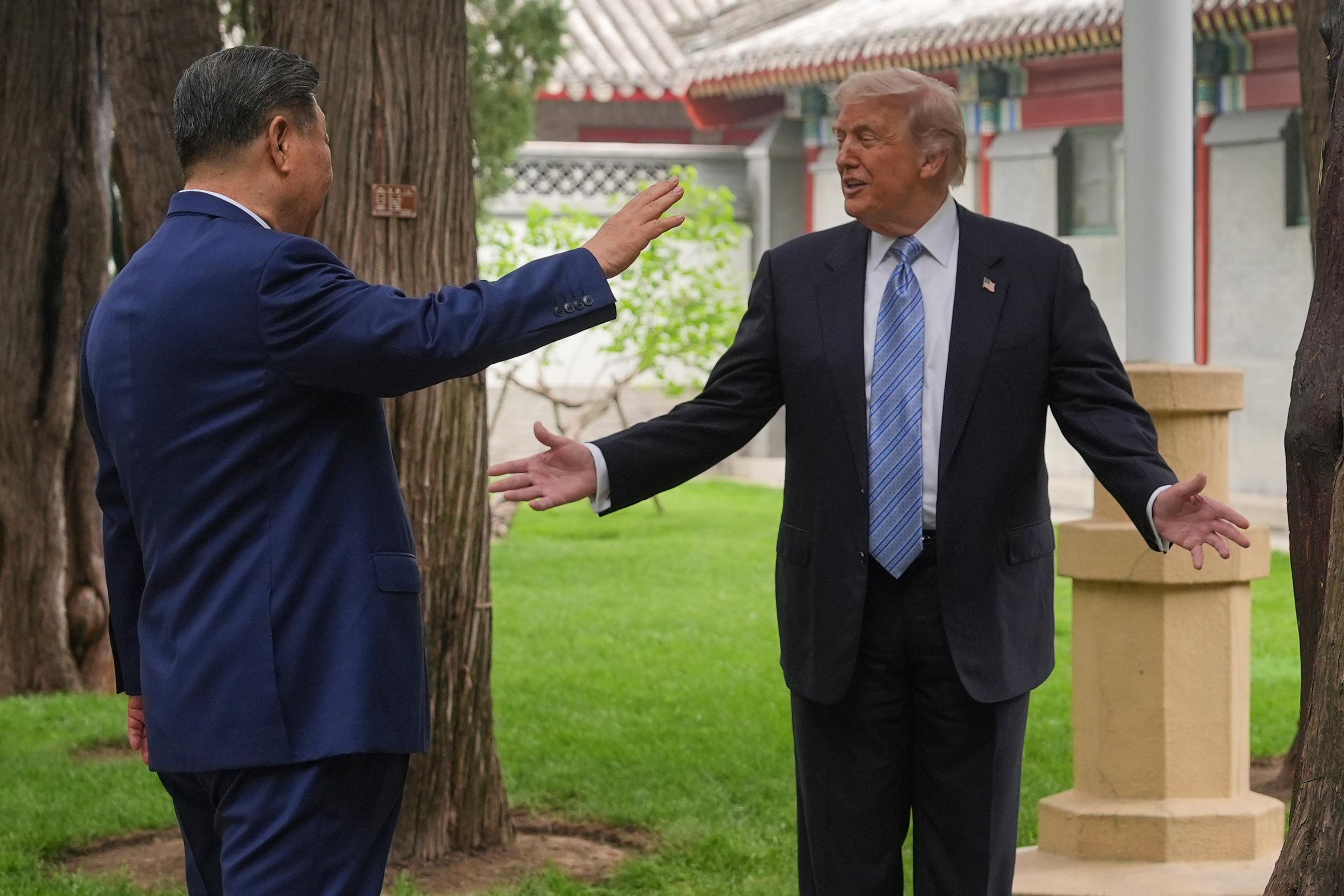
To hear President Trump talk about his meeting this week with Chinese President Xi Jinping, it's more a chummy reunion of old pals than a high-stakes summit between the leaders of the world’s two largest economies, both commanding nuclear arsenals and both struggling for supremacy in the development of artificial intelligence.
Perhaps never has an American president gushed so profusely about the authoritarian leader of a U.S. adversary. In June, Trump called Xi “very smart,” “something special,” “a strong man” with “a great look,” “great confidence,” and “great stature.” In May, as he prepared to fly to Beijing, he called Xi "a wonderful guy" and "a friend of mine.” Last year on Joe Rogan's podcast, he called Xi “brilliant." During his 2024 campaign, he told Bloomberg, “I very much respect President Xi. I got to know him very well and I liked him a lot. He’s a strong guy, but I liked him a lot. I respect him.” At a meeting in Japan in 2019, he said the two have "become friends." A year later at Davos, he said, “We love each other.”
The problem for the American president is that the object of his affections is not as free with the personal compliments. Through their seven earlier meetings—five in Trump’s first term and two so far in the second term—Xi has been all-business, never reciprocating the kisses blown his way by Trump.
The president seems to be undeterred in his courtship. He signaled that when the White House announced that he would drive the 15 miles to be at Joint Base Andrews when Xi’s plane lands. With the exception of presidents traveling to Andrews to welcome Pope Benedict in 2008 and Pope Francis in 2015, no president has gone to the base to greet a visiting foreign leader in 64 years, since President Kennedy welcomed British Prime Minister Harold Macmillan in 1962.
When Trump arrived in Beijing in May, he was greeted at the airport by Vice President Han Zheng, who holds a largely ceremonial role and is ranked 8th in the party structure.
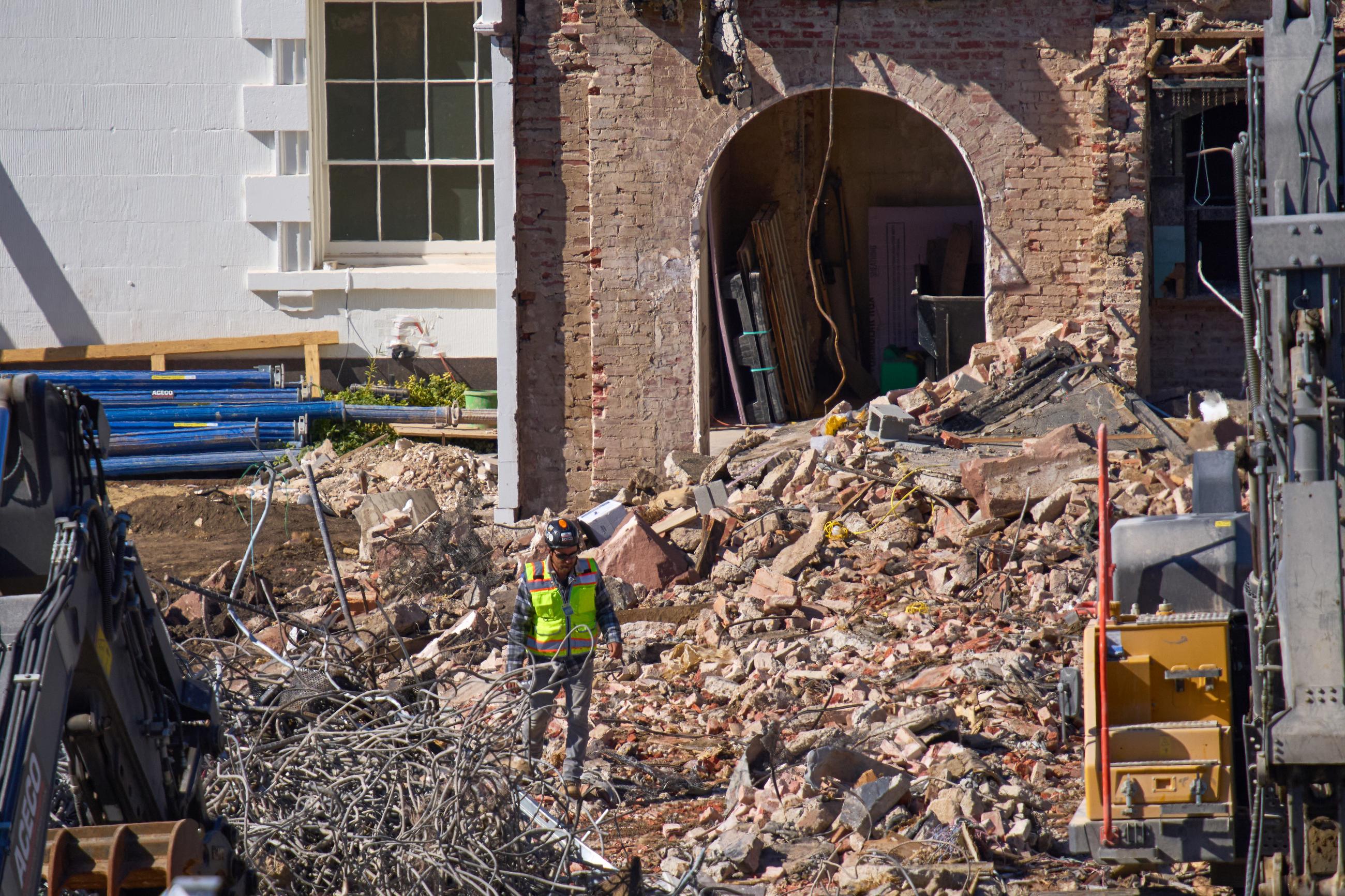
Before Xi leaves Friday afternoon, he will be treated to far more than a red carpet at the airbase. He will witness hundreds of troops marching, warplanes flying over in salute, and a posh State Dinner. Talking to reporters at the United Nations on Tuesday, the president gushed about the plans. “Everyone wants to be there,” he said, lamenting that one of his pet projects hadn't been completed in time. “I wish we had the ballroom. If we had the ballroom we could have 2,000 people,” he said.
From the perspective of Capitol Hill, it all seems a little over the top, given China's continued provocations in the Indo-Pacific and in the Taiwan Strait, its theft of American intellectual property, and the help it has provided to Iran in targeting U.S. bases.
“President Trump basically spends too much time sucking up to President Xi,” complained Democratic Sen. Tammy Duckworth in a speech at the Center for American Progress on Tuesday. “He’s very distracted,” she added, accusing him of “cozying up to an authoritarian regime at the expense of our friends and allies in the region.”
More surprisingly, her criticism was echoed in a Senate floor speech on Tuesday by a normally staunch supporter of the president, Senate Armed Services Committee Chairman Roger Wicker.
“Had the White House asked me for advice, I would have suggested the president not invite Xi Jinping to Washington for such a lavish welcome here in the United States, based on all of the troubling issues we have with President Xi and the Chinese Communist Party,” Wicker said, adding: “During every minute of dialogue, our commander in chief should keep in mind that his guest is a brutal, unelected, and oppressive dictator who seeks to dominate his neighbors and whose massive military arsenal is aimed directly at the United States of America.”
That is not what Trump wants to hear. From his very first meeting with the Chinese leader at Mar-a-Lago in April 2017, when he plied Xi with what he called “the most beautiful piece of chocolate cake that you have ever seen,” the president has insisted that “lots of very potentially bad problems will be going away” because of his relationship with Xi.
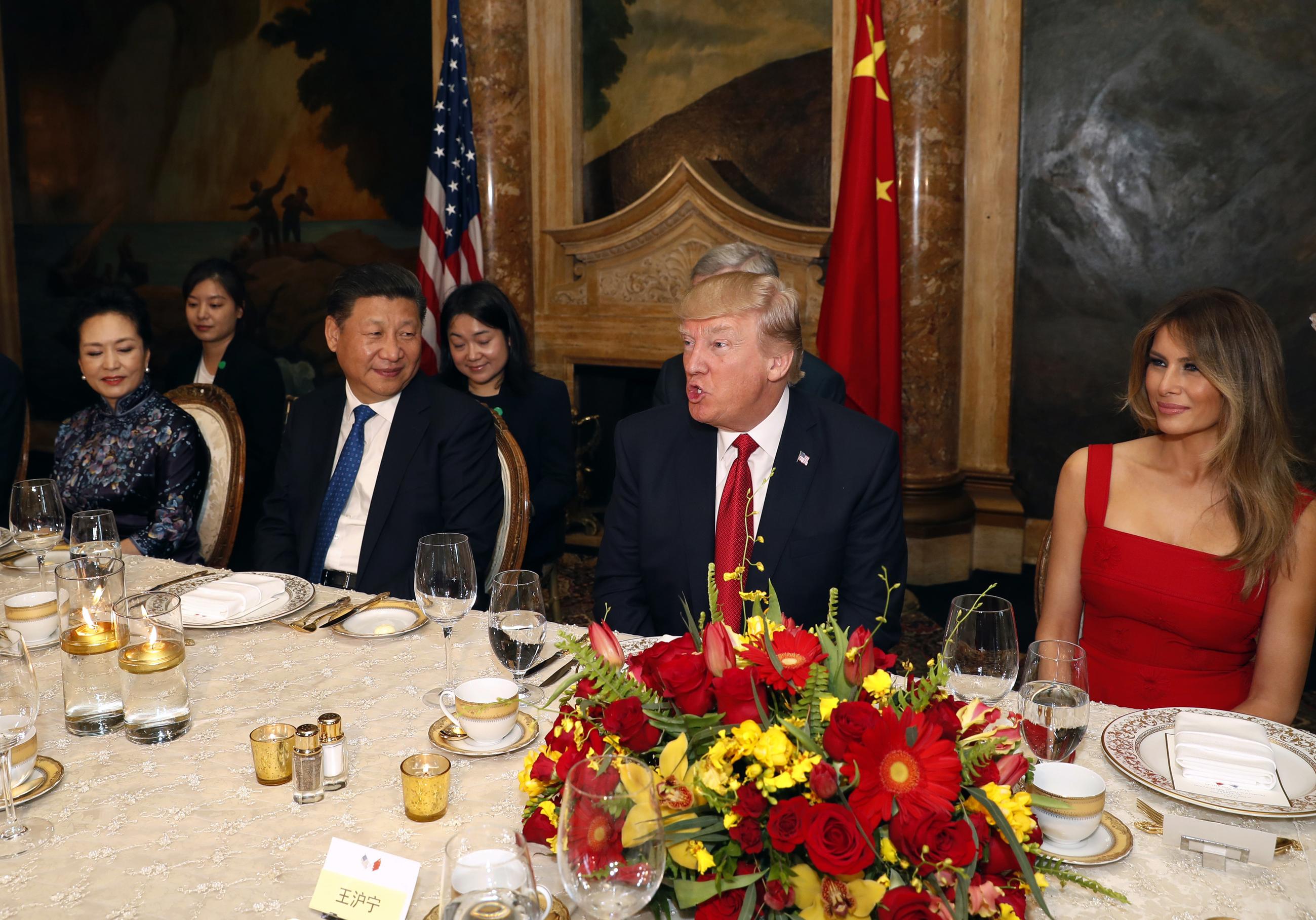
In this 2017 file photo, Trump and Xi, with first lady Melania Trump and Chinese first lady Peng Liyuan, are seated during a dinner at Mar-a-Lago, during which Trump promised Xi the most beautiful chocolate cake he'd ever seen. (AP Photo/Alex Brandon, File)
None
To get there, he has been willing to overlook Chinese actions that in the past would have drawn rebukes from the White House. In an April interview with CNBC, he said he was “surprised” when a ship was intercepted trying to take supplies to Iran. He called it “a gift from China, perhaps” and said it “wasn’t very nice.” He said, “I was a little surprised … because I have a very good relationship and I thought I had an understanding with President Xi. But that’s all right. That’s the way war goes, right?”
Talking to reporters aboard Air Force One returning from Ireland, he also shrugged off reports that China had provided Iran with satellite imagery to kill Americans. “They do what we do,” he said, adding, “You know, when they say that China spies on us, I say, ‘You're right, and we spy on them, too.'”
Writing last week in Foreign Affairs, Orville Schell, the Arthur Ross Director of the Center on U.S.-China Relations at the Asia Society, contended that “the kind of superficial flattery and bonhomie in which Trump can excel when he is trying to make nice does not generate the deeper confidence that has assured Chinese leaders in the past.”
Schell added that no one knows how the private meetings went when Trump was in Beijing in May. “But in public, the courtship was strikingly one-sided,” he said. He added: “There was something strained about his ersatz and unreciprocated bonhomie that hinted at the summit’s deeper limitations. Through all of Trump’s efforts to ingratiate himself, Xi remained characteristically aloof, offering only a very meager display of rapport in response.”
Despite Xi’s public reserve, Trump emerged from that summit claiming a triumph, but not because of any treaty or formal agreement. “I think the most important thing is relationship. It’s all about relationship,” he told Fox News. “It sounds like something that doesn’t mean anything, but it’s everything."
Even with little hope of anything firm coming out of this week’s hoopla, there’s no doubt he is ready to once again boast of that relationship when Xi departs the White House on Friday. Less certain is whether the president will yet again deploy another “beautiful piece of chocolate cake” from his diplomatic arsenal. The dessert course for the State Dinner has not been announced.