
Republicans struggled to repeal the Affordable Care Act almost a decade ago—and came as close as they could through their sweeping health and tax cuts bill passed last summer. Now, House Democrats are looking to repeal the GOP’s 2025 Medicaid cuts if they take back the majority next year.
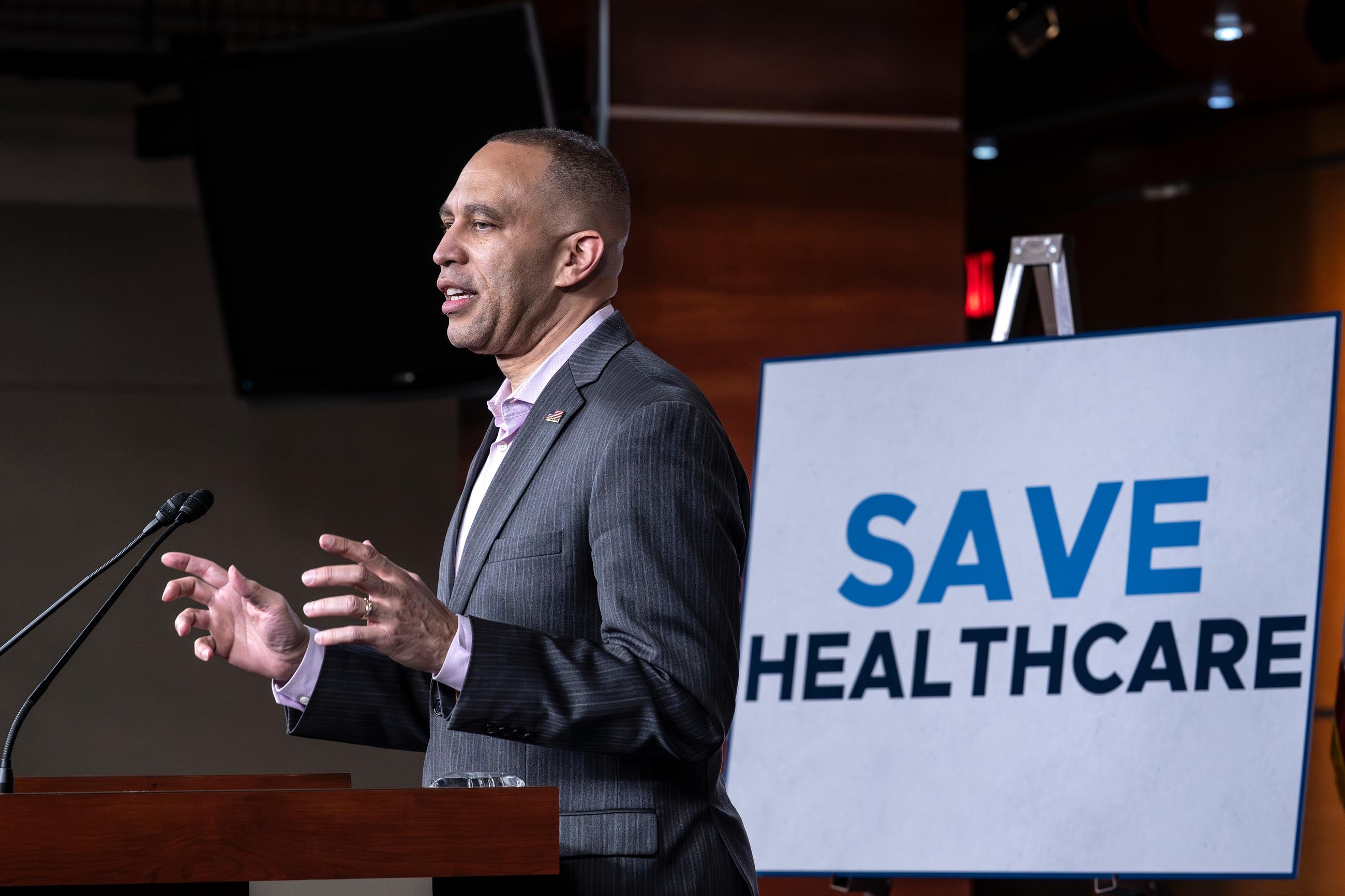
Earlier this week, House Minority Leader Hakeem Jefferies said Democrats plan to put health care at the top of their agenda, with the party united around reversing the Medicaid cuts in the 2025 “One Big Beautiful Bill” Act. Democrats would also seek to restore funding for enhanced Obamacare subsidies that help to lower the cost of premiums.
While any aggressive repeal of the Medicaid cuts is expected to get a veto from President Trump, efforts by the next Congress could set the stage for a larger health care platform for Democrats if they win control of Congress in this year's midterms and then the presidency in 2028.
“Honestly, some of what we do to fix it is going to foreshadow what we hope to do in a trifecta,” said Rep. Don Beyer, a Democratic member of the House Ways and Means Committee, which writes tax and health care legislation.
On Monday, Jeffries detailed key areas that would define Democrats’ agenda if they return to town with a majority in January. Health care is at the top of the list, along with restoring congressional tariff authority and addressing the war in Iran.
In conversations with National Journal, several Democrats expressed interest in repealing tax provisions to help pay for the effort, as the party continues to press the narrative that OBBBA has undercut the country’s health safety net to allow for tax cuts for the wealthy.
“The pay-for is going to be to cut back on the tax cuts for wealthy people,” said Ways and Means ranking member Richard Neal. “I think that’s the most formidable way to proceed. … I think it’s a winning argument.”
White House spokesman Kush Desai told National Journal in a statement, "What a shocker: Democrats’ top priority is enrolling illegal aliens onto Medicaid and removing commonsense verification requirements to prevent Medicaid fraud."
And while there are few specific policy ideas the caucus has formally gotten behind, some prominent members have a few ideas.
Beyer, a member of the centrist New Democrat Coalition, suggested closing the carried-interest tax loophole. Carried interest is a share of an investment fund’s profits paid to a fund manager as a performance award. The loophole allows managers to pay a lower capital-gains tax rate on income, compared to wage and salary earners. While Trump advocated for closing the loophole in his first run for the White House—and Democrats proposed bills to rein the incentive in—it has largely been protected after the passage of recent tax bills.
One proposal to close the loophole by Sens. Ron Wyden, Sheldon Whitehouse, and Angus King was estimated to bring in $87.7 billion in revenue over a decade, according to an analysis from Yale University’s Budget Lab.
“I think that our agenda is not characterized as taxing the rich or taxing the billionaires, but there will be a lot of ways to tweak it,” Beyer said.
Some Democrats want to go further than just restoring what Republicans have cut, arguing they would need to offer their own solutions on health care policy,
“I also think we need to have a bigger discussion on health care, with more focus on prevention,” said House Rules Committee ranking member Jim McGovern, who said he has a bipartisan measure that would create a pilot program for medically tailored meals for seniors on Medicare.
Meanwhile, some Democrats continue to push for the progressive priority of Medicare for All. During this year’s election cycle, Michigan Democratic Senate candidate Abdul El-Sayed has centered much of his campaign around reigniting support for the policy, even as Democrats grow more divided on the issue.
The president remains the largest hurdle. He would all but certainly refuse to repeal major parts of his signature bill. But as some of the more painful parts of the Medicaid cuts are enacted after this year’s November elections—and as hospitals warn Congress about the pain of such cuts—more Republicans, especially those in moderate districts, could look to join Democrats in reversing certain parts of the bill.
“There will be a constituency for reversing the limits on provider taxes and state-directed payments to hospitals,” said Larry Levitt, the vice president for health policy at KFF, which tracks health care policy. “Hospitals will be lobbying hard for that, as many governors will as well.”
Sen. Josh Hawley, a populist Republican, introduced a bill that would reverse those exact provisions just a couple days after OBBBA was passed. Conservative health care experts, such as those at Paragon Health Institute, have argued that the policy levers are fiscal “gimmicks” that increase federal spending and drive up health care costs.
Other provisions, such as reversing work requirements and eligibility limits for undocumented immigrants, might be harder to pass.
While details are still scant on what Democrats plan to do, don’t expect a wholesale repeal of OBBBA. Democrats will likely be particular on the parts they choose to repeal.
“This is a chance to not only restore the Medicaid cuts, but to do it in a way that's an honest assessment for whatever fraud there was,” Beyer said. “There's not the amount of fraud the Republicans say, but if there's any fraud, we should get rid of it.”
The federal deficit will also loom large in the coming years. The national debt hit a milestone of $40 trillion last month, and Social Security is expected to be insolvent beginning in 2032.
“I think there is certainly a scenario where rising borrowing costs for the U.S. federal government may be coupled with an economic slowdown,” said Dan Hopkins, a political scientist at the University of Pennsylvania. That combination, he said, “could force both parties into a state of fiscal reckoning.”
“To restore the various cuts in the One Big Beautiful Bill Act, the Democrats would either have to deficit-spend, which would mean not doing it through the budget-reconciliation process, or they would need to find a way to pay for it, whether it’s with higher taxes or what-not," Hopkins said. "And that would take significant negotiation within the Democratic caucus.”