National Journal Logo
×

Welcome to National Journal!

Enjoy this premium "unlocked" content until September 23, 2026.

Continue
WHITE HOUSE FILE

'Places for mischief': A brief history of midterm conventions

Despite what Trump says, there have been three such gatherings in the modern era, all for Democrats. They were disastrous.

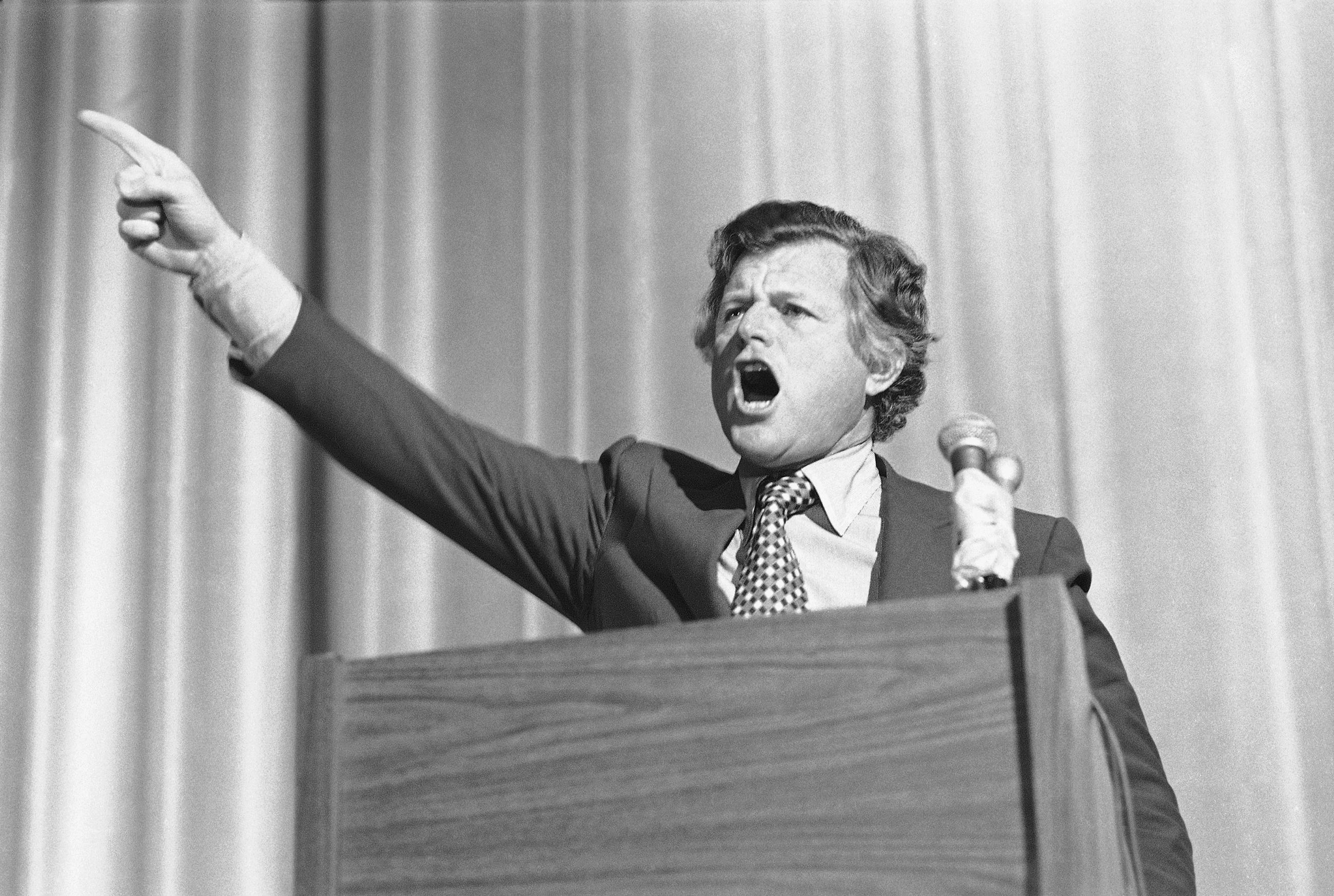
Sen. Edward Kennedy at a health care policy workshop at the Democratic Mid-Term Conference on Dec. 9, 1978 (AP Photo)
None
Add to Briefcase
George E. Condon Jr.
Sept. 2, 2026, 5:34 p.m.

One constant in Donald Trump’s 11 years in politics has been his demand for credit for every idea, event, and program. In his telling, no one before him ever was clever enough to conceive of his newest scheme. As he likes to say, “no one’s ever seen" whatever he's currently talking about.

All that is on display again as Republicans, more anxious than excited, plan to gather next week to fulfill the president’s desire to have a midterm convention to showcase his second-term record. When he first proposed it last year, he boasted, “It has never been done before.” He repeated those words in June when he announced the date and location—Sept. 9 and 10 in Dallas.

The only problem is that it has been done before. And it didn’t work out very well, making this an instance when Trump would have been far better served if he had actually talked to Democrats. They’re the only ones with experience at midterm conventions—and the bruises to show for it.

Far from being an idea that sprang from the fertile mind of Trump, midterm conventions were first suggested by Republican National Chairman John Hamilton in the wake of Franklin D. Roosevelt’s 24-point shellacking of GOP nominee Alf Landon in 1936, according to Hamilton College professor Philip Klinkner in his 1994 book, The Losing Parties: Out-Party National Committees, 1956-1993. Twenty years later, Sen. Estes Kefauver championed midterm conventions after Dwight Eisenhower’s 15-point thrashing of the Democratic ticket, which included Kefauver as vice presidential nominee.

Both Hamilton and Kefauver failed to sell the idea. But another 20 years on, a reform-minded Democratic Party, stung by its 23-point clobbering by Richard Nixon in 1972, revived the idea, even managing to stage events in Kansas City in 1974, in Memphis in 1978, and in Philadelphia in 1982.

They did not go well.

“Trump doesn't understand what came before. He just doesn't know history,” said Al From, an adviser in the Jimmy Carter White House and a loud voice for moderating the Democratic Party after Ronald Reagan’s two victories. From attended the Democratic midterm convention in 1982, which, he said, along with the editions in 1974 and 1978, “didn’t work out very well.”

That understates how disastrous the gathering was in 1978. In that year, like this one, it was the party that won the most recent presidential election that proposed the gathering—although, in a key difference, the Democrats assembled weeks after the midterms.

Carter gave a speech on the opening night to a tepid reception and then returned to the White House. He was not there on the concluding night when Sen. Edward Kennedy gave one of the most rousing speeches of his career, urging his party to “sail against the wind,” signaling he would be a likely primary opponent to Carter in two years.

It is an item of faith today that Carter was deeply unpopular at the time of that convention. The numbers tell a different story, though. While his approval, as measured by Gallup, was only 39 percent in August 1978, it was at 49 percent by the November election and at 51 percent when the convention started on Dec. 7.

The contrast with Trump’s current unpopularity is sharp. The University of Massachusetts poll conducted in late August showed 64 percent disapproving of his performance and only 32 percent approving. That is slightly worse for the president than other current polls—42 percent approval in Quantus Insights, 36 percent in YouGov/The Economist, and 33 percent in Reuters/Ipsos.

Democrats killed off their midterm conventions in 1985 when new party chairman Paul Kirk declared them “places for mischief” and a waste of party time, money, and energy.

The abiding lesson from the three mini-conventions was that they could prove to be boons to future candidates, but debilitating for incumbents. Jimmy Carter, the loser in the 1978 event, had been the star in the 1974 convention, laying the groundwork for his later campaign. Similarly, Bill Clinton effectively used the meeting in 1978, and Walter Mondale was a star in 1982. Indeed, as The Washington Post put it, Kirk said the conventions mostly just "kick off speculation about presidential contenders when Democrats should be focusing on electing senators, House members and governors."

Trump is oblivious both to these lessons and to the broader historical record about what works for an incumbent party in a midterm election. David Axelrod, who covered the 1982 midterm meeting as a reporter, noted how hard it is for a party to escape the drag of an unpopular president.

“If they’re being honest, no rational Republican who has a truly contested race in November wants to attend a midterm @GOP convention in Dallas shortly after Labor Day that will feature a deeply unpopular @POTUS, who hangs from their necks like the anchor off the Queen Mary 2,” Axelrod tweeted last week.

A Super Bowl rematch between the Seattle Seahawks and the New England Patriots will likely cut into the viewership for next week's Republican midterm convention. (Adam Hunger/AP Content Services for the NFL)
A Super Bowl rematch between the Seattle Seahawks and the New England Patriots will likely cut into the viewership for next week's Republican midterm convention. (Adam Hunger/AP Content Services for the NFL) None

Veteran Democratic strategist Joe Trippi, who is working on Doug Jones’s gubernatorial race in Alabama against Sen. Tommy Tuberville, said of Trump: “Both the convention and his plans to run ads focused on himself are going to hurt candidates in toss-up races or battlegrounds in November.” He added, “Anything that puts attention front and center on the president hurts his party’s candidates. I doubt candidates like Mike Rogers [in Michigan] or Tommy Tuberville will be rushing to be on stage to be seen with Trump at his convention.”

Yet there is one factor that could spare those candidates from being seen on television with the president, even if they do appear with him. That's the inexplicably amateur bit of scheduling that has the convention counter-programmed against the NFL's first two games of the season, including next Wednesday’s rematch of February’s Super Bowl.

In the end, that may be remembered as the biggest fumble. In this instance, it is true that no one’s ever seen such scheduling.

Welcome to National Journal!

Enjoy this featured content until September 23, 2026. Interested in exploring more
content and tools available to members and subscribers?

×
×

Welcome to National Journal!

You are currently accessing National Journal from IP access. Please login to access this feature. If you have any questions, please contact your Dedicated Advisor.

Login