Sept. 1, 2026, 6:38 p.m.
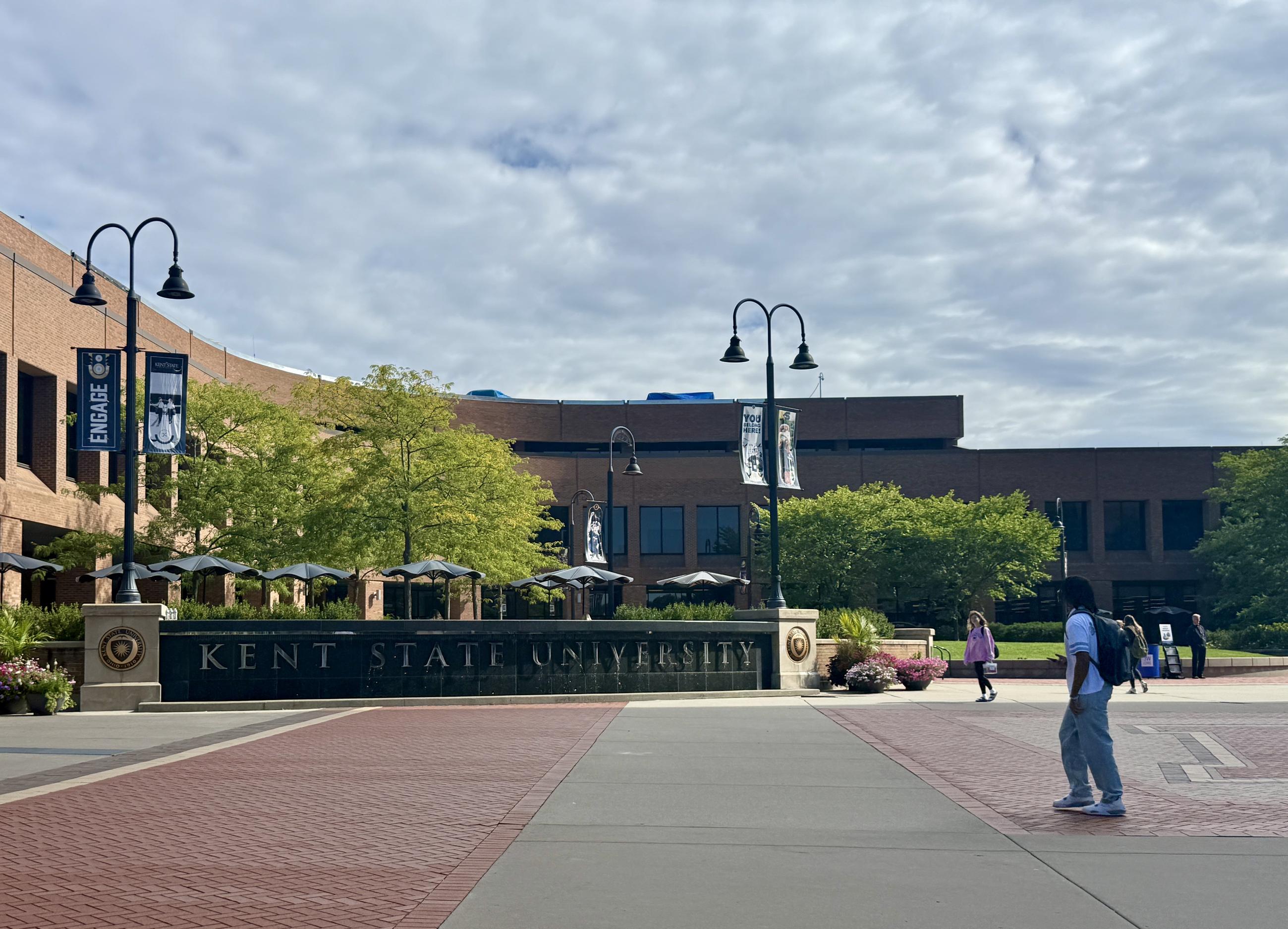
KENT, Ohio— Keira Caprette and Fatima Iy are soaking in their first day of college as freshmen at Kent State University. Students whizz by on electric scooters. Friends reunite with hugs after summer break. Freshmen decked in Kent merch wander across the main campus, nearly 25,000 students strong, navigating to their first classes at the Northeast Ohio school.
But if GOP gubernatorial nominee Vivek Ramaswamy had his way, this campus, and many other public universities, could look a lot different come next fall.
The former presidential candidate and brief DOGE co-chair has proposed to restructure Ohio’s expansive public college and university system to address declining enrollment, rising tuition, and changing workforce demands. He said Ohio has “too many” universities and should consolidate, naming Kent State as one struggling school on the chopping block.
Caprette commutes from Bainbridge Township, around a 35-minute drive each way. If Kent were to be consolidated, even with the University of Akron one county over, she would have to pay to live on-campus because the drive would be too far. For Caprette, as a first-time voter this November, Ramaswamy’s proposal is top of mind heading into the final sprint of the governor’s race.
The controversy has opened a window for Democrats, who are hoping to tap into Ohioans’ unique connections to the state’s 14 distinct public universities serving over 260,000 students, each with their own communities, cultures, and traditions. And the issue could be particularly salient in the Northeast, where Democrats have lost ground in the Trump era and where public higher-education institutions serve as community anchors.

The question is whether Democrats can translate that initial backlash into votes in the toss-up gubernatorial race. For Ramaswamy, it’s a test of whether voters see his proposal as a necessary response to a changing higher-education landscape, or a threat to their communities.
Walking back the school plans
Ramaswamy’s campaign debuted his original proposal to consolidate public universities in a March social media video explaining how he could accomplish eliminating the state income tax.
“Look at the number of universities in our state," he said. "I love universities in Ohio, I want us to have the best universities, but we have too many of them. They need to be consolidated."
Former state Health Department Director Amy Acton, the Democratic nominee, has leaned on her story as a three-time public school graduate in criticizing Ramaswamy’s plan, arguing it shows he is out of touch with ordinary Ohioans. “You don’t know what it feels like to be us; I’m not even sure you like us very much,” Acton said.
Immediate backlash prompted Ramaswamy to clarify his proposal in a Columbus Dispatch column, where he detailed the hurdles facing Ohio’s public higher-education institutions—an aging population, declining enrollment, and rising tuition costs. He proposed appointing a chancellor of higher education to “identify where missions overlap, where enrollment collapse has made independence untenable, and where administrative functions can be unified without harming students.”
But in the op-ed, he wrote that Ohio “should go further” than Georgia, which reduced its state universities from 35 to 26 in 2018. In the process, he named specific Ohio schools experiencing hardships—Cleveland State University, the University of Akron, Kent State University, and Central State University, the state’s only public HBCU.
Matt Dole, a Republican strategist in Ohio, said a flawed rollout of the policy via a social media video spurred some of the initial backlash.
“It requires the detail behind it because what people hear is you're going to close Ohio State or community colleges or [Ohio University] or whatever, right? And no one wants to see that happen,” Dole told National Journal.
Ramaswamy now denies that he wants to shut down universities to fund his proposed tax cuts, saying he instead wants to close underperforming programs within those universities.
“Students and parents are already being squeezed by rising tuition and debt, while our universities are barreling toward an enrollment cliff," Connie Luck, a spokesperson for the Ramaswamy campaign, said in a statement to National Journal. "As governor, Vivek will fight to make sure Ohioans can afford a college degree that actually helps them get ahead in life by challenging the ‘that’s the way we’ve always done it’ mentality that drives unnecessary spending, administrative bloat, and skyrocketing tuition.”
This is a fantastic issue for Democrats in [the Youngstown] area. ... [Y]ou just say simple words: ‘Vivek wants you to have less opportunity.’ ”
—David Niven, University of Cincinnati, on Ramaswamy's college-consolidation proposal
But the distinction may be hard to communicate to voters who were struck by Ramaswamy’s initial proposal to consolidate universities, especially in areas where higher-education institutions are more than just a place to take classes.
Unlike other states under big umbrella university systems, Ohio’s 14 public universities are separate and unique, with their own sports teams, traditions, and communities. And because of that, for Ohioans, they represent more than just an education. Ohio’s schools are the bread-and-butter to many communities, culturally and economically, in a way that’s unique to the Buckeye State.
“I think it's a combination of the fact that these schools are so deeply rooted in their place, so that they have personality,” said David Niven, a political science professor at the University of Cincinnati who served as a speechwriter for former Gov. Ted Strickland.
And that is thanks to a past Republican governor: Gov. Jim Rhodes.
Transforming Ohio’s higher-education landscape
Rhodes, Ohio’s longest-serving governor, campaigned on a simple promise in 1962: Every Ohioan should have access to a public university within a 30-mile drive. His goal was to increase the number of college graduates to strengthen and adapt Ohio’s economy for a changing era.
Rhodes’ impact is hard to overstate. He took Ohio from mainly a blue-collar and agricultural state to one that attracted businesses, expanded jobs, and led in academic research and university hospitals, adapting to a time in the 1960s and 1970s when white-collar, knowledge-based jobs were on the rise.
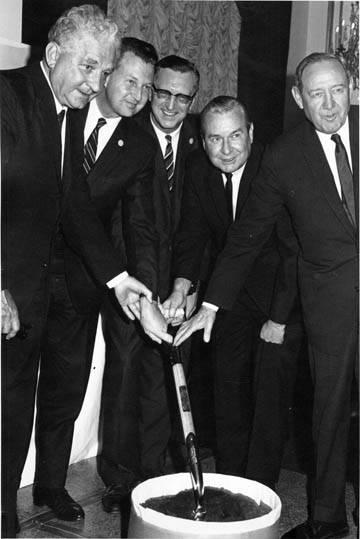
In attendance for groundbreaking ceremonies at Cleveland State University's Science Building in 1966 were (left to right) Sen. Frank Lausche, CSU President Harold Enarson, Cleveland Mayor Ralph Locher, Ohio Gov. Jim Rhodes, and CSU Board of Trustees Chairman James Nance.
Michael Schwartz Library, Cleveland State University
Under his watch, Ohio established the Board of Regents, which coordinated the funding and programming for higher education, and ushered in $175 million in funding for higher education through a capital bond issue. This led to the creation of six state universities, two-dozen branch campuses, and 21 state-funded community technical colleges in Cleveland, Akron, Toledo, Cincinnati, Youngstown, and Dayton—places under-served by the contemporary higher-education system.
Even existing universities saw a bump. Kent State grew from just 7,000 students to nearly 30,000 in 15 years, and built 60 new buildings in the 1960s.
Today, Ohio’s public universities support one in eight jobs in the state, and delivered $68.9 billion in economic impact in fiscal 2021-2022, nearly 9 percent of the gross state product. In all, Ohio’s public colleges and universities are home to 450,000 students, and three-fourths of Ohioans who pursue higher education do so in-state.
“[Rhodes] makes a commitment, a university degree in every community or every region of the state," Niven said. "And that's a source of Ohio pride and opportunity, and especially in the context of—you know, Ohio doesn't have super trains, it doesn't have an ocean. You can come up with a list of 1,000 wonders that are not something that are in Ohio, but Ohio has a university in every region open to its people.”
Regional differences
The backlash to Ramaswamy’s proposal could be especially potent in Northeast Ohio, a region that professors and Democratic strategists said would be hit the hardest by potential consolidation. Youngstown State University, located on the Pennsylvania border, is one of the top employers in Mahoning County, and the campus serves as a central hub for the city. The city of Youngstown, where Acton grew up, has one of the highest poverty rates in the state.
Consolidating schools in this region could have a devastating impact much like that previously caused by manufacturing plants leaving the region.
“Industry, you know, is not coming back to Cleveland and Akron and Canton and Marion and the other cities," said Bob Gitter, emeritus professor in the Department of Economics and Business at Ohio Wesleyan University. "So it's going to be more of a knowledge-based economy, and we need universities for that. So the long-run impact is going to be you're making it that much harder for people to get jobs.” Gitter added that a school closure in Akron or Youngstown would be “decimating.”
Jeff Rusnak, a Democratic strategist who grew up in Youngstown, said Ramaswamy’s proposal is a top issue for voters there.
“This is a fantastic issue for Democrats in that area," Niven said. "Those are prime targets, and you just say simple words: ‘Vivek wants you to have less opportunity. The Harvard guy thinks you have too many chances. Your kids have too many chances to go to the university.’ ... This is where the Democratic revival happens in Ohio, and this issue is going to help advance that.”
Following Ramaswamy’s proposal, 11 of 14 economists surveyed by Scioto Analysis agreed that reducing the number of state universities would reduce the long-term economic output in the state.
“I think it’s something [Democrats] can campaign on in every corner of Ohio because people take pride in their institutions, whether it’s in Toledo or Bowling Green, whether it’s in Cincinnati or Miami of Ohio,” former Democratic Gov. Dick Celeste told National Journal. “So to me, it’s a statewide issue, and it’s important as it goes not just to education, but it goes to economic development.”
Lauren Leemaster, a senior at Kent State, said if it wasn’t for the convenient access to the school’s architecture program, she might have not attended college at all. When living on campus was too much of a financial strain, she was still able to continue her studies at Kent while living at home near Akron.
Kent’s tuition has risen, and for in-state students it costs just shy of $14,000 for this academic year—slightly higher than the national average of around $12,000. By law, Ohio’s public universities can’t raise tuition by more than 3 percent each year for incoming students.
The latest state budget earmarked $565 million for the Department of Higher Education and public institutions. David Brasington, professor of political economy at the University of Cincinnati, said every dollar invested into a university’s budget can have roughly twice the amount of economic impact on its surrounding community. And even consolidating schools or back-end functions would only be a drop in the bucket compared to the state’s overall budget.
'Talk to the students'
Democrats are weaving the backlash to Ramaswamy’s proposal into their attacks against him as an outsider.
“It really underscores a sense that here’s an individual who is out of touch with the state,” Celeste said. “And so I think that it won’t be about red and blue attitudes. It’ll be about who cares about my community and what’s going to be important for the future of my community.”
Acton, throughout the campaign, has discussed her childhood experiences of escaping poverty, enduring abuse, and being homeless for a period. Access to public higher education is one of the issues Democrats are using to define Acton heading into the fall, after Republicans aired over $20 million of digital and TV ads attacking her over her handling of the COVID-19 pandemic and police reports detailing marital disputes between her and her husband.
“I wouldn't be here today if it wasn't for the ability to work three jobs and commute to Youngstown State University and still be able to go to a BS-MD six-year accelerated program,” Acton told National Journal. “You should be able to work hard and have it pay off, and we know that the quickest way out of poverty is workforce training and education.”
Acton attended Youngstown State, Northeast Ohio Medical University—founded under Rhodes’ watch—and Ohio State University—all public institutions.
“What's key here, of course, is Acton’s story is going to be Ohio's story,” Niven said.
Bring Ohio Back Now, a 501(c)(4) organization launched in June, put up billboards starting Monday near university campuses, including in Northeast Ohio, attacking Ramaswamy’s plan. The billboards read, “Tell Sen. Rob McColley to reject Vivek’s plan that could wipe out Ohio colleges,” referencing Ramaswamy’s running mate, the state Senate president.
Democrats have some backup in their fight to characterize Ramaswamy as out of touch. Multiple college and university leaders decried the proposal, including Kent State University President Todd Diacon, who detailed how the school has already adapted to declining enrollment and financial pressure.
“To anyone raising questions about Ohio’s public universities, I extend a genuine invitation," Diacon wrote in April. "Come visit. Spend a day on a Kent State campus or at any campus within the footprint Gov. Rhodes designed. See what the work looks like. Talk to the students doing it.”
It’s also not helping Ramaswamy that fellow Republicans have come out against his plan as well. Term-limited Gov. Mike DeWine said he is “not in favor of consolidating our colleges or doing away with any of our 14 public universities” because “people who can’t afford to live at the college and pay room and board, they can commute.”
Declining enrollment
Whoever wins the governorship in November will need to address the declining higher-education enrollment.
Between 2014 and 2023, enrollment at the 14 universities and two dozen community colleges fell 11.4 percent, a growing trend nationwide due to a dip in the birth rate during the Great Recession, COVID-19, and young adults opting for alternative paths.
But Acton hasn’t laid out a detailed plan to address the enrollment issue she would inherit as governor.
Acton told National Journal that “our heads of our universities have known, you know, that we have up-and-down declining and increases in birth and enrollment, and they have been adjusting.” She added: “We have incredible programs that have been created that meet the needs of our workforce. So I'm excited to work alongside our colleges and universities.”
“College keeps getting more expensive for Ohio families, and Amy Acton's answer is to simply accept it," said Luck, Ramaswamy's spokesperson."That’s not leadership.”
For now, Republicans like Dole say they are skeptical that the issue will sway the electorate. Some students at Akron and Kent approached by National Journal weren’t even aware of Ramaswamy’s proposal.
In the scant ads Democrats have aired in this race, none attack Ramaswamy over the proposal. For now, Republicans are dominating the airwaves in spending—primarily with anti-Acton ads—with over $50 million already spent.
And even if Democrats ramp up criticism of Ramaswamy’s proposal and the race heats up, Republicans say the issue still might not draw Ohioans' attention this fall.
“During football season, people are going to be talking about football in the state of Ohio,” Dole said.