Aug. 12, 2026, 4:19 p.m.
From the moment Donald Trump took the oath of office for his second term, he has praised President William McKinley and striven to recreate the Gilded Age of the late 19th century through tariffs, foreign conquest, and Great Power diplomacy. On most of those fronts, the results have been decidedly mixed. Yet unintentionally, the president has been a central figure in recreating the politics of that era.
In his Inaugural Address, he promised a new Golden Age, saying, “We were at our richest from 1870 to 1913. That’s when we were a tariff country.” He contended that McKinley “made our country very rich through tariffs and through talent.”
Hindering his path to that Golden Age, however, has been a polarized electorate that would have been familiar to McKinley.
It has been 120 years since the United States muddled through a similar period of evenly matched, polarized electorates.
Since the Bicentennial of 1976, “we have been not only deeply divided, but closely divided,” said William Galston, who witnessed the polarization firsthand while serving as President Clinton’s domestic policy adviser in his first term. “That is about the worst box to be in for governing purposes because it makes it very difficult to execute a consistent line of policy for long enough to make it effective.”
Galston, who is now the Ezra K. Zilkha Chair in Governance Studies at the Brookings Institution, added, “This also means abrupt lurches back and forth between one conception of the country and where it ought to be going. So, this 50-50 nation finds itself in a difficult situation.”
Galston sees many structural similarities to the post-Civil War period between the end of Reconstruction in 1877 and McKinley’s election in 1896, when the country endured “bitterly contested elections yielding narrow and shifting majorities.” That period was marked by “hyper-partisanship because the margins were so narrow with every election there was a prospect of bringing your party back to power.”
The similarities between that era and today are striking.
Four of the five times in U.S. history that a president has been elected despite losing the popular vote occurred in these two periods—Rutherford B. Hayes in 1876, Benjamin Harrison in 1888, George W. Bush in 2000, and Donald Trump in 2016.
In the seven elections between 1876 and 1900, only McKinley topped 50 percent, getting 51 percent in 1896 and 51.7 percent in 1900. In the seven elections between 2000 and 2024, only Barack Obama in 2008 managed to hit 52 percent, with the other winners landing between 46 and 51 percent.
These are the only two seven-election stretches in American history where no president broke 53 percent, with no landslides to be found. With no electoral coattails for congressional candidates to grasp, no new president entered office with a true mandate or majorities large enough to speed his program through Congress.
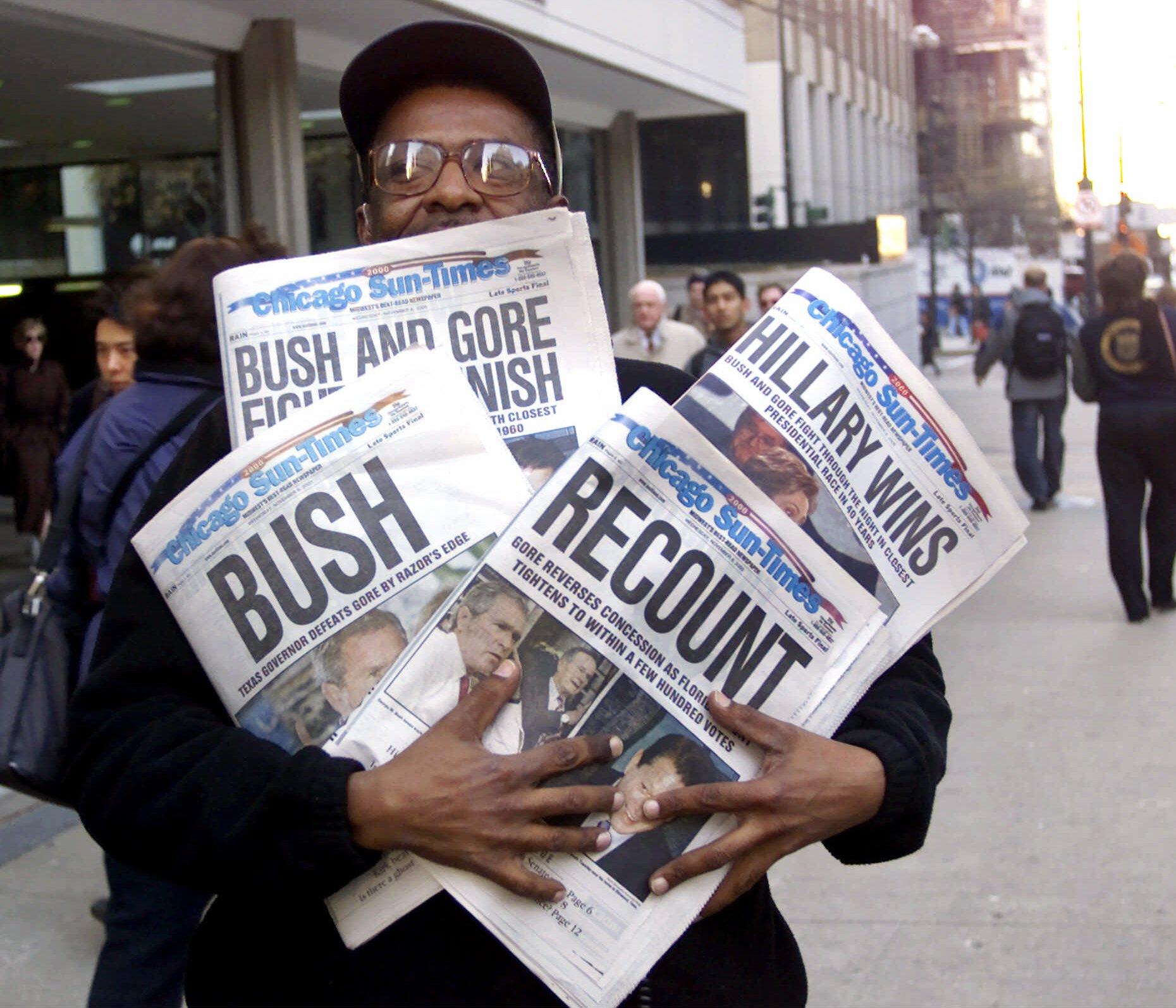
Willie Smith holds four copies of the Chicago Sun-Times, each with a different headline, Wednesday morning, Nov. 8, 2000, reflecting a night of suspense, drama and changes in following the presidential race between Vice President Al Gore and Texas Gov. George W. Bush. (AP Photo/Charles Bennett)
ASSOCIATED PRESS
These also happen to be the only two periods when an incumbent president was defeated in a bid for reelection, only to run again and win a nonconsecutive second term—Democrat Grover Cleveland in 1892 and Republican Donald Trump in 2024. The two periods also included the only elections in which the Supreme Court, directly or indirectly, had a role in determining the presidential outcome—a special commission, including three justices, awarded Hayes the presidency in 1876, and the Court essentially awarded Bush the office in 2000 by a 5-4 decision when it ordered the recounts of Florida ballots to stop.
That instability extended to Congress in both eras. Between 2000 and 2026, control of the House flipped four times. The Senate also flipped party control six times, with Democrats in control for 13-and-a-half years and Republicans in control for 12-and-a-half years. In the 19th century period, the House flipped five times and the Senate four times.
In neither era did any “realignment” election have a long shelf life, as Congress careened from one “change” election to another, driven by a never-ending “throw the bums out” attitude.
In both eras, partisan lines hardened. Throughout most of American history, it has been common for states to have senators of different parties, with the appeal of individual candidates outweighing party loyalty. But the polarization in these two time periods broke that norm.
When the Bicentennial was celebrated, 20 of the 50 states had Senate delegations split between the two parties; less than three years later, in the Congress that opened in January 1979, that number increased to 27 states. But, as polarization grew, that number shrank—to 19 in 1995, 11 in 2005, and eight in 2019. Today, only three states have a Republican paired with a Democrat (or an independent who votes with Democrats)—Maine, Pennsylvania, and Wisconsin.
The same trend was evident a century earlier, though with fewer states in the Union. In 1875, the 76-seat Senate featured 11 split delegations. That shrank to only three split states in the 90-seat Senate in 1900.
That, said Galston, has consequences: “One of the things we know is the more uniform the views of a population are, the more the population will drift towards more and more extreme versions of that view.”
He said that also shows up in the shrinkage of the presidential campaign battlefield as fewer and fewer states are genuinely up for grabs. Trump won the 2024 election by only 1.47 percentage points, a closer margin than Jimmy Carter’s 2.1 percentage point margin in 1976. But fewer states were close. Only 13 states were decided by less than 10 points, compared to 31 in 1976. Similarly, only three states were decided by less than 2 percentage points in 2024, compared to 11 in 1976.
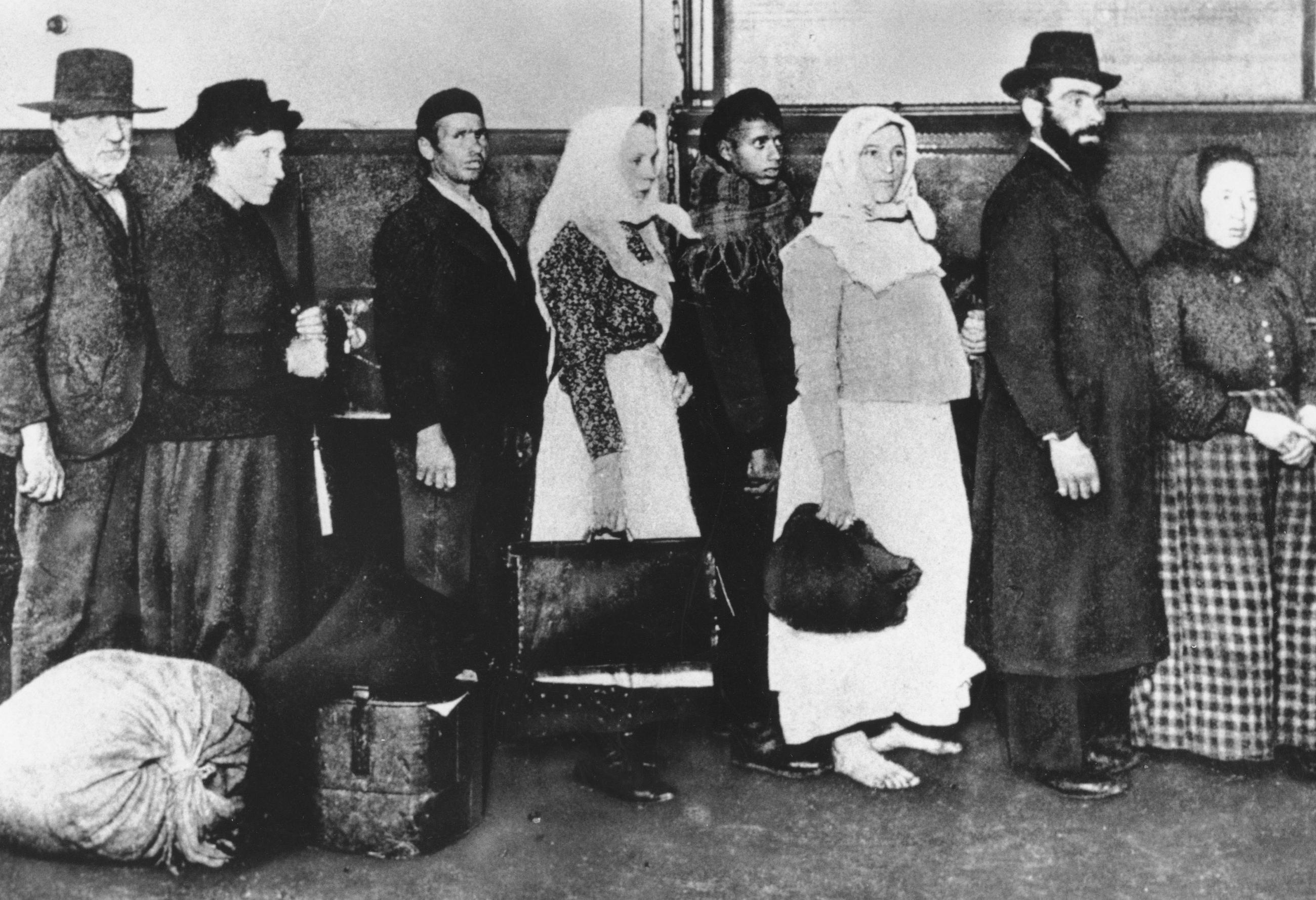
FILE - In this undated file photo, a group of immigrants who arrived at Ellis Island in New York wait in line to begin immigration proceedings.(AP Photo/File)
ASSOCIATED PRESS
Jeffrey A. Engel, director of the Center for Presidential History at Southern Methodist University, has been studying the two eras. “There are many ways the times are similar,” he said. “You’ve got massive economic change. You’ve got massive immigration and then a pushback on immigration. You’ve got new technologies disrupting things. You have a sense that the world is moving too fast. Internationally, you have great power competition. And you have a series of economic shocks to the system that cause not only disillusionment but have people thinking that perhaps capitalism and democracy itself are in trouble.”
In both eras, many Americans also were unsettled by dramatic changes in the electorate. In the 19th century, ratification of the 15th Amendment in 1870 guaranteed the right to vote to formerly enslaved people at the same time the country was experiencing its largest immigration surge to date. Between 1870 and 1900, nearly 12 million immigrants entered the United States.
Prior to the Biden administration, the highest-ever foreign-born share of the U.S. population was 14.8 percent in 1890. In 2023, the share hit 15.2 percent.
Exit polls confirm changes in the electorate. In the 1976 Bicentennial election, white voters made up 89 percent of the electorate, the first time they dropped below 90 percent. Hispanic voters made up 1 percent. Twenty-eight years later, in 2004, white voters dropped below 80 percent for the first time. And Hispanic voters were at 8 percent.
In 2024, exit polls showed the electorate was 71 percent white, 11 percent African American, 11 percent Latino, 3 percent Asian, and 3 percent other. White voters could fall below 70 percent in 2028.
In the late 19th century, in response to the disruptions, some Americans flirted with socialism, even electing some Socialist Party members to local and state offices. It took the larger-than-life Theodore Roosevelt to end the long streak of close elections with his almost-20-point victory in 1904. He then pulled the country back from the brink with his progressive reforms. “His mantra,” said Engel, “was effectively ‘reform capitalism in order to save capitalism’ because he thought there was an explosion coming.”
A century later, the question is whether there is anyone on the current political scene who can reprise Roosevelt’s role to right the ship of state.