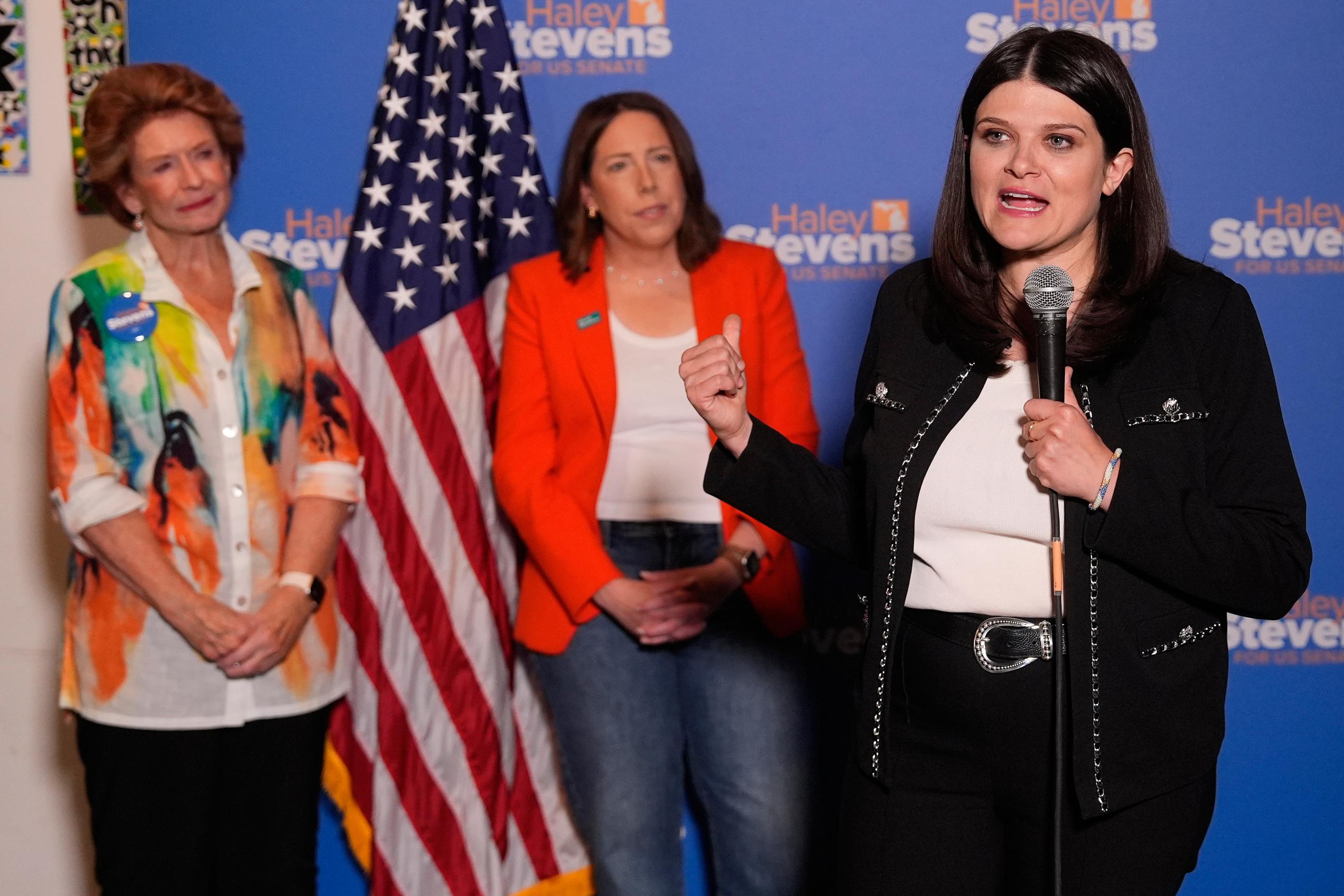

In what is perhaps this year’s most contentious Democratic primary, progressive Senate candidate Abdul El-Sayed of Michigan looks likely to defeat the establishment-preferred candidate, Rep. Haley Stevens. The stakes are high: If Democrats lose this seat, vacated by retiring Democratic Sen. Gary Peters, they would have to hold Georgia and flip five of six seats across Maine, North Carolina, Alaska, Iowa, Texas, and Ohio to win a Senate majority. Most of those states are redder than Michigan.
Those stakes mean “electability” is a huge part of the primary arguments. The conventional logic is that Stevens, a candidate more in line with Sen. Elissa Slotkin, who won her seat at the same time President Trump won the state, is more “electable” in Michigan. El-Sayed is further left and will struggle more against Rep. Mike Rogers, the presumptive Republican nominee.
Of course, progressives and El-Sayed’s supporters say this is not the case. Much of the progressive movement believes that there is a contingent of nonvoters who will show up for unabashedly progressive candidates, akin to the nonvoters who showed up for Trump. There isn’t much evidence of those people’s existence, and the theory hasn’t been tested in a battleground race yet. Michigan would provide that test.
Both camps use polls to insist that their candidate is more electable, or at least equally electable, than the other. Therein lies the entire problem with “electability” arguments: They rely on polls conducted before primaries, which are imprecise, at best, at anticipating a general election outcome several months later.
There is a reason people who grade pollsters typically use only the last three weeks of polling before an election in their assessments. Anything before that won’t reflect changes as voters actually tune in to elections or late-breaking events. One example: In some polls, Clinton had stronger polling numbers than Barack Obama against presumed Republican nominee Sen. John McCain, fueling debates about Obama’s “electability.” Obama ultimately won 365 electoral votes with an 8-point margin in the popular vote over McCain.
What the spring 2008 polls couldn’t account for was McCain’s choice of running mate in Sarah Palin, and, more consequentially, the economic crash in September that kneecapped the already-small chance of a Republican winning a third straight term.
Vast differences between Clinton vs. Obama in 2008 and Stevens vs. El-Sayed in 2026 aside, the point is that we have no idea what will happen over the next three months that will affect any given candidate’s “electability.” The political environment is unfavorable to Republicans, as was 2008, and there are a host of events—known, like the war in Iran, and as-yet unknown—that will shift just how much the environment favors Democrats.
Then we have to consider polling more broadly, and how precise it can really be in measuring different candidates’ performance against an opponent before a primary. The short version: It’s not very precise right now. Most of the numbers the Stevens and El-Sayed camps argue over are 2-4 percentage-point differences, mostly within the polls’ margins of error. The most recent EPIC-MRA poll has Stevens leading Rogers, 44 percent to 42 percent, and Rogers leading El-Sayed, 46 percent to 43 percent.
At face value, those figures argue for Stevens’ electability. But another poll from Mitchell Research shows El-Sayed tied with Rogers at 45 percent and Stevens losing to Rogers by three points, 46 percent to 43 percent. In both cases, the 2- and 3-point differences between candidates are well within the polls’ margins of error. The race is shaping up to be close no matter which Democrat wins.
Some respondents are switching back and forth in the poll, but the differences are more likely driven by undecideds than Democratic dropoff. In the EPIC-MRA poll, El-Sayed gets 43 percent, only a 1-point drop from Stevens’ 44 percent, while Rogers picks up 3 points. The biggest source of the difference is not Democratic dropoff—that is at most 1 of 3 points—but undecideds shifting toward Rogers. In the Mitchell poll, Stevens drops 2 points compared to El-Sayed, and Rogers gains only 1 point.
In both polls, 10-14 percent of voters are undecided between Stevens or El-Sayed and Rogers. Those figures plainly show that these voters are the X-factor. We don’t know anything about them—samples of undecideds in polls are generally too small to analyze with any accuracy, and then we have no idea which of them will actually show up to vote.
Neither Democratic candidate has a strong claim to an “electability” advantage over the other when you read the numbers for what they really mean a few months out: Fuzzy estimates, at best. Arguing about electability based on poll data only serves to feed internet algorithms; we have no idea what will happen by November.