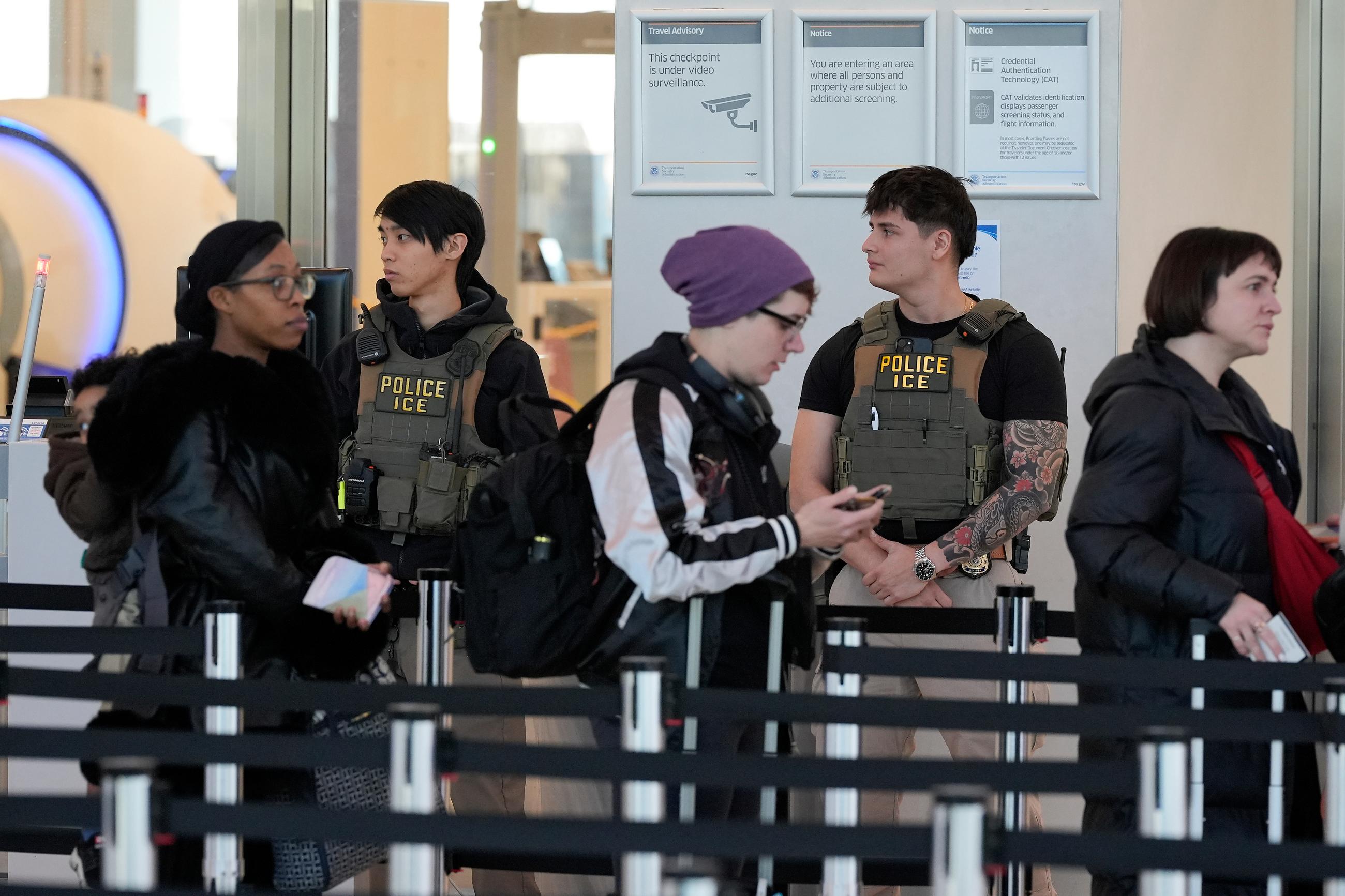

President Trump and his allies have not ruled out sending federal agents to the polls this fall, spurring nonpartisan and Democratic-aligned voter-advocacy groups to prepare messaging to reaffirm the safety of voting and remind voters of their rights and options.
Trump administration officials’ hesitancy to rule out sending agents to the polls is part of their larger effort to use the tools at their disposal, including the courts, to influence how elections are run. The Justice Department has sued 30 states for their voter rolls—in the 18 cases where judges have issued rulings, they’ve gone in the states’ favor every time. Now, threats to deploy agents at polling places seem similarly destined for legal disputes, should they come to fruition.
Sending armed federal agents—including Immigration and Customs Enforcement agents—to polling stations is illegal. The Posse Comitatus Act of 1878 states that troops and federal agents cannot go to “any place where a general or special election is held, unless such force be necessary to repel armed enemies of the United States.”
No judge has ruled on what exactly constitutes a place where an election is held and how close agents can legally be to a polling station. Stephen Richer, a former Maricopa County recorder, said it’s unclear how close ICE agents can be to polling locations if they’re conducting legitimate immigration-enforcement operations.
“The legality of the situation is a bit more of a gray area than some people suggest,” Richer told National Journal.
He said it was “very improbable” that agents would show up near voting locations and added that it would be “impossible” to place agents at the nearly 100,000 polling locations nationwide.
Democrats are proactively trying to rein in Trump before he carries out his threats. Senate Democrats sent a letter Tuesday requesting the administration disclose any potential plans to send agents to the polls, setting a deadline of Aug. 11. More than half a dozen Democratic-controlled state legislatures across the country have proposed laws to explicitly ban ICE and federal agents from approaching polling places. And election officials and state attorneys general have game-planned for hypothetical scenarios in which agents show up at polling stations and the legal responses they would immediately file.
Some fear that regardless of whether agents actually appear outside polling locations in November, the mere possibility of their arrival might dampen turnout. Election officials and voting-rights groups stress that voters have options that do not involve showing up to a polling location on Election Day. In many states, voters can cast their ballots early in person or by mail.
“Remember, you don’t have to go to a polling place at all,” Minnesota Secretary of State Steve Simon said last month during a panel on the role of the federal government and states in elections. “You can vote from home, from your kitchen table, if that concerns you.”
Ricardo Rauseo Landa, national press secretary for Somos Votantes, said Latino voters are “extremely motivated” to go vote, and polling has backed him up. A May poll from Unidos US found 76 percent of registered Latino voters in 32 competitive congressional districts planned to vote in November. Forty-four percent said they or someone in their community fear that immigration authorities will harass or arrest them, even if they are U.S. citizens or legally residing in the U.S.
“We have to remain cautious about it,” Rauseo said of the threat of ICE at the polls. “But obviously we haven’t seen any evidence of this actually happening.”
Primaries have so far taken place without incident, but voter-protection groups worry about heightened federal interference in the November election. Rauseo said Somos Votantes has implemented tabling at its events to help voters check their registration and develop a plan to vote. After raids in Minnesota and California, Somos Votantes implemented know-your-rights trainings.
“We just went through this in this last winter, so it’s still a fresh wound where I’m from,” Simon said last month of the ICE raids in Minneapolis earlier this year.
Voter-advocacy groups face a challenge—addressing concerns among Latino voters without creating unnecessary panic.
“We’re not going to invalidate their feelings, because no matter what, that narrative is actually already out there,” Michelle Villegas Tapia, a strategist with Deliver Strategies, told National Journal. “People are already hearing about it; people are already expressing some fear around this. But we are not going to be a part of the echo chamber that just continues to give anxiety to the community.”
Villegas Tapia, who previously worked as the Latino voter-engagement director for former Vice President Kamala Harris’ campaign, said “Latinos are highly susceptible to misinformation” because they tend to get information from less-regulated channels like WhatsApp, Facebook, and YouTube.
“Latino voters are overwhelmed with information online, and so sometimes, reaching voters directly in their mailbox and having them have a tactile piece of mail that they can put on their fridge or give to a neighbor can be really helpful in combating disinformation,” Villegas Tapia told National Journal.
These concerns haven’t applied solely to the election process. During his first term, the Trump administration attempted to add a citizenship question to the 2020 Census, which civil rights groups argued would lead immigrants to avoid participating in the Census for fear of being targeted. The Supreme Court temporarily blocked the administration from adding the question, saying the reason for adding it seemed “contrived.”
Voto Latino, a Democratic-aligned group that aims to register Latino voters, is investing six figures into message testing on voting ahead of the November elections. Next month, the group will test between 15 and 20 messages, including information on know-your-rights and what to do if agents are present near polling stations.
“We’re in some uncharted territory,” Ameer Patel, deputy director at Voto Latino, told National Journal.
Patel said he hopes to research which messages best boost turnout without worsening fears. Voto Latino plans to test the messages in 22 battleground congressional districts across Arizona, California, Colorado, Nevada, New York, Pennsylvania, Texas, and Virginia.
“We want to be able to show that there’s an effective way to mobilize people, even in the face of some of these threats, without having unintended consequences,” Patel said.