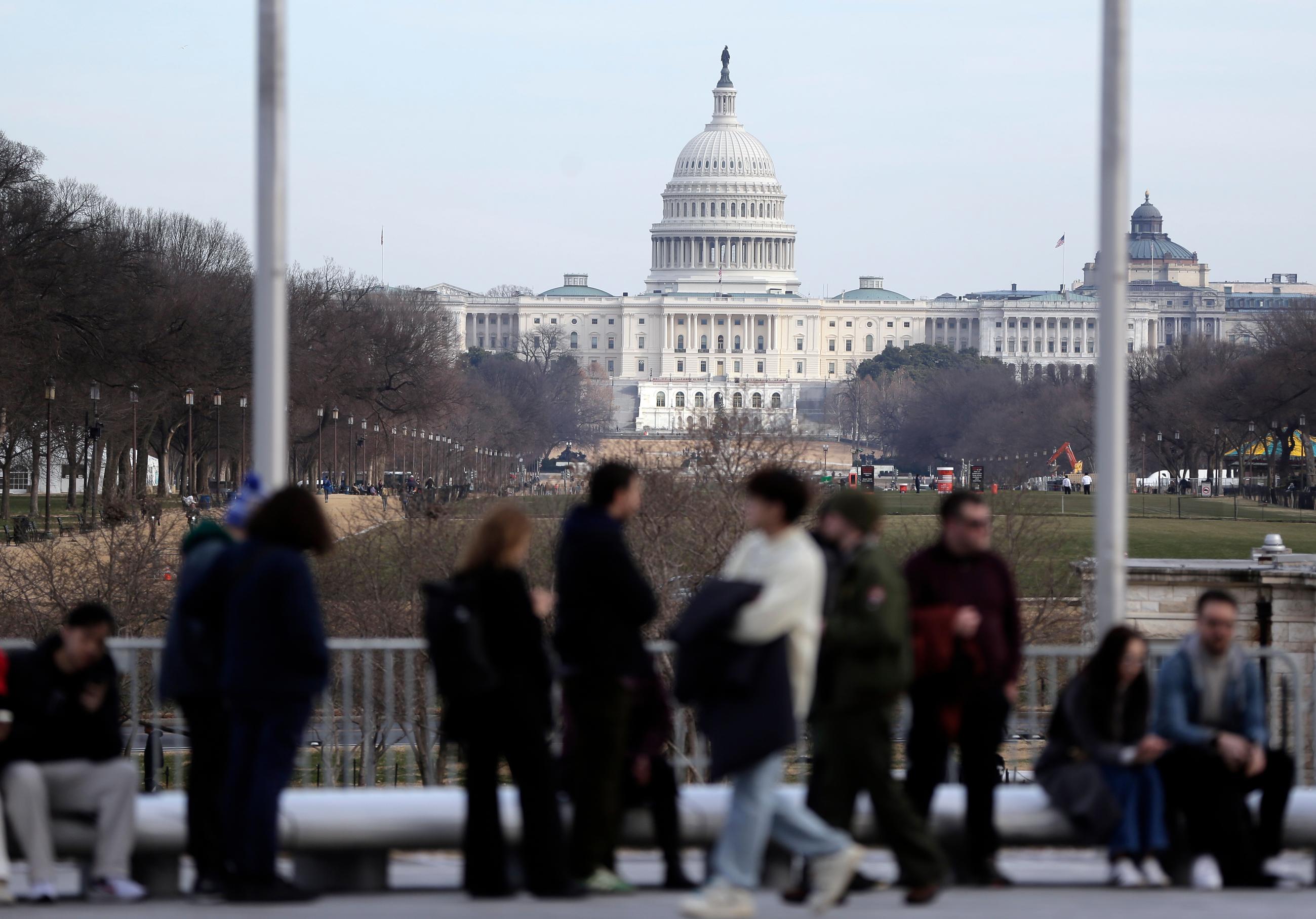


Think of how Washington will finally deal with Social Security’s funding crisis this way: Senators elected this November will still be in office by the time the program is expected to be unable to pay full retirement benefits in 2032.
“Make no mistake: the next Congress—and especially the next class of senators—will decide the future of Social Security,” said Max Richtman, president and CEO of the National Committee to Preserve Social Security and Medicare.
The warning signs have been flashing for years, as program watchdogs reemphasized last month.
“As in prior years, we found that the Social Security and Medicare programs both continue to face significant financing issues,” the trustees of Social Security and Medicare wrote in their annual report.
The concern is bipartisan. A group of senators, including Health, Education, Labor, and Pensions Committee Chairman Bill Cassidy, is championing a proposal to help fix the problem. Also teaming up are Sens. Bernie Moreno and Elizabeth Warren, who are proposing to expand who contributes Social Security taxes.
At the moment, though, Congress is embroiled in other, more urgent controversies, so “the odds of anything happening before the end of the year on a big-picture fix are very, very low,” said Sen. Tim Kaine, who is part of the Cassidy group.
A crisis long in the making
The Social Security and Medicare programs have been barreling toward a financial crisis for years.
The prognosis never seems to improve. The trustees cited lower fertility rates and less immigration as among the reasons.
“These two demographic changes lowered the projected number of workers, projected taxable payroll, and projected GDP (the size of the nation’s economy) over the long range,” the trustees found in their annual report.
With revenue projected to slow, they predicted that the program’s Old-Age and Survivors Insurance Trust Fund, which pays monthly retiree and survivor benefits, will only be able to cover 100 percent of those benefits until the end of 2032.
“At that time, the fund’s reserves will become depleted and continuing program income will be sufficient to pay 78% of total scheduled benefits,” the trustees wrote.
Other program funds—including the Hospital Insurance Trust Fund, which pays for Medicare Part A and includes expenses for hospitals, skilled nursing care, and other items—face shortfalls in the near future.
The outlook means that the senators elected in November whose terms will end in January 2033 will face this crisis during their terms; it’s why the National Committee has launched “Social Security on the ballot,” a voter-education initiative reminding people of the issue’s urgency.
What can be done?
While there’s little agreement on what to do—and little political will to do anything quickly to cut benefits or raise taxes—there is agreement that something needs to be done.
Most lawmakers agree that times have changed dramatically since Social Security was created 91 years ago. It was viewed as a social insurance program for seniors, who then had a life expectancy at birth of 61.7 years. Since then, life expectancy at birth has climbed to 79 years, according to the Centers for Disease Control and Prevention. Social Security has expanded as automatic cost-of-living increases have been added.
Medicare went into effect in 1966, and its prescription drug coverage was added 40 years later. A 1983 overhaul of the Social Security program, championed by a bipartisan commission, raised the retirement age to 67 while increasing Social Security taxes.
Any proposal to change Social Security today tends to focus on raising that age and raising the ceiling on taxes.
Currently, people pay Social Security tax on income up to $184,500. Employers and employees each pay 6.2 percent.
Warren and Moreno want the income cap lifted. They maintained in a New York Times op-ed that “since the vast majority of Americans make less than that, most people are paying Social Security taxes on 100 percent of their earnings while the highest earners are paying on only part of theirs.”
A bipartisan idea
One of the more ambitious efforts to find a path to easing the Social Security crisis came from the bipartisan Senate group’s PROMISE Act, which would have the Social Security Advisory Board, an independent group that recommends policy to Congress, propose legislation aimed at fully funding the Social Security trust funds for the next 50 years.
Congressional committees would then hold hearings and write legislation to fund Social Security. If committees did not accept the commission bill, the House and Senate could consider it anyway, subject to amendments. Debate would be limited, and final passage would require a three-fifths majority for passage in the Senate and a majority in the House.
“We want to act before it’s dire. We think the fixes will be easier if we don’t wait till the last minute,” Kaine said. He conceded, though, that “history shows these fixes don’t get done until the last minute.”
Richtman said that while his group appreciates the effort, “Social Security is too important for solvency legislation to be rushed through in the waning days of the 119th Congress.”
Even if it is taken up in the next Congress, his committee would not back the bill since its plan “would limit public debate and because it would provide political cover to members of Congress that want to cut earned benefits."
But there is the hope that sentiment is growing to do something.
“We get calls in the office almost daily: Don’t cut Social Security,” Sen. Chuck Grassley said at a recent Social Security Subcommittee hearing.
“I'm not on the phone talking to these constituents, but I’d like to say to them, if you knew how scared members of Congress of both political parties are of the issue of Social Security, you’d be laughing at us instead of calling in and saying, ‘Don't cut Social Security,’” Grassley continued.