
July 28, 2026, 1:49 p.m.
If you’re Gavin Newsom, Josh Shapiro, Pete Buttigieg, or any other Democrat with dreams of reaching Super Tuesday in 2028, you might want to start sending additional fundraising emails.
The Democratic National Committee’s Rules and Bylaws panel selected six states to hold their primaries before Super Tuesday, rearranging the nominating calendar for the first open contest in nearly a decade. Barring a surprise at next month’s full DNC meeting, South Carolina will kick off the dash to the nomination, followed by Nevada, New Hampshire, New Mexico, Michigan, and Virginia.
Democrats on the Rules and Bylaws Committee selected the states in the early window to showcase diverse perspectives—Black voters in South Carolina, Latino voters in Nevada and New Mexico, and swing voters in Michigan and Virginia.
“We had been starting with places like Iowa and New Hampshire, which trend, obviously, extremely white and extremely college-educated,” said Lanae Erickson, senior vice president for policy and education at the center-left think tank Third Way. “It wasn’t until several states in that we actually got a real representation of voters of color in the primary in the last order that we were using.”
In addition to spotlighting a broad range of demographics Democrats want to woo, including voters of color and swing voters, the calendar sets candidates up for a long journey before the eventual nominating convention. The two additional states in the early window—and the expensive media market in the final two states on the list, Michigan and Virginia—mean candidates will need more cash to soldier on to Super Tuesday.
“You’re just going to need a ton of money to compete,” Democratic strategist Jesse Lehrich said.
The population included in the early window is more than double that of the states in the early window in 2020—Iowa, New Hampshire, Nevada, and South Carolina. Michigan has roughly three times the population of Iowa, the past Midwestern litmus test.
Six states last held their primary contests in the early window in 2008, when Florida and Michigan held unsanctioned early primaries.
Candidates strapped for cash may need to pick and choose their contests. Should they make an impressive showing in the first two states—even without a win—they may be able to argue to their supporters and donors that contests later in the window could shift momentum for them.
“With the elongated early window and two very expensive states right before Super Tuesday, a candidate is likely going to need to win one of the first three or four to convince donors to keep giving,” said Steve Schale, a Democratic strategist who worked for a pro-Biden super PAC in the 2020 campaign. “I can see a world where candidates try to pick their spots to get a win rather than draining their bank account to finish fifth in South Carolina.”
Biden’s 2020 win in South Carolina catapulted his campaign toward victory after he had taken fourth place in the Iowa caucuses, fifth place in the New Hampshire primary, and a distant second place in the Nevada caucuses.
Democrats in Nevada and South Carolina said their states will force candidates to test their messages across a range of demographics.

Kentucky Gov. Andy Beshear at the South Carolina Democratic Party's Blue Palmetto Dinner in Columbia, S.C., on May 29 (AP Photo/Meg Kinnard)
AP Photo/Meg Kinnard
South Carolina
Former DNC Chair Jaime Harrison said South Carolina is similar to New Hampshire in that its voters value “meaningful conversations and discussions.”
“The first part is showing up and people knowing that you actually want to be there and you want to engage and you really give a shit about the things that are important to them,” said Harrison, a former candidate for Senate from South Carolina.
He said some candidates weren’t as successful because they “felt like they needed to check the box” and weren’t truly invested in the state.
Harrison cited the importance of courting rural voters in South Carolina.
“They’re not as big as Columbia, they’re not as big as Charleston, but when added together, they can be sizable and impactful,” he said.
South Carolina has an open primary, but voters can participate in only one party’s primary. Erickson of Third Way said the chances of Republican meddling are slim, given the likely size of the field in the state.
More than half a dozen rumored presidential candidates have already visited South Carolina, including Rep. Ro Khanna, who stopped in Charleston, Orangeburg, and Goose Creek.
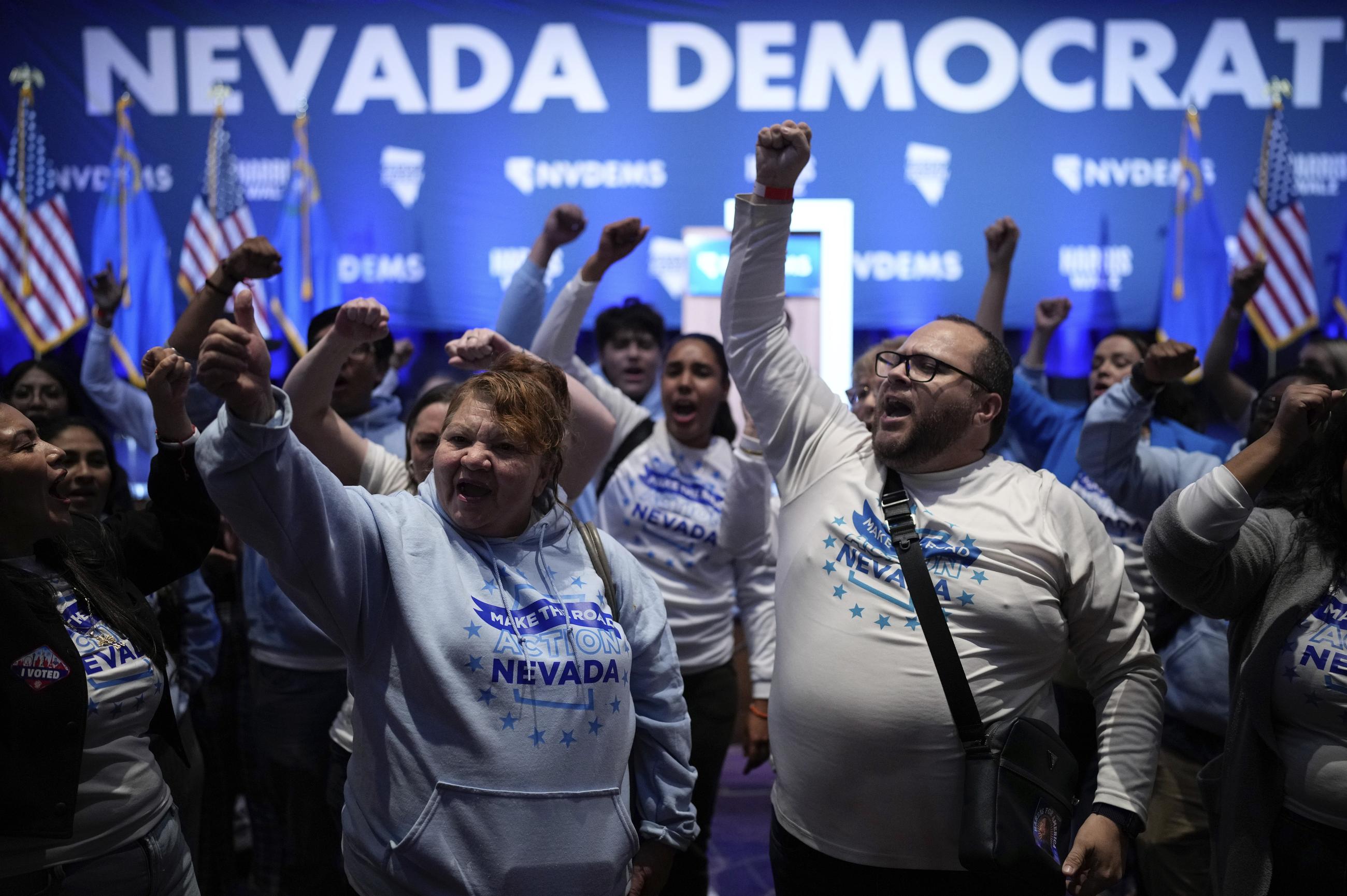
A watch party for Nevada Democrats on election night in 2024 in Las Vegas (AP Photo/John Locher)
ASSOCIATED PRESS
Nevada
Nevada switched from a caucus to a primary in 2024, making its contests more accessible for less politically active voters. Turnout in the 2024 primary beat the all-time turnout record for caucuses in the Silver State.
The Nevada voting population skews less college-educated and more working-class than the national average. Roughly 13 percent of wage and salary workers in Nevada are unionized, more than the 10 percent national average, according to the Bureau of Labor Statistics. Historically, Democrats have wooed the powerful Culinary Union in Las Vegas, but the building-trades unions also play a role in the state.
At least a dozen Democrats rumored to hold White House ambitions have visited Nevada in the last year. Rep. Khanna and Sen. Cory Booker attended the Teamsters convention in Las Vegas last month.
Nevada sees a lot of both inbound and outbound migration, meaning the electorate might not stay loyal to a candidate it supported in the past.
“Every year, you have to redo your electorate because there’s a whole new group of people who move in to work in the casinos, are trying to make it big there, or they fail in doing that and they move out,” said Chuck Rocha, a Democratic strategist who worked on Sen. Bernie Sanders’ 2016 and 2020 campaigns.
State Democratic Party Chair Daniele Monroe-Moreno stressed that while Nevada has a significant Latino population, it also has higher Asian American-Pacific Islander and indigenous populations than the national average.
“You’ve got to demonstrate that your message and your candidacy cuts across demographic groups,” a Nevada-based Democratic strategist told National Journal.