July 27, 2026, 5:29 p.m.
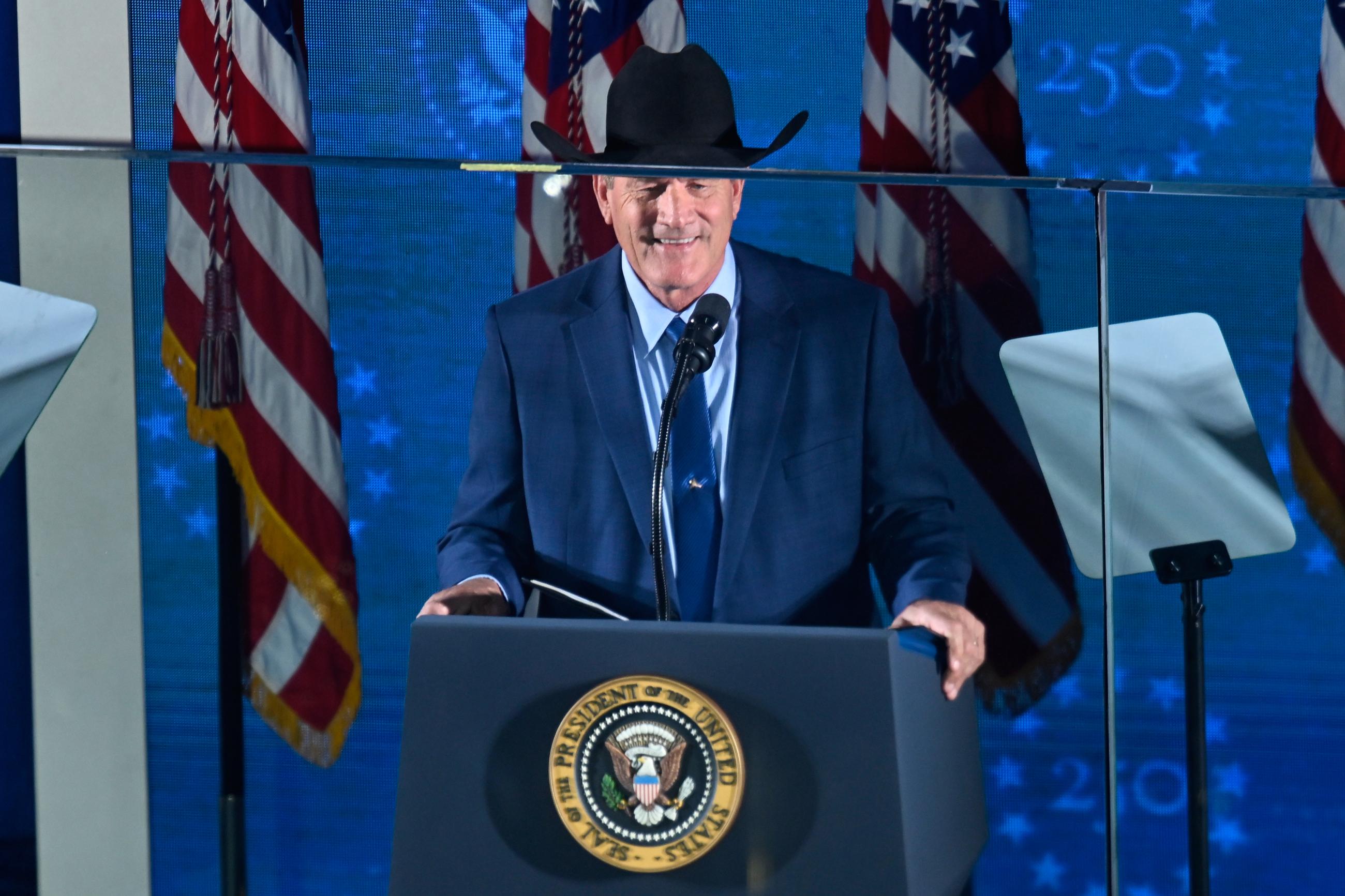
South Dakota Gov. Larry Rhoden entered his run for a full term as one of the most at-risk governors this cycle. He succeeded Kristi Noem when she left to become Homeland Security secretary in January 2025, had few legislative successes to tout in his year-long stint, and faced a bruising property-tax fight, spurring multiple primary challengers to throw their hats in the ring.
Rhoden was forced into a primary runoff that comes to a head Tuesday. But facing businessman Toby Doeden, a car salesman and political newcomer who has coalesced the state’s right-most factions, might be a blessing in disguise for Rhoden.

Doeden came in first in the June 2 primary after spending $3 million on air, but he came short of the 35 percent needed to avoid a runoff. Rhoden came in second, and the perceived front-runner, Rep. Dusty Johnson, was eliminated from contention with a third-place showing.
The outsider candidate took particular pride in defeating Johnson. “Dusty Johnson, ideologically and politically, is about as far opposite of me, and many South Dakotans, quite frankly, as you can get," Doeden said after the primary. "So I ... just said, ‘Over my dead body will Dusty Johnson ever be governor of this amazing state.’”
The race has turned from a referendum on Rhoden’s short-lived term to a referendum on his opponent among more-moderate Republicans, who “are sort of very nervous about Toby Doeden,” said Michael Card, professor emeritus of political science at the University of South Dakota. While the state voted for President Trump resoundingly, there are still a sizable chunk of Reagan-era Republicans who are turned off by Doeden’s far-right, anti-establishment campaign, Card said.
Now, the attacks that helped Doeden squeak into first place may be making it harder for him to consolidate voters who backed Johnson and state House Speaker Jon Hansen.
“[Supporters of] the other two candidates in the actual primary election have largely gone to Rhoden, and part of that was because Doeden, in his campaigns, even though he claims to not be negative, was very negative,” Card said.
Neither Johnson nor Hansen have endorsed in the runoff.
In a primary ad, Doeden criticized Rhoden, Johnson, and Hansen as “crime career politicians” who released “thousands of criminals and offenders back onto our streets.” Most of his lengthy social media posts targeted Johnson, calling him a “lying liberal” and “a Never Trumper.”
I think there are more people who are motivated to vote against Doeden than people who are motivated to vote against Rhoden. On the other hand, you have more people who are motivated to vote for Doeden than are motivated to vote for Rhoden. ”
—Julia Hellwege, University of South Dakota
Voters appear to have taken notice. A recent Emerson College poll found Rhoden leading Doeden in the runoff, 62 percent to 32 percent—results Doeden called “fake.” Of voters who supported Johnson, who captured 23 percent of the primary vote, 95 percent backed Rhoden. Among supporters of Hansen, who got 21 percent in the primary, 69 percent support Rhoden in the runoff, according to the poll.
“There's this concern that Doeden doesn't have a real actual plan and might just end up being that proverbial bull in a China shop. ... Will he do things that make the state suffer and then there's really no way to go back?" said Lisa Hager, a political science professor at South Dakota State University. "Like, if you get rid of property taxes, then what? You're not going to fund schools.”
Rhoden has picked up support from prominent Republicans since the primary, including Sioux Falls Mayor Christine Erickson and her predecessor, Paul TenHaken.
Another advantage for Rhoden is that he has more of a record to run on than Doeden. Rhoden faced blowback over his property-tax plan during the legislative session, a fight complicated by the fact that Hansen, the state House speaker, was challenging his renomination. But Rhoden successfully pushed property-tax relief subsidized by increases in the state sales tax—a concrete win he can tout on the campaign trail, said Julia Hellwege, distinguished professor at the Chiesman Center for Democracy at the University of South Dakota.
Meanwhile, Doeden has drawn skepticism over a lack of detail as to how his own plan would subsidize eliminating property taxes, Card said.
Trump also hasn’t handed down his coveted endorsement, and likely won’t. Given his not-so-perfect gubernatorial endorsement streak this cycle, he may not want to back Rhoden in case he loses. At the same time, he may not want to endorse against Rhoden, who supports the president.
Neither campaign responded to interview requests.
Doeden is an easier opponent for Rhoden to face head-to-head in comparison to Johnson, who would have competed for the same moderate voters as the governor. But Rhoden still faces an enthusiasm gap heading into Tuesday’s runoff that also plagued him in the primary.
“I think there are more people who are motivated to vote against Doeden than people who are motivated to vote against Rhoden," Hellwege said. "On the other hand, you have more people who are motivated to vote for Doeden than are motivated to vote for Rhoden.”
The runoff, the first ever for a governor’s race in the state, will be decided by a sliver of the electorate, likely fewer than the 136,000 voters who turned out in June. And those hyperpartisan, activist voters who are more motivated to turn out may lean toward Doeden. Polling ahead of the primary failed to capture Doeden’s momentum, instead showing Rhoden and Johnson ahead.
“The Doeden voters are motivated voters, and so they were always going to be very likely to turn up, and turn up for him,” Hellwege said.