Never have presidential remarks to the annual White House Correspondents’ Association Dinner been more anticipated.
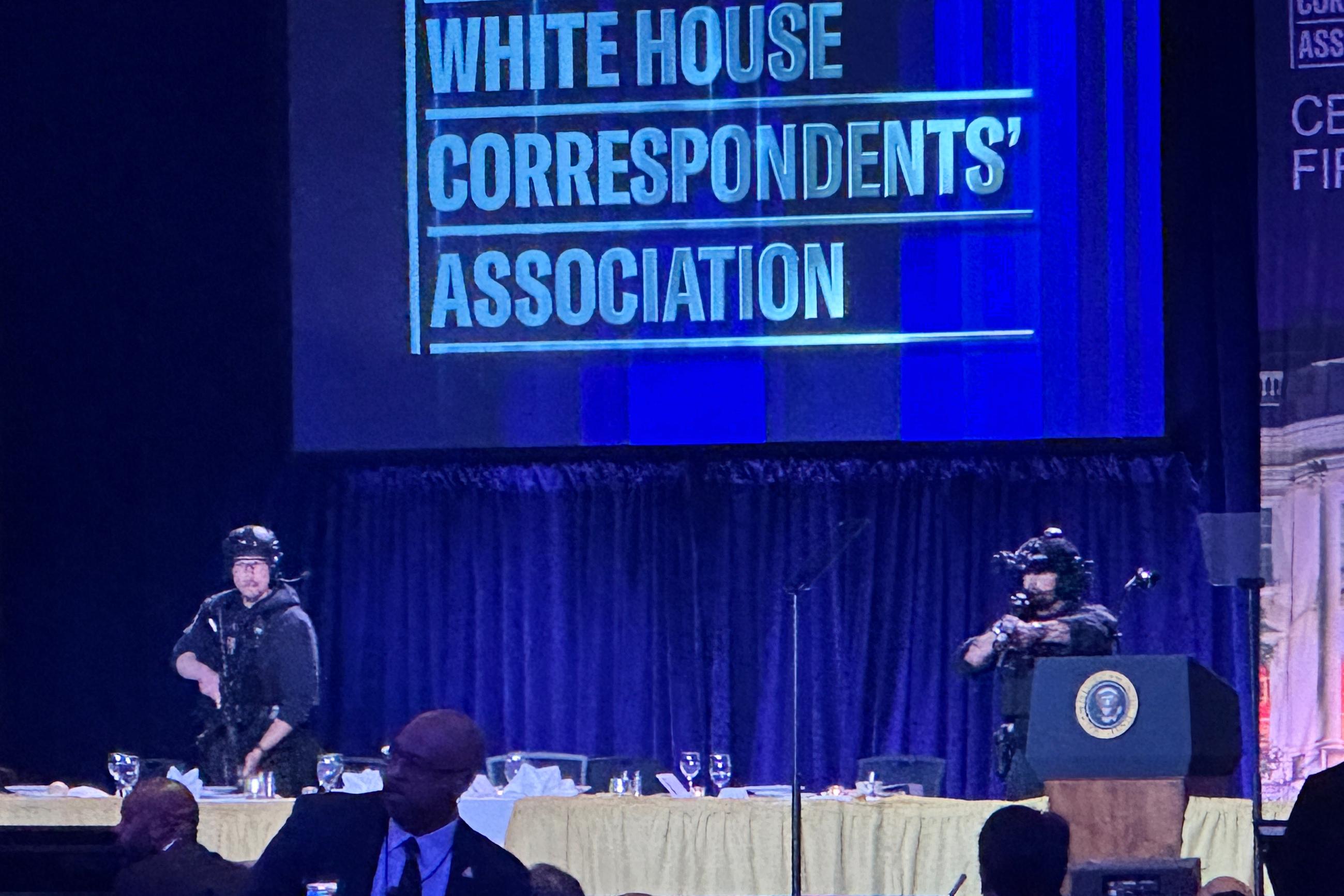
When President Trump takes to the podium of the Waldorf Astoria Hotel Friday night, no one quite knows what to expect. Will he offer a serious take on the gunshots that disrupted the dinner 91 days earlier? Will he offer the type of light-hearted jokes usually associated with the event? Will he be “nasty,” as he said he planned to be? Or will it be the “speech of love” that he contemplated shortly after the assassination attempt?
The White House is not saying, and the president seems intent on keeping the suspense alive. When the scaled-down redo of the interrupted dinner was announced on June 2, he praised the decision but added in a social media post, “I don’t know whether or not I will give the same rather nasty statements, at least as it concerns certain people, but we will soon find out.”
In an interview with 60 Minutes the day after the incident at the Washington Hilton, Trump said he was ready with a new approach had the dinner resumed that night.
“I was going to get up and make an entirely different speech,” he said. “I was going to really rip it last night. I was talking about everybody. And then I said, ‘Well, my speech is going to be much different. It’ll be a speech of love.’ But I didn’t get a chance to do that.”
The only thing that seems guaranteed is that the president, once again, is determined to shatter the norm of a light-hearted, self-deprecating speech designed to at least approximate a one-night truce in the heated war between the chief executives and the correspondents who daily do battle with them. In any administration, such a truce is illusory and short-lived. But it is particularly unlikely at a time when Trump is demanding the Justice Department subpoena reporters and force them to disclose sources.
Since announcing his presidential candidacy in 2015, Trump has struggled at the four occasions when he was supposed to bring a light touch to his oratory:
Laughs were forced and sporadic when he spoke at the Alfred E. Smith Memorial Foundation Dinners in 2016 and 2024, occasions best remembered for his attacking Hillary Clinton as “corrupt” at the former event and cursing (“I don’t give a shit”) in front of Cardinal Timothy Dolan at the latter dinner.
At the Alfalfa Club Dinner earlier this year, The Washington Post described his routine as “unapologetic and awkward,” with “punch lines that at times fell flat.”
Only at the Gridiron Dinner in 2018 did he manage to pull off some self-deprecation, and that was by mocking his lack of self-deprecation. “Nobody does self-deprecating humor better than I do,” he said, adding, “Donald Trump is the best at self-deprecating in the history of America; better than Washington and better than Lincoln.”
Trump’s history at such events suggests he could come to the dinner with an “all of the above” approach: some nastiness, some serious reflection, some attempts at humor, and many Trumpian digressions, which are likely to make his speech one of the longest in the long history of the dinner.
Trump already holds the record for the longest modern commencement speech, State of the Union, political convention acceptance, and Inaugural address.
Before Barack Obama, most WHCA speeches were very short. Ronald Reagan never topped 8 minutes; George H.W. Bush held his at around 7 minutes; Bill Clinton averaged 15 minutes; and George W. Bush averaged 8 minutes. Obama averaged 21 minutes and gave the longest in 2016, at 32 minutes.
In that, Obama took a page from the WHCA’s founding days.
Presidential speeches at the dinner did not start out auspiciously. The first came the evening of March 8, 1924, when Calvin Coolidge traveled two blocks from the White House to the Hamilton Hotel on 14th Street NW. Despite the “Silent Cal” mythology, on this occasion Coolidge could not stop talking.
“I know that to be put on in the middle of a meal before it is anywhere near finished is an invitation to be brief. I used to have something of a reputation in that direction, but then it was shattered more or less by my associations here and my continuous association with the members of the press,” he said.
He then reminisced about the newspapers he read in his childhood, recalled newspaper criticism of him in Massachusetts, talked about his press conferences, and discussed his decision to come to the dinner, saying, “I am exceedingly glad of an opportunity to come here and be at your annual banquet and have the opportunity to talk to you as one friend talks to another.” He then got to the point of his speech, a long, discursive, and clichéd examination of the separation of powers.
The correspondents were polite—The Washington Post reported “a ripple of applause.” But they didn’t want to sit through another evening like that. So they decreed that presidents at future dinners would not be asked to give speeches. It turned out to be a fortuitous decision. The presidents who followed Coolidge stated that one of the things that drew them to the dinner was that they did not have to give a speech.
The only exceptions in the next four decades came in 1941 and 1943, when Franklin D. Roosevelt used the dinner to make national radio addresses, both on the war.
The biggest change—and the start of the modern WHCA dinner—came when John F. Kennedy spoke. He was brief: 1 minute 35 seconds in 1961, 5:18 in 1962, and 1:34 in 1963. But the correspondents were enthralled. There was no turning back. The pressure was on for every president to match Kennedy’s wit. It was particularly intense on Lyndon B. Johnson in 1964, prompting him to demand that his writers make a secret call to comedian Bob Hope for help.
At Johnson’s final dinner, in 1968, he concluded with a heartfelt and poignant reminiscence about his relationship with the press. The dinner was only 71 days after he had ended his campaign for another term. In a self-deprecating bit, he showed up wearing an oversized photo ID around his neck, an acknowledgement of the correspondents’ battle to overturn an order dictating that they had to start wearing their credentials.
“You may not like to wear your pass, but what do you think about me? I finally had to start using it after my announcement on March 31st,” he said. He called the speech “my valedictory address to the press,” saying, “So tonight I can be even more frank with you than I have customarily been in the past—if that is humanly possible.” He called the relationship between presidents and the press “sort of a lovers’ quarrel.” He added, “Despite all the friction, however, I do admire and I do envy the press.”
He concluded, “You have been the reporters of my hopes and the recorders of my convictions throughout these many days of my presidency. There have been days and nights when you told the people that I had asked for their help and for their prayers as I tried to lead them and as I worked for peace in the world. So tonight, as I leave you, I ask again for yours.”
In 2026, the biggest surprise would be if Trump says anything that conciliatory.