National Journal Logo
×

Welcome to National Journal!

Enjoy this premium "unlocked" content until October 1, 2026.

Continue

Hotline's Gubernatorial Power Rankings

Democrats look to capitalize on anti-Washington sentiment despite some messy primary battles.

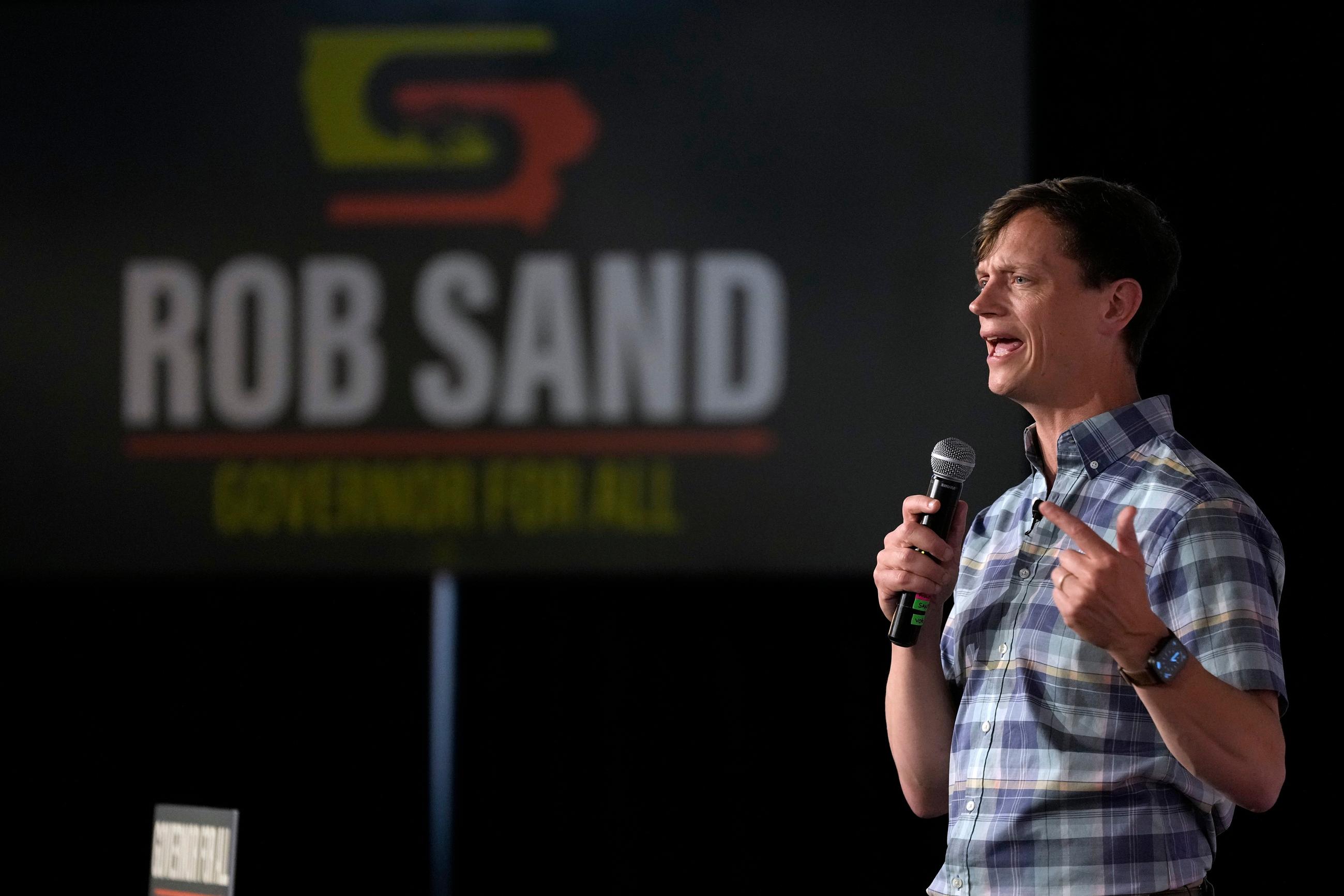
Iowa Democratic gubernatorial candidate Rob Sand speaks during a campaign rally in Des Moines on June 7.
AP Photo/Charlie Neibergall
Add to Briefcase
Abby Turner and Kirk A. Bado
July 21, 2026, 11:31 a.m.

Gubernatorial races are usually more insulated from national headwinds. But frustration with Washington and anti-establishment sentiment have continued to shift races in Democrats' direction.

Some Republican members of Congress looking to make the jump to the governor's mansion have fallen short in primaries in key states like Iowa. Democrats are looking to continue that pattern in states like Arizona, Michigan, and Wisconsin, tying other representatives-turned-Republican nominees to an unpopular Washington.

Democrats still see an expansive gubernatorial map in play, but they’re going on the defense early in must-win swing states. At the same time, the party faces its own challenges as moderate candidates are pitted against more-progressive counterparts in messy primaries.

These rankings of the seats most likely to flip are based on interviews with committees and operatives, as well as analysis of fundraising and polling.

1) Kansas: Open (D)

Democratic Gov. Laura Kelly proved her 2018 win wasn’t a fluke when she was decisively reelected four years later. Fast forward to 2026 and state Sen. Ethan Corson, Kelly’s chosen successor, is trying to follow the same path. Standing in his way isn’t just the inherent math problem of a Democrat running in a state that President Trump carried by more than 15 points each time, but also a literal political football. Last year, Kelly announced a slew of sweetheart incentives to lure the Kansas City Chiefs across the border to Kansas from their home in Missouri. These plans have met swift public backlash, and Corson has found himself on the backfoot against attacks from fellow Democratic state Sen. Cindy Holscher, also running to replace Kelly.

This fight will leave whoever emerges from the primary battered and bruised. The Democrats will try to tie the eventual Republican nominee to former Gov. Sam Brownback, whose controversial 2012 tax plan proved to be a fiscal disaster for the state. Kelly rode that backlash to two terms, but with Brownback out of office now for more than a decade, those attacks might have lost their juice. The brewing backlash from rural voters over the tariffs and increased fuel prices might give Democrats a boost, but it’s still an uphill battle.

2) Iowa: Open (R) ↑

The Hawkeye State delivered President Trump the first major statewide endorsement flop of his second term when businessman Zach Lahn squeaked by Rep. Randy Feenstra, who had skipped primary debates and struggled to build grassroots support. Lahn is untested as a candidate, and Democratic state Auditor Rob Sand wasted little time defining him before he could define himself. Sand recast Lahn as a carpetbagger from Kansas and an experienced political operative, undercutting the image he cultivated during the primary as an outsider willing to take on big agriculture interests. Sand’s first ad attacking Lahn argued that, as a “part-time Iowan,” Lahn was ill-equipped to take on issues like a sagging economy and rising cancer rates—the latter reference a direct shot on one of the core themes of Lahn’s MAHA-inspired platform.

Lahn enters with the ability to partially self-fund, but Sand still holds a commanding advantage with nearly $18 million on hand from contributions and family wealth. Sand is one of the strongest Democrats running statewide across the country, and he is giving the party a playbook to gain back ground in the heartland. Sand is currently on a "100 Town Hall Tour," the second since launching his bid. He’s built a moderate populist brand by emphasizing government accountability and criticizing both parties. With his strength as a candidate, along with the unpopularity of retiring Gov. Kim Reynolds and the strain of tariffs on the farm economy, Republicans know this is one of their toughest holds of the cycle. Just look at the $5 million the Republican Governors Association dished out for Lahn in the latest reporting period, which made up a majority of his contributions.

3) Georgia: Open (R)

The Republican primary in Georgia delivered Trump another upset when health care executive Rick Jackson defeated Trump-backed Lt. Gov. Burt Jones in the runoff. Even so, Republicans got what they wanted: former Atlanta Mayor Keisha Lance Bottoms as the Democratic nominee. Republicans want to put Bottoms’ record as Atlanta mayor during a tumultuous 2020 summer front-and-center. They see a lane for Jackson to run as a continuation of popular Gov. Brian Kemp, while focusing on his compelling rise from poverty and his outsider business background.

But Republican divisions threaten that playbook. Jones still refuses to back Jackson, and Jackson heads into the general election after months of damaging attacks from fellow Republicans. The fast-growing Atlanta suburbs continue to make the state more competitive, an advantage Bottoms looks to seize on. She and Sen. Jon Ossoff launched a strong general-election ticket while their counterparts were locked in bitter runoffs. Bottoms has honed in on health care in a state that never expanded Medicaid, drawing a contrast with Jackson, whom she portrays as an out-of-touch health care executive. This biggest task for Democrats will be overcoming Jackson’s self-funding advantage in a state whose airwaves will already be dominated by Senate advertisements.

Francesca Hong, a Democratic socialist candidate for Wisconsin governor, in Madison, Wis., on July 7
Francesca Hong, a Democratic socialist candidate for Wisconsin governor, in Madison, Wis., on July 7 AP Photo/Scott Bauer

4) Wisconsin: Open (D)

No clear Democratic front-runner has emerged in the race to succeed Gov. Tony Evers, but Republicans are doing everything in their power to get state Rep. Francesca Hong, a member of the Democratic Socialists of America, across the finish line. Hong has seized on a fractured Democratic field to break through, and moderate Democrats are making a last-ditch effort to quash her success. Evers, who had said he would stay out of the race to succeed him, endorsed Milwaukee County Executive David Crowley for governor. Crowley hopped back in the race after his pick, Lt. Gov. Sara Rodriguez, dropped out over mishandled campaign finances. The maneuver hasn’t pushed other Democrats out of the field yet. If Crowley fails to coalesce support, Hong could secure the nomination with a plurality by uniting the party’s left flank.

If Hong secures the nomination on Aug. 11, Democrats in Wisconsin worry this race could turn from a referendum on Republicans to one on the rise of Democratic socialism. The Democratic Governors Association is up early with ads painting Rep. Tom Tiffany as a “MAGA Extremist.” In his own ads, backed by over $5 million already on the air, Tiffany is trying to create a nice-Wisconsin-grandpa vibe. Republicans recognize the baseline Democratic support in the swing state doesn’t give them much wiggle room. But no matter which Democrat emerges from the primary, the party will need to quickly regroup to gain on the general-election advantage Tiffany has enjoyed since January. Wisconsin Democrats and Evers launched a fund to support the eventual nominee, but it’s unclear how much money will be ready to be deployed come Aug. 12.

5) Ohio: Open (R) ↑

Republicans have spent millions portraying former state Health Director Amy Acton as unfit to serve, pointing to her role initiating COVID-19 lockdowns, but it hasn’t moved the needle. Acton and 2024 presidential candidate Vivek Ramaswamy have polled neck-and-neck since the May primary despite his massive self-funding advantage and super PAC support. Some of Ramaswamy's biggest headaches have been caused by the Republican governor he’s trying to succeed. Gov. Mike DeWine, who could sit on the sidelines as a lame-duck governor without higher political aspirations, denounced as "inaccurate" a Ramaswamy ad claiming that Acton “called off Ohio’s election at the last minute." DeWine, who did endorse the GOP nominee, has also publicly cast doubt on Ramaswamy’s proposals to eliminate property and income taxes and close and consolidate public universities.

Democrats are characterizing Ramaswamy as an out-of-touch outsider who can’t relate to Ohioans, a criticism he has seemed to confirm with trips on his private jet and time spent out of state. While Ohio knows Acton from her daily COVID-19 briefings, she’s not making that the focus of her campaign. Instead, she’s leaning into her personal story of experiencing abuse and homelessness to relate to Ohioans' affordability concerns. Baseline partisanship will be the biggest hurdle for Democrats in a state Trump won three times. But for not having spent much on the air yet, Acton is in a strong place heading into the fall.

6) Michigan: Open (D) ↓

This race came tumbling down Hotline’s rankings all the way from No. 2 in our previous edition after former Detroit Mayor Mike Duggan dropped his independent bid in May. Duggan stepping aside brought a sigh of relief from Democrats who were concerned that he would siphon support from the all-important Black communities in the Detroit area.

But there are still challenges for Democrats. The gubernatorial and Senate races are mirror images of each other. In the former, Secretary of State Jocelyn Benson has the Democratic nomination to replace term-limited Gov. Gretchen Whitmer all but wrapped up while Republicans are locked in a bruising slugfest through Aug. 4. In the latter, it’s the Democratic primary that’s a mess while former Rep. Mike Rogers, the 2024 nominee who came just short, has the GOP nomination sewed up. It’s that messy primary in the Senate race that could present challenges for Benson as progressive Democrat Abdul El-Sayed aligns himself with firebrands on the Left.

On the GOP side, Rep. John James secured the Trump endorsement, but the president’s support isn’t enough to guarantee a nomination this cycle—especially in governor's races. James is facing off against Perry Johnson, who has sunk millions from his personal fortune into the race.

Nevada Gov. Joe Lombardo
Nevada Gov. Joe Lombardo AP Photo/Jae C. Hong

7) Nevada: Gov. Joe Lombardo (R)

Lombardo is the most vulnerable Republican governor in the country. It’s incredibly difficult for incumbent governors to lose reelection, especially Republican ones. In the last major blue wave in 2018 when Democrats flipped more than 40 House seats, only two GOP governors lost reelection—Illinois Gov. Bruce Rauner and Wisconsin Gov. Scott Walker. But Lombardo still might fall victim to the same political gravity that helped elevate him over former Democratic Gov. Steve Sisolak four years ago. The Vegas tourism industry still hasn’t fully recovered from the pandemic, while Trump’s energy policies are impacting the state economy. In addition, the governor is facing increased scrutiny after Las Vegas police body-camera footage showed him getting out of a traffic stop by telling the officer, “I’m Joe Lombardo. … Come on, man.”

Democratic state Attorney General Aaron Ford isn’t exactly setting the world on fire—despite setting a fundraising record for a non-incumbent—but that might not matter given the darkening national environment for Republicans.

8) Arizona: Gov. Katie Hobbs (D) ↓

Hobbs and her Democratic allies got the opponent they wanted in Rep. Andy Biggs, a MAGA-aligned member of the House Freedom Caucus. While he’s no Kari Lake—the fanatic election denier Hobbs defeated four years ago—he’s a pretty close approximation. Democrats are counting on those ties to be enough to reelect Hobbs. The bubbling anti-Washington sentiment in the electorate could also hamper the Republican.

As for Hobbs, she barely scraped by four years ago despite having a less-than-stellar general-election opponent. Now that she has a record, Republicans will focus on litigating her last four years in office.

9) Alaska: Open (R)

Republicans dodged a bullet when former Rep. Mary Peltola opted for the Senate race instead. But with the Last Frontier’s quirky top-four primary and ranked-choice voting, the GOP is not in the clear yet. A dozen Republicans, a handful of independents, and two Democrats are vying for a spot in the top-four primary. Former state Sen. Tom Begich and former state Rep. Jonathan Kreiss-Tomkins are fighting to consolidate Democratic support after state Sen. Matt Claman dropped out. No clear front-runners have emerged from the fractured Republican field. If one Democrat and three Republicans advance to the general election, Democrats are hoping the ranked-choice voting math will work in their favor.

10) Oregon: Gov. Tina Kotek (D) ↑

Kotek’s reelection looks easier than her 2022 bid against a well-funded Republican and a competitive independent, but her second fight against 2022 GOP nominee Christine Drazan won’t be a shoo-in. The race is shaping up to be a referendum on Kotek’s administration during a time when the state has struggled with housing costs and homelessness. While Democrats say she has made improvements on the issues, they recognize they won’t be resolved in one term. Drazan’s fundraising is competitive, and if she gets the backing of Nike co-founder Phil Knight again, she could give Kotek a run for her money. The DGA has already doled out $1 million for Kotek. Polling is scant, but an internal from Drazan shows the two statistically tied. For now, voters seem to be considering an alternative to Kotek, but in what is a solid blue state on the federal level, voters’ opposition to Trump will likely prevail over anti-incumbency sentiments.

Welcome to National Journal!

Enjoy this featured content until October 1, 2026. Interested in exploring more
content and tools available to members and subscribers?

×
×

Welcome to National Journal!

You are currently accessing National Journal from IP access. Please login to access this feature. If you have any questions, please contact your Dedicated Advisor.

Login