July 16, 2026, 5:55 p.m.
BIG PICTURE
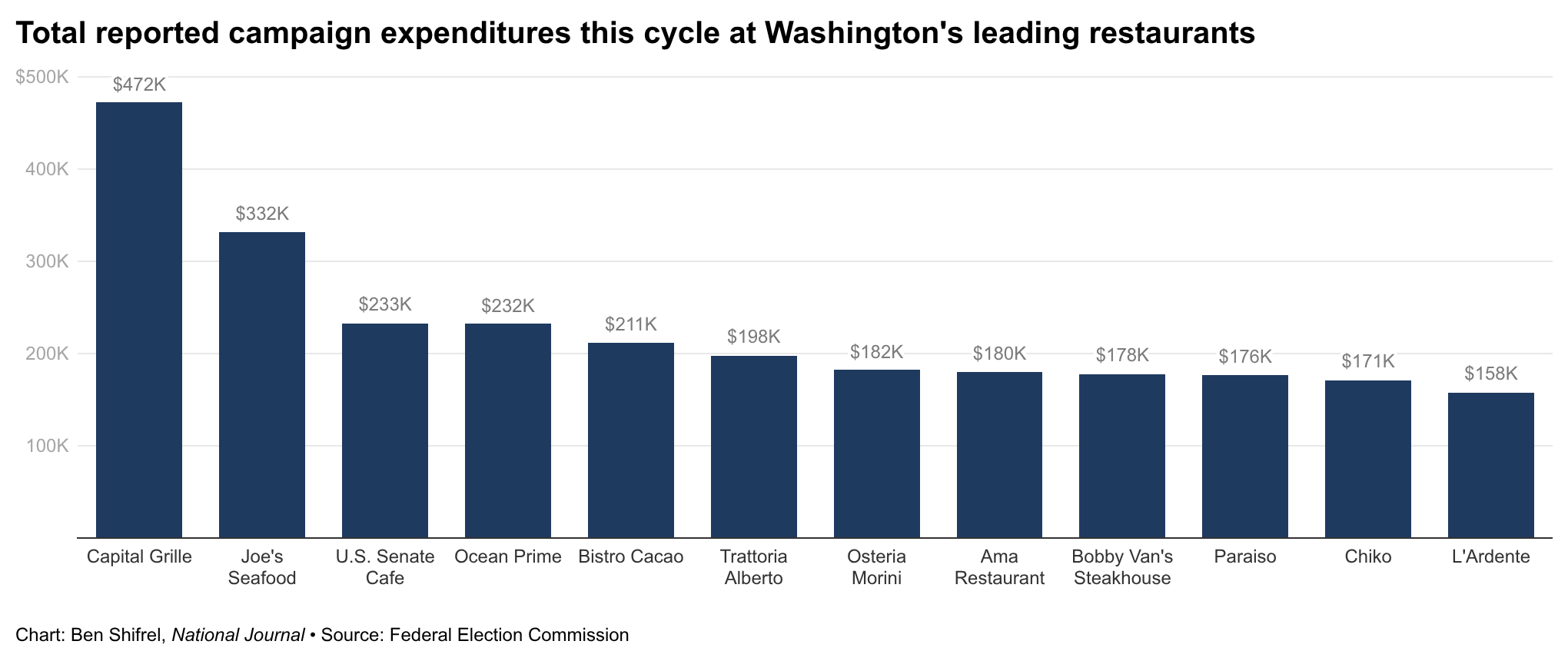
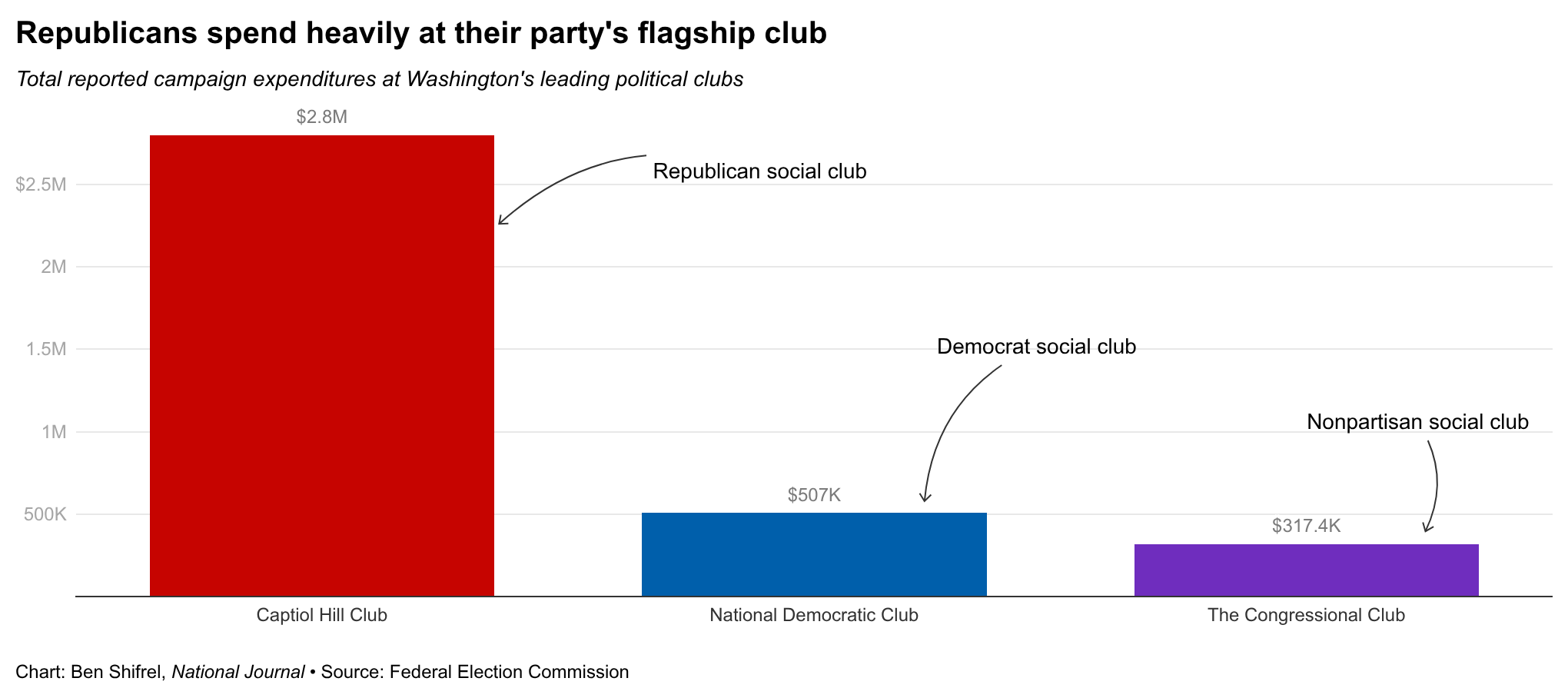
Federal election law allows campaign committees to use donor funds for meals and events that further campaign activity. Federal Election Commission data from the first half of the year shows where those dollars went. The largest share of campaign dining expenditures went to upscale restaurants and long-standing Washington institutions—including steakhouses, seafood restaurants, and Italian restaurants near Capitol Hill—that cater to business meetings, donor dinners, and private events. Political clubs also play a massive role in campaign spending, though the Republican-affiliated Capitol Hill Club received almost $2.8 million in reported campaign expenditures—more than five times what was spent at the National Democratic Club.
BEFORE YOU LOG OFF...
ISRAEL AID: More than 100 House Dems vote to cut off aid to Israel
An amendment to the appropriations bill that sought to cut aid to Israel, introduced by Rep. Thomas Massie, failed on a vote of 104-317-10, with 103 Democrats voting in favor, 98 Democrats voting against, and 10 voting present. Massie was the only Republican to vote in favor.
- ANALYSIS: This symbolic vote from Democrats highlights how contentious the issue is within the party. With Republicans still in the majority and no chance enough Republicans would cross the line to vote with Massie and the Democrats, voting for cutting aid was a great way for Democrats to signal to the activist base that they’re listening and are doing something—without the pressures of actually having to do something. If Democrats flip the House in November, votes like this will become much more important and much more divisive.
THAT’S NEW: Hegseth announces low-T screening for troops
Defense Secretary Pete Hegseth announced a new mandatory testosterone-level screening for service members aged 30 and over, including women. Hegseth said that the U.S. needs a “High-T Department of War,” citing the need to “optimize” troops’ “natural capability.”
- ANALYSIS: There are multiple levels to this new order. On the surface, it looks like another decision from Hegseth that was guided by “manosphere” influencers like Joe Rogan—as when Hegseth repealed the mandatory flu vaccination earlier this year and a flu outbreak subsequently sickened hundreds and killed one at Air Force basic training. Digging a little deeper, this mandate could have more implications for transgender service members and women—two groups Hegseth has made clear he doesn’t want in uniform. This screening could be used to identify transgender members or flag women with higher-than-average testosterone.
OIL ALTERNATIVES: Chevron looks to Iraqi pipeline to bypass Strait of Hormuz
Chevron said it plans to sign agreements to invest in two Iraqi oil fields and join a consortium studying a pipeline from northern Iraq to Syria's Mediterranean coast. The resulting export route would avoid the Strait of Hormuz.
-
ANALYSIS: If pipelines reduce reliance on the strait, Tehran could lose one of the most significant sources of geopolitical leverage that it has gained from the war. For the U.S., Chevron's involvement also aligns with the Trump administration's push to improve economic ties with Iraq and remove Baghdad's dependence on Iran.
STUDENT LOANS: Trump officials eye SBA-backed lending program
The Trump administration is looking into a new student-loan program to be run through the Small Business Administration that would fill financing gaps created by new federal borrowing caps. The proposal would not replace existing federal loans but could offer another option for students who need additional funding.
-
ANALYSIS: Republicans' overhaul of federal student aid left more students likely to turn to private financing. An SBA-backed program could help fill that gap, but if the administration moves forward, it would be another step in moving education policy outside the Education Department.
LABORATORIES OF DEMOCRACY
CONVERSATION STARTER
Did you see the mockup for the new $1 coin with President Trump’s face on it?
The U.S. Mint will soon start producing a new gold-hued $1 coin with the president’s face on it to commemorate America’s 250th anniversary. The coin, which is not made of real gold, features “In God We Trust” and the image of an eagle holding arrows and olive branches on the flip side. This is the latest Trump-branded government item to come out recently. Passports with the president’s face on them, Social Security cards with “Freedom 250” stamps, and his signature on new $100 bills have all been announced in commemoration of America’s 250th anniversary.