July 8, 2026, 3:42 p.m.
The Congressional Black Caucus has long been a legislative powerhouse. Until a few weeks ago, it appeared poised to gain even more influence.
Suddenly, thanks to an April Supreme Court decision and Republican-driven redistricting in GOP-leaning states, the caucus’s momentum is shaky at best and may be stalled outright.
It could shrink even further if President Trump is able to get Congress to pass the SAVE Act, which would require voters to provide ID and proof of citizenship, stoking fears that Black voters, who historically have faced intimidation at polling places, could again be subject to such treatment.
Some Black lawmakers are cautiously optimistic that the recent setbacks will trigger an outpouring of voter turnout, as Black voters and Democrats generally look to fight back.
“I think it’s incentivizing people to demonstrate that, whatever the courts do, people will go to the polls and demonstrate their opposition to it,” said Rep. Bennie Thompson, a veteran Mississippi Democrat.
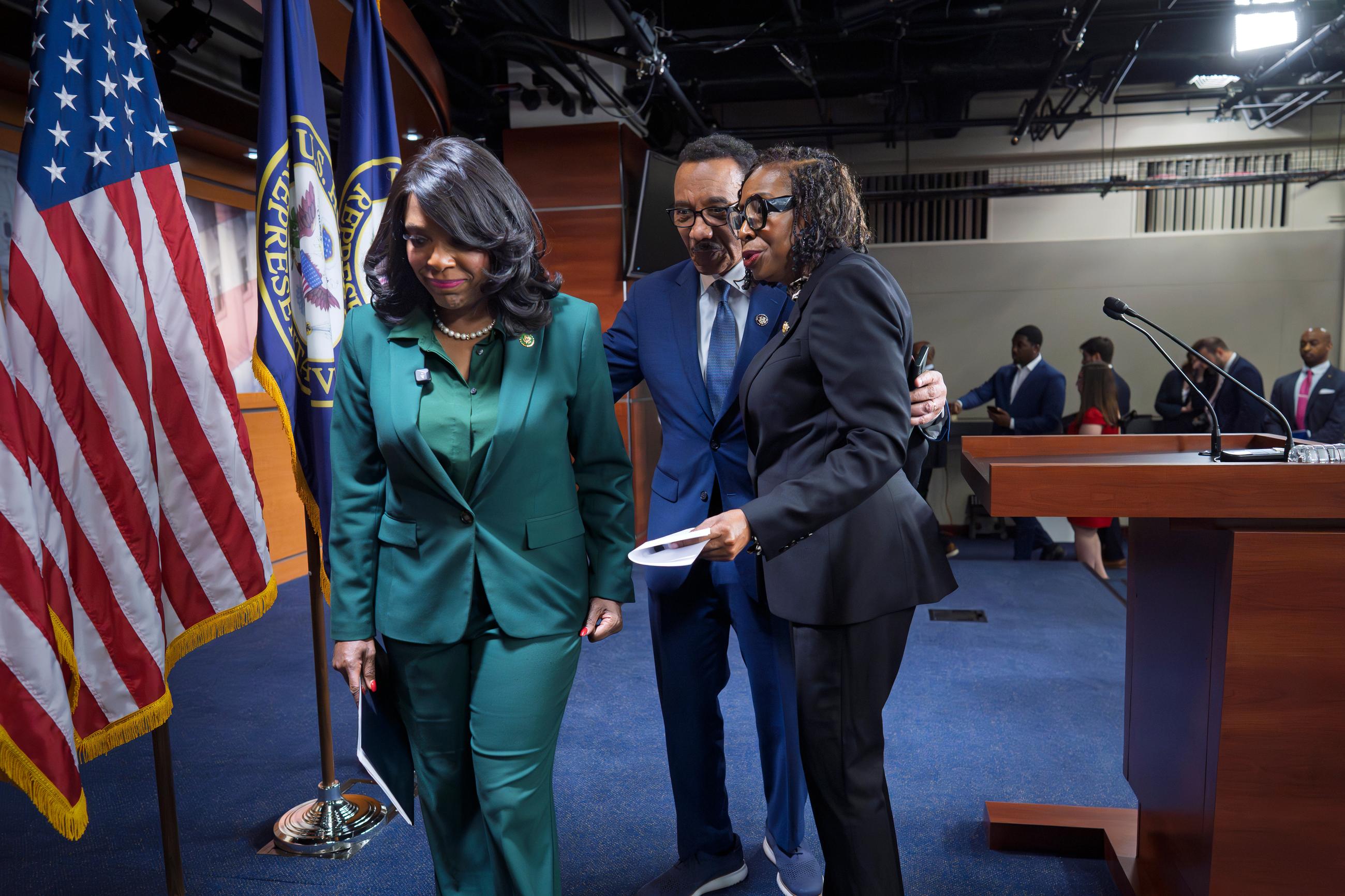
Congressional Black Caucus Chair Yvette Clarke agreed, though she also had a more tempered view of what’s ahead.
“I think that in the South, that has been a real disservice to Black communities,” Clarke said. “Their voices are now muted because they don't have the ability to have any continuity whatsoever in their representation.
“It's been short-circuited, and our hope is that we'll be able to overcome some of those gerrymandered districts.”
Emerging from the Civil Rights Era
The Black Caucus today has 60 members, making up a bloc that can provide an enormous chunk of the 218 votes needed for a House majority.
This spring, members eagerly looked forward to 2027. House Minority Leader Hakeem Jeffries would become speaker if Democrats win control of the chamber, the first Black member to have that job. Four veteran caucus members could become chairs of important committees.
Those hopes have cooled as this year’s redistricting efforts dismantled some of the caucus’s strongholds, redrawing some majority-minority districts to dilute the concentration of Black voters in a single district.
Then came the big blow: the April 29 U.S. Supreme Court decision in Louisiana v. Callais, which said the 61-year-old federal Voting Rights Act provided “no compelling interest” justifying the creation of a second minority-majority district in that state.
The VRA was a civil rights milestone that had once signaled a new era for Black political representation.
With Reconstruction coming to an end, federal troops left the South in 1877, taking with them minority voters’ best protection from intimidation. In Southern states, Black voters thereafter were subject to poll taxes, difficult literacy tests, or threats of violence.
“These and other voting barriers meant that, practically, African Americans remained disenfranchised throughout much of the South,” said a report from the nonpartisan Congressional Research Service.
Change came nearly a century later as the civil rights movement of the 1950s and 1960s spurred ratification of the 24th Amendment to the Constitution in 1964. It barred the poll tax or any other tax as a condition for voting.
A year later, President Lyndon Johnson signed the Voting Rights Act, which prohibited barriers to voting such as literacy tests. It created “preclearance,” which meant the Justice Department had to approve changes in voting procedures in certain places with a history of racial discrimination.
Dedrick Asante-Muhammad, president of the Joint Center on Political and Economic Studies, which studies Black issues, said that prior to the VRA, “Black political representation was not just limited—it was nearly nonexistent.”
The civil rights victories changed the political landscape dramatically.
“By dismantling formal barriers to voting, it opened the door to Black political participation and, over time, increased representation,” Asante-Muhammad said.
A high-water mark
In 1971, the House had 13 Black lawmakers. It’s now up to 64, although the four Black Republicans are not members of the Black Caucus.
Caucus members are the ranking Democrats on four major House committees: Financial Services (Rep. Maxine Waters); Homeland Security (Thompson);, Education and Workforce (Bobby Scott); and Foreign Affairs (Gregory Meeks).
But now a significant portion of the CBC is at risk.
Karen Dolan, senior fellow at the Institute for Policy Studies, a liberal research organization, estimated that one-third of the Congressional Black Caucus seats could be in play in November.
If caucus membership drops, so could its clout. Its members, usually almost all Democrats, have historically backed efforts to reform civil and worker rights, education, and health care.
“Without representatives of Black voters from the South, there would be no” Affordable Care Act, said Bishop William Barber II, founding director of the Center for Public Theology and Public Policy at Yale Divinity School. The ACA passed the House in 2010 by seven votes. No Republican voted for it.
The caucus has also been instrumental in securing funding for Historically Black Colleges and Universities, which the caucus says in its agenda statement “have always been agents of equity, access, and excellence in education—especially for students of color.”
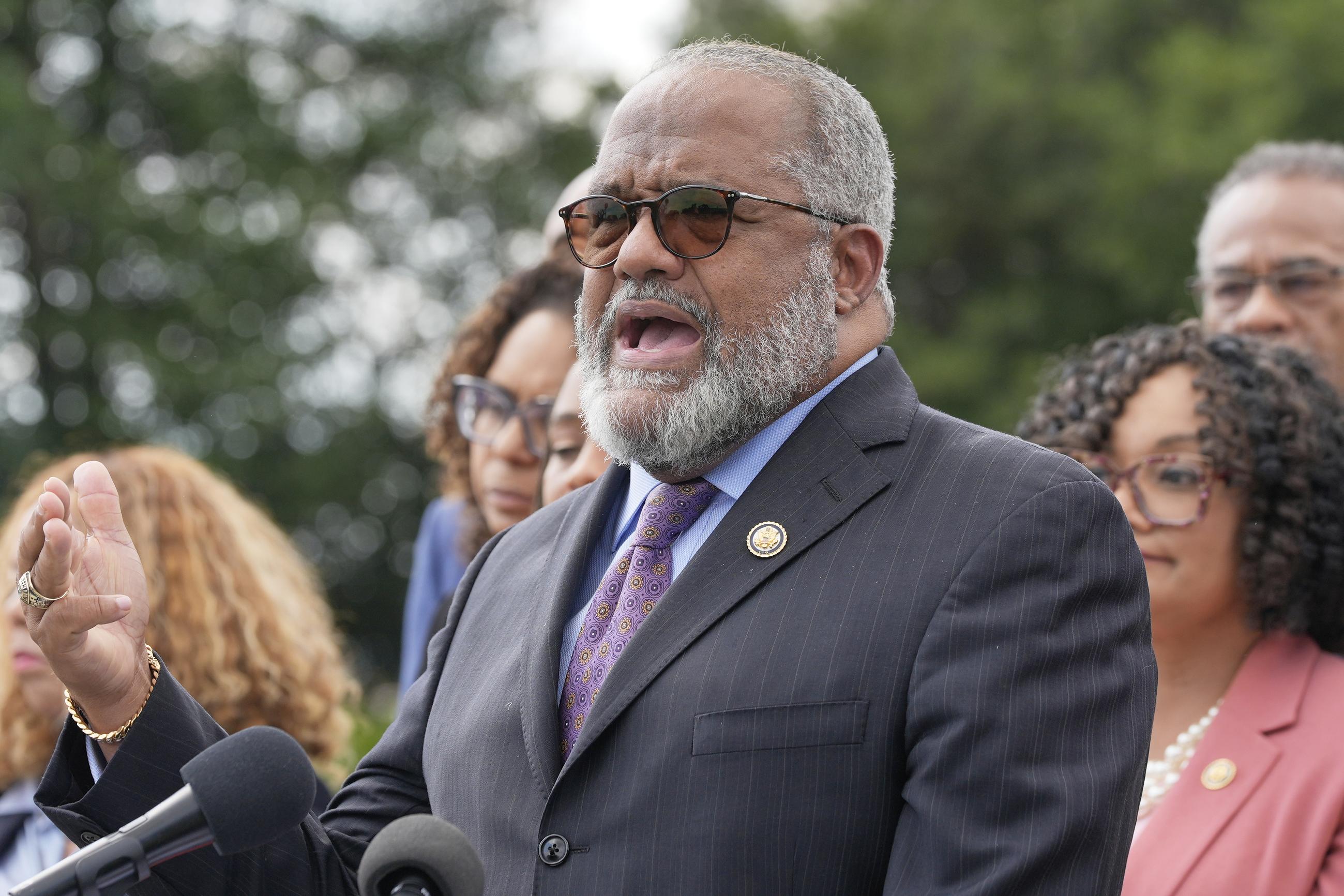
Rep. Troy Carter of Louisiana (AP Photo/Mariam Zuhaib)
None
The road ahead
This year’s redistricting efforts have created new districts in eight states that could help Republicans and in two that could help Democrats, according to the Center for Politics at the University of Virginia.
Republicans could gain as many as four seats each in Florida and Texas, and one seat each in Louisiana, Missouri, North Carolina, Ohio, Alabama, and Tennessee. Democrats stand to gain as many as five seats in California and one in Utah.
The House currently has 218 Republicans, 212 Democrats, and one independent who usually sides with Republicans. There are four vacancies.
Rep. Troy Carter, a Black Caucus member whose New Orleans-area district was retained while a second state majority-minority district was redrawn by Republicans, noted that about one-third of Louisiana’s population is Black.
"As a matter of fairness and representative democracy, African American voters should have a meaningful opportunity to elect candidates of their choosing,” he said.
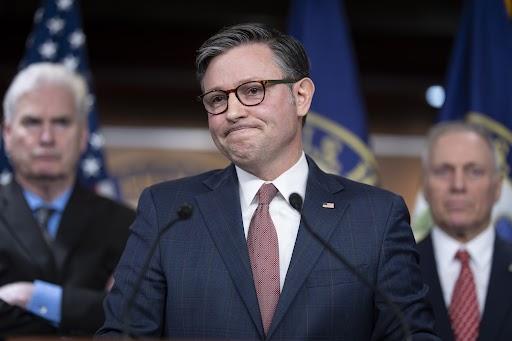
Conservatives saw the ruling differently. “The Court restored a simple but profound truth—yes, the Constitution protects every American equally, and that's a very important concept for us to maintain,” House Speaker Mike Johnson, a Louisiana Republican, told reporters. Kevin Roberts, president of Heritage Action, a conservative advocacy organization, said the ruling “reaffirms that the Constitution does not permit sorting Americans by race in the exercise of political power.”
Black lawmakers insist that supporters are ready to fight.
The Court decision “put a lot of people on the same page ... and that's a good thing,” Thompson said.
Carter maintained, “This is still America. This is not some third-world dictatorship, although this president seems to want that. There are a whole bunch of us that are going to fight … to make sure that never happens.”
Clarke, the caucus chair, is eager for that fight.
“We continue to see voting rights as our north star, so we're not going to stop agitating, mobilizing, activating around the issue,” she said. “It's a nonstop issue.”