National Journal Logo
×

Welcome to National Journal!

Enjoy this premium "unlocked" content until September 30, 2026.

Continue

Hotline's Senate Power Rankings

Primary season shakes up the Senate map.

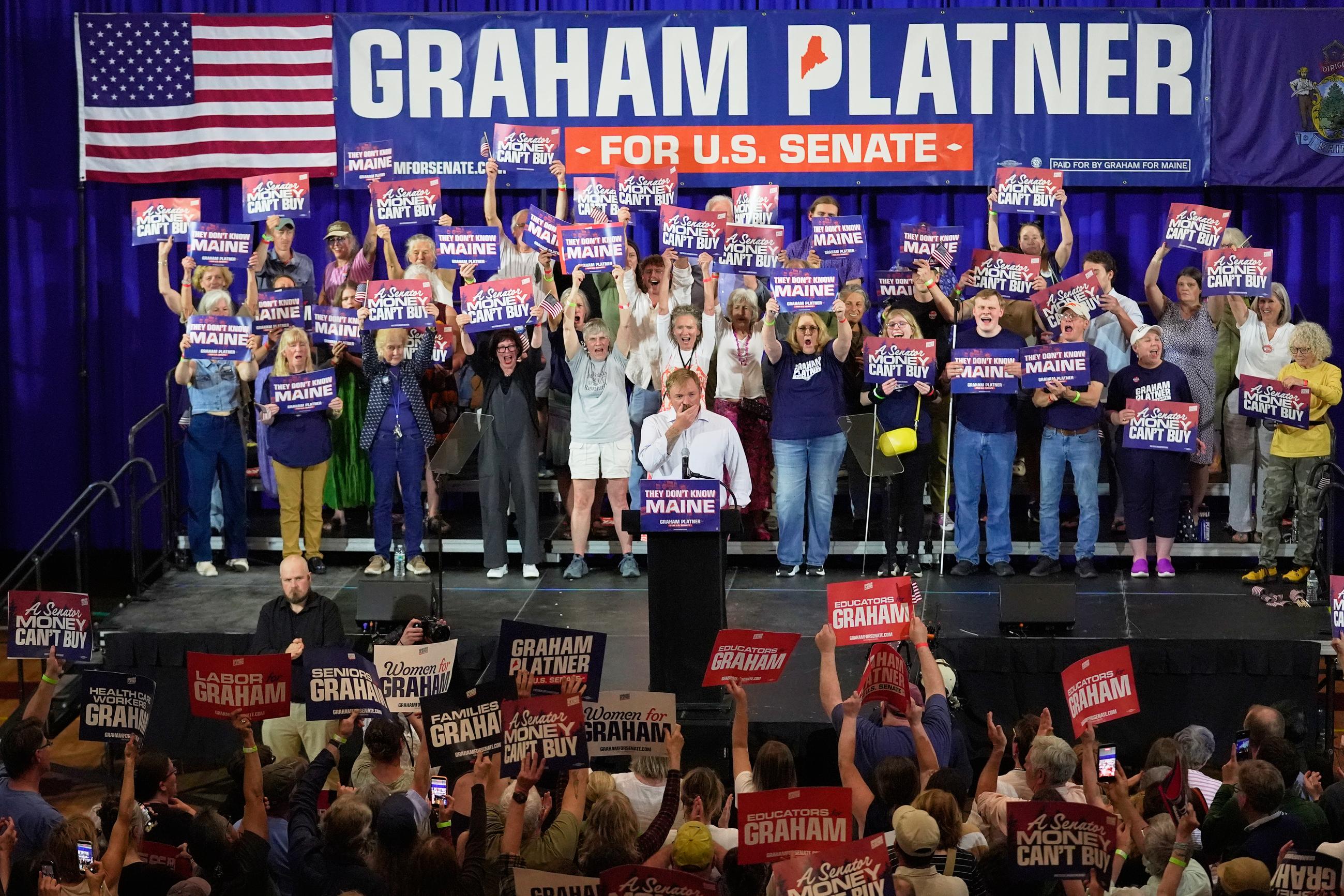
Democratic U.S. Senate candidate Graham Platner at a primary election night watch party in Blue Hill, Maine, on June 9 (AP Photo/Robert F. Bukaty)
AP Photo/Robert F. Bukaty
Add to Briefcase
Nicholas Anastácio and Kirk A. Bado
July 6, 2026, 6:47 p.m.

Democrats are inching closer to potentially flipping Senate control, but they are still the underdogs heading into November.

The minority party is sticking to its four-seat playbook in Alaska, Maine, North Carolina, and Ohio, while eyeing pickup opportunities in Iowa and Texas. A series of New York Times/Siena and Fox News/Beacon Research/Shaw & Company Research polls conducted last month found Democrats within reach of a Senate majority, albeit within the margin of error in many of the battleground states.

But Democrats have plenty of hurdles left to clear before Election Day. Senate Minority Leader Chuck Schumer scored his preferred nominee in Iowa, but oyster farmer Graham Platner’s scandal-plagued bid in Maine could doom any chance at the majority. Primaries in Democratic-held Michigan and Minnesota could shake up the Senate map further as moderate congresswomen battle local progressives backed by Sen. Bernie Sanders.

Republicans believe their committees’ financial advantages can forestall any Democratic momentum, especially after the Supreme Court struck down coordinated party-committee expenditure limits last week in National Republican Senatorial Committee v. Federal Election Commission.

The GOP-aligned Senate Leadership Fund plans to invest $342 million across eight battleground states, not including Minnesota and Texas. The Democratic-aligned Senate Majority PAC announced it intends to spend at least $185 million on television ad reservations in the same states.

These rankings are based on conversations with operatives, strategists, campaigns, and pollsters in both parties.

1. North Carolina: Open (R)

North Carolina hasn’t elected a Democrat to the Senate since Kay Hagan swept into office in 2008 on Barack Obama’s coattails. However, former Gov. Roy Cooper is in the driver’s seat in this race, Democrats’ best pickup opportunity. Public and private polling has shown Cooper comfortably ahead of former Republican National Committee Chairman Michael Whatley. Republicans acknowledge they have plenty of ground to make up before November, but they point to a few compounding factors that could break their way. First, Cooper’s massive cash-on-hand advantage isn’t quite the same edge as it was before the Supreme Court removed the campaign-committee coordinating limits. Cooper has $18.5 million on hand to Whatley’s $2.5 million, but the deep resources at the GOP campaign committees will help close that gap. Second, Republicans are banking on shifting the blame for voters’ concerns over public safety and the economy onto the former two-term governor. Cooper has never lost a statewide race, but it’s a long way until November.

2. Michigan: Open (D) ↑

Democrats’ prospects in holding Michigan are teetering as party members remain divided over who’ll take on former GOP Rep. Mike Rogers in November. State Sen. Mallory McMorrow’s departure from the Democratic primary race on Sunday solidifies an ideological showdown between moderate Rep. Haley Stevens and 2018 gubernatorial candidate Abdul El-Sayed, a progressive. Stevens, backed by Schumer and the party establishment, is banking her candidacy on electability, arguing she’s best suited to win over independents and moderates in the swing state. El-Sayed, endorsed by Sanders and Rep. Alexandria Ocasio-Cortez, posits he’s best positioned to expand the Democratic electorate, particularly younger voters and Arab American voters disillusioned with the party’s position on Israel’s war in Gaza. Whoever clears the bitter primary on Aug. 4 will have just three months to run a general-election campaign, whereas Rogers has had a clear path to the GOP nomination since he entered the race. Republicans prefer to face El-Sayed in November, viewing his progressive rhetoric as out of step with a state that narrowly backed President Trump in 2024. Democrats contend that the electoral environment will push their eventual nominee across the finish line.

3. Ohio: Sen. Jon Husted (R) ↑

If presented with a poll asking, “Who is your current senator: Jon Husted, Sherrod Brown, or Other?” Ohio voters might be hard pressed to get it right. Former Sen. Brown’s 2024 loss means that the last year and a half are the longest time he’s gone without holding some form of public office in decades, so voters might be forgiven if they think the Democrat is still in power. Husted and his allies want to turn that career into a liability for Brown. They are trying to tap into the anti-establishment wave that’s sweeping through Democratic primaries by painting the former senator as an antiquated and ineffective creature of Washington. That strategy hasn’t resonated with voters yet. For now, polling has shown Brown with a slight edge. The biggest variable in this race might be out of the control of both candidates—crypto money. In 2024, the crypto industry dumped more than $40 million into ousting Brown, the former chair of the Senate Banking Committee. Big tech has stayed on the sidelines for now, and Brown and his allies hope it stays there.

Alaska U.S. Senate candidate Mary Peltola (AP Photo/Becky Bohrer, file)
Alaska U.S. Senate candidate Mary Peltola (AP Photo/Becky Bohrer, file) AP Photo/Becky Bohrer

4. Alaska: Sen. Dan Sullivan (R) ↑

Sen. Dan Sullivan’s reelection was already difficult. Then the Republican incumbent gained a same-name challenger in former U.S. Forest Service employee Dan J. Sullivan, who says he’s also a Republican. Former Rep. Mary Peltola (D) is holding the senator’s feet to the fire, outraising him 5-to-1 last quarter and defying Democratic expectations in a Trump-won state. Available polling shows the former congresswoman ahead of Sen. Sullivan or within the margin of error, a promising prospect for Democrats’ majority hopes. Dan J. Sullivan is only complicating the senator’s reelection pitch, potentially confusing primary voters into advancing him to the four-way general election. Republicans are taking the political newcomer’s campaign seriously, modifying the incumbent’s name in advertising and seeking legal action against the other Sullivan. The incumbent’s allies point to his support from GOP Sen. Lisa Murkowski and his support for mandatory oil and gas leases in the North Slope. Democrats believe Peltola could unseat the senator with or without two Sullivans on the November ballot. Her supporters argue the fall contest will be a referendum on the senator himself.

5. Maine: Sen. Susan Collins (R) ↓

Platner’s campaign is flailing. New revelations about his past digital activities and his alleged treatment of women have tanked his public perception in Maine, raising alarm bells for Democratic strategists. The most recent scandal involves serious allegations of sexual assault five years ago, which Platner denies. As of publication, he is “taking time to reflect on the best path forward.” Maine law stipulates that the state party can replace Platner if he were to withdraw from the race by July 13. At this point, replacing Platner might be the only way to salvage this race. Yes, it’s true that Platner cruised to the nomination in June without a significant protest vote and that he has inspired a movement in the state that could have seriously threatened Collins, but this personal baggage might be too much to overcome. Independent women voters will be a critical voting bloc, and the allegations against Platner have sent his numbers with this key group spiraling. Collins, running for her sixth term, is staring down some of the worst approval ratings of her career. Any generic Democrat has more than a puncher’s chance to beat her, and at this point, that might be just what Democrats need.

6. Georgia: Sen. Jon Ossoff (D) ↓

Ossoff and Democrats got the Republican nominee they wanted in Rep. Mike Collins. After popular two-term Republican Gov. Brian Kemp passed on a bid, a bottleneck of B-list Republicans jockeyed to take on Ossoff. Nicknamed “MAGA Mike” Collins, the trucking magnate and two-term House Republican performed the worst in the swing counties around Atlanta during the GOP primary runoff with former Tennessee University football coach Derek Dooley, the more moderate candidate in the overtime period. Democrats will have an easy time tying Collins to the unpopular president, and Ossoff has the massive cash advantage to litigate his case. The campaign is going so well for Ossoff there’s already chatter he might run for president in 2028. But he has to win reelection first.

7. New Hampshire: Open (D) ↓

One last name is keeping the Granite State Senate race competitive: Sununu. The Sununu name has long been a winner in New Hampshire races for elective office, from the House chamber to the Senate halls to the governor’s mansion. Republicans are hoping to extend that legacy to elect former Sen. John E. Sununu and flip the Democratic-held seat, banking on the popularity of his brother, former Gov. Chris Sununu. Democrats are prepared to defend the open seat, having recruited Rep. Chris Pappas into the race early last year. Both Pappas and Sununu face contested primaries in September, but they are expected to face off this fall in what will likely be the most competitive Senate race in New Hampshire since 2016.

Rep. Ashley Hinson of Iowa speaks during a campaign rally in West Des Moines on May 30. (AP Photo/Charlie Neibergall)
Rep. Ashley Hinson of Iowa speaks during a campaign rally in West Des Moines on May 30. (AP Photo/Charlie Neibergall) AP Photo/Charlie Neibergall

8. Iowa: Open (R)

A bevy of high-profile races in the Hawkeye State are encouraging Democrats in this GOP-held seat. Schumer got his preferred pick—state Rep. Josh Turek—in the Democratic primary, but it took VoteVets spending eight figures on his behalf. Republicans argue that Rep. Ashley Hinson is prepared for prime time, pointing to her electoral experience and her congressional record, including pushing for year-round E15 gasoline. Hinson also outraised Turek ahead of the June primary, adding to Republicans’ larger financial investment in the race. Democrats’ challenge, as it is elsewhere on the Senate map, will be winning in a state that Trump won by double digits. They argue the congresswoman is tying herself too closely to the president, standing behind his tariff policy and his war in Iran. Turek’s supporters contend that his personal story as a prairie populist who was born with spina bifida could better resonate with voters in an anti-incumbent wave. They also hope that Democratic state Auditor Rob Sand’s spirited run for governor energizes the party's voters up and down the ticket.

9. Texas: Open (R)

State Attorney General Ken Paxton (R) has more baggage than the Dallas-Forth Worth Airport on the day before Thanksgiving. He’s going through a messy divorce, he’s been indicted on fraud charges, he was impeached by the GOP-controlled state House, and he has a huge financial disadvantage to the Democratic nominee, state Rep. James Talarico. Yet despite all these challenges, he’s still the slight favorite in November thanks to partisan politics. A Democrat hasn’t won statewide since 1994, and Talarico, a progressive from Austin, has made plenty of left-leaning public comments that could make moderate Republican voters skeptical. Outside investments will be key in this race—Paxton will need a major cash infusion from either the NRSC, the GOP-aligned SLF, or Trump's vast resources at MAGA Inc. to get him over the line. This is not a race Republicans had budgeted for before Paxton defeated Sen. John Cornyn thanks to Trump’s endorsement. In some operatives’ minds, if the president broke it, then the president should be responsible for burdening the financial load.

10. Minnesota: Open (D)

The Democratic primary to succeed retiring Sen. Tina Smith is anything but "Minnesota nice." Lt. Gov. Peggy Flanagan and Rep. Angie Craig are locked in a battle centered around ideological consistency and electability. Flanagan—endorsed by the Democratic-Farmer-Labor Party, Smith, and several progressives within her party—criticizes Craig’s splits from Democrats, including her now-regretted vote for the Laken Riley Act. Craig argues that Flanagan is a general-election liability because the GOP can tie her to the state social-services-fraud scandal. Yet Democrats maintain that whoever wins the nomination will hold the seat this fall. Former sportscaster Michele Tafoya leads the GOP field ahead of the Aug. 11 primary, but she’ll have to fight for the nomination and dip into her campaign cash after losing the state GOP endorsement to former Navy SEAL Adam Schwarze. Neither SLF nor SMP have announced ad reservations in Minnesota, potentially putting the onus on candidates to boost themselves ahead of Election Day.

Welcome to National Journal!

Enjoy this featured content until September 30, 2026. Interested in exploring more
content and tools available to members and subscribers?

×
×

Welcome to National Journal!

You are currently accessing National Journal from IP access. Please login to access this feature. If you have any questions, please contact your Dedicated Advisor.

Login