Every time President Trump promises, like King Canute, to command the economic tides that have put the coal industry on its death bed, I can’t help but think of William Smiley Smith. He was an Ohio painter more than 100 years ago who, like Trump, stubbornly insisted that a once-thriving domestic industry could be restored to its previous health.
Smith was my great-grandfather. Born two years after the Civil War, he died six years after the end of World War II. From his teen years on, he worked for companies with “buggy,” “wagonworks,” or “carriage” in their names. His job was painting wagons to be pulled by horses. And he wasn’t about to let the industry he loved go down just because folks like Henry Ford, Alexander Winton, and Ransom Olds now were making motor cars.
His wrong-headed odyssey is part of family lore. Over a four-decade career, he chased jobs, working for 12 different companies in six different states. A widower, he left his two sons behind in Springfield as he moved to Owensboro, Kentucky; Florence, Alabama; East Point, Georgia; Hamilton, Ohio; Cincinnati; Chicago; Carthage, Ohio; Detroit; Toledo; and eventually back to Springfield. Finally, with no real choice left, he embraced the future and began working on the newfangled, horseless motor machines.
Today, Trump is trying to succeed in a nostalgic rescue mission where Smith failed. His commitment to the battle first surfaced in 2016 when he traveled to West Virginia to take advantage of a campaign gaffe by Hillary Clinton, his Democratic opponent. At a CNN town hall in Ohio in March, she had curtly said her presidency would “put a lot of coal miners and coal companies out of business.”
In May, Trump wanted to remind voters in Coal Country of her mistake, so he went to Charleston. There, a grandmother who had driven two hours to see the candidate told The Washington Post, “West Virginia is big with coal; that’s our heartbeat. I think he really cares about us, no matter how crazy he gets.” In turn, Trump promised the miners that the revival of coal is “going to happen fast, and you’re going to be back to better than ever.”
But his promised recovery failed to materialize during his first term. When Trump took office, the coal industry employed 51,000 workers, down from almost 890,000 at its peak in 1923. When he left office four years later, that number had dropped to 38,000, according to the Bureau of Labor Statistics, as 75 coal-fired power plants closed on his watch. It then actually rebounded under President Biden, rising to 42,300 jobs by the end of his term. Today, it has dropped again under Trump to its current level of 38,700.
That job loss came despite an aggressive push by Trump's whole administration to eliminate regulations, waive environmental restrictions, block planned closings of old coal plants, and cut aid for competing forms of energy. The Interior Department in January even introduced a cuddly coal mascot—a cute lump of coal with googly eyes, a wry smile, and a yellow miner’s helmet. They named him “Coalie.”
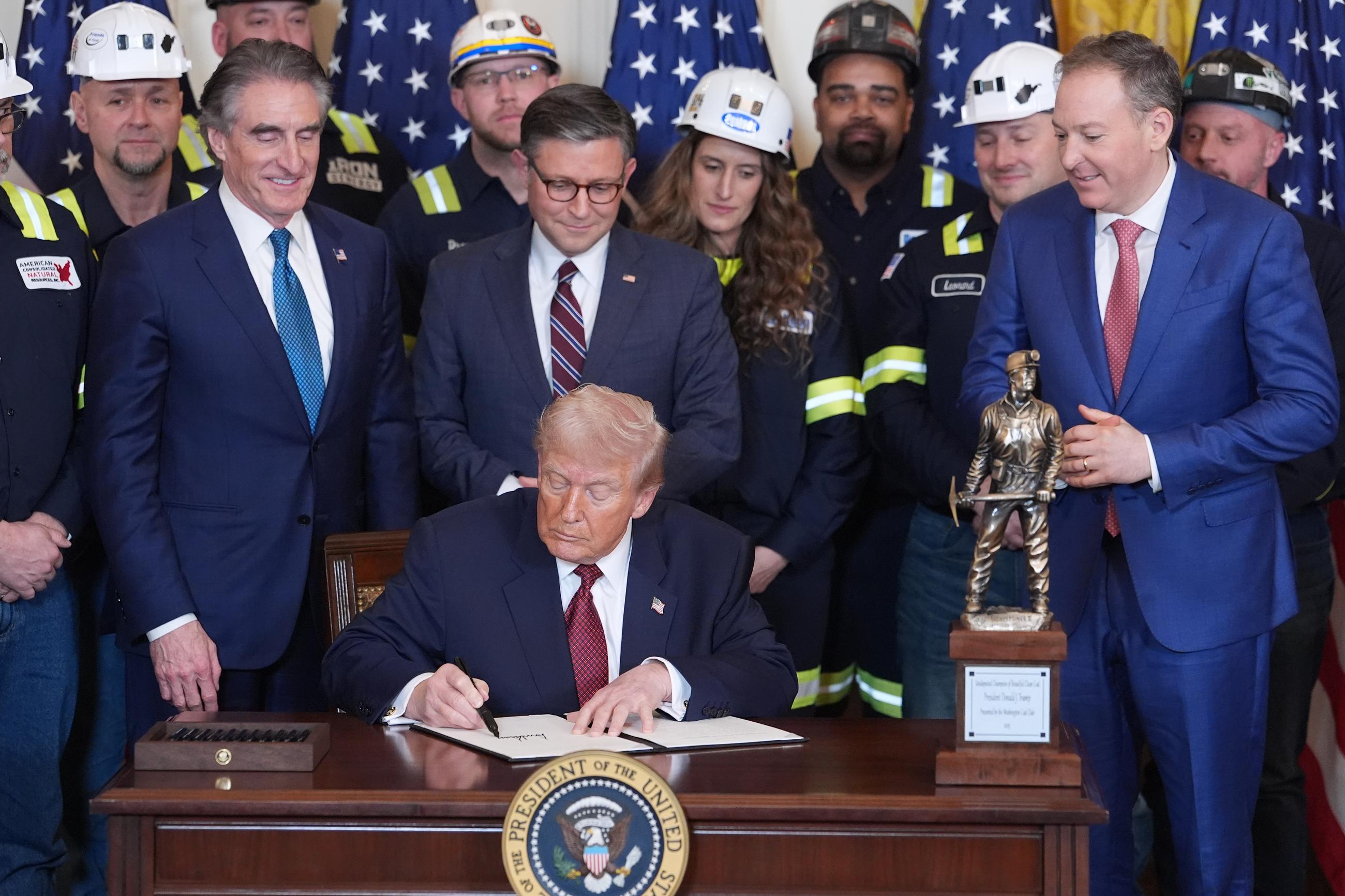
In April last year, Trump signed four executive orders while hard-hatted miners watched in the Oval Office, cheering when he said, “We’re bringing back an industry that was abandoned.”
In February this year, he used wartime powers to order the military to buy power from coal plants. He announced $700 million in funding for coal plants. In return, the president and CEO of the National Coal Council presented him with a trophy proclaiming him “Undisputed Champion of Beautiful Clean Coal.”
Then, earlier this month, Trump declared a “national energy emergency,” claiming his actions would save 42 coal mines.
At all the events, he noted, “I know you well. I think I get 97 percent of your vote.” It is a Trumpian exaggeration. But he did reap political benefits from his crusade. In all three of his elections, his two best states were Wyoming and West Virginia, the two biggest states for coal production.
The economic and environmental benefits for the country are less clear. Citing the “fundamentals of coal economics,” Bryan Hubbell, a senior fellow at Resources for the Future,” said not even a president can “wish that away.”
Hubbell, who is an expert on air pollution, said the president’s moves are “frustrating because these are not clean technologies” and because they disrupt what had been a move toward cleaner energy. “The markets were driving us in the direction they should. And now we have a government that’s interfering with the markets to try to keep something going that really is not the best source of energy.”
With the increased demand for electricity for data centers, Hubbell said Trump’s actions could buy as much as four years extra for some coal plants. But over the long term, their fate is unchanged.
The combination of government intervention and even the mascot Coalie are “giving false hope” to communities that, under Biden, were shifting to renewables, he said. “It gives them a lifeline to keep doing what they were doing. But it just delays the transition, which will ultimately be costly.”
Gordon Hanson, the Peter Wertheim professor in Urban Policy at Harvard University’s Kennedy School, has studied how energy transition affects local labor markets. To him, Trump’s policies are driven more by “nostalgia” than by economics. “What we’re watching is just performative politics, and the economic impacts are going to be minimal,” Hanson told National Journal. What Trump sees as a liberal “war on coal” is not what caused the decline in the industry. What sealed the fate of coal was when fracking unlocked sufficient natural-gas reserves around 2010.
“Trump is scoring political points by saying he’s taking on this left-wing conspiracy to make everything renewable,” Hanson said. “But in truth what he’s fighting is very strong market forces to replace coal with gas.”
He added that the end result of Trump’s orders will be less than promised: “Whatever they’re announcing, the amount that will actually flow is likely to be substantially less because these things just aren’t economically viable in the end.”
To a president wedded to an old technology and appealing to workers who don’t want to give up the livelihood to which they've been accustomed, it will take more than economic facts to persuade him that he cannot thwart progress.
More than 100 years ago, William Smiley Smith learned King Canute's lesson that no single man can command the tides, economic or otherwise. Today, though armed with all the powers of the federal government and willing to spend millions of dollars to get his way, Trump may be facing a similar lesson—no matter how many executive commands he issues.