
June 24, 2026, 2:41 p.m.
The president who led America's 200th Independence Day celebration a half-century ago would, to put it mildly, have zero use for President Trump’s gaudy 250th-anniversary reprise—and vice versa.
In 1976, Gerald Ford hoped to reunify a country recovering from seismic shocks—Vietnam, a presidential resignation, and crippling economic baggage. He wanted to reassure fellow citizens that, although bruised and battered, America was still standing, a brighter future in sight.
Essentially, Ford hoped to rekindle The Spirit of ‘76.
By contrast, Donald Trump has promised the semiquincentennial celebrations will be “the most spectacular birthday party in the history of the world.”
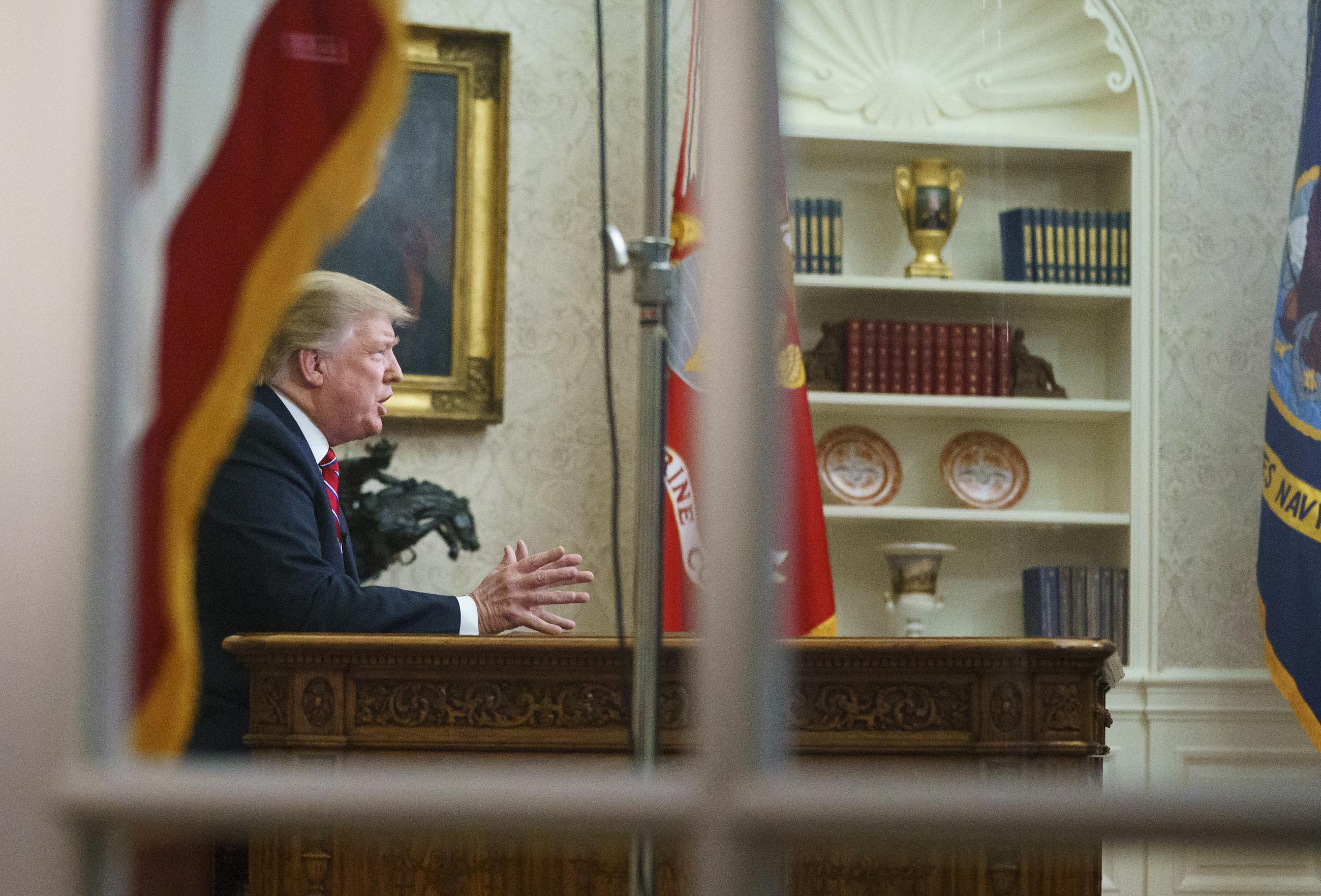
The impresario-in-chief has unleashed the full force of his towering self-esteem and unbridled showmanship for the 250th festivities, triggering charges that what should be a unifying event has regressed into a self-aggrandizing, unseemly, partisan spectacle—as evidenced by Trump kicking off his "Great American State Fair" on the National Mall Wednesday night with a rally-style speech after many of the performers had bailed out of the planned music festival.
That comes after last week's mixed-martial arts cage fight on the White House South Lawn for Trump's own birthday, and ahead of a Grand Prix race around the National Mall and a world-record-busting fireworks extravaganza.

The UFC Freedom 250 event on the South Lawn of the White House on June 14 (AP Photo/Mark Schiefelbein)
AP Photo/Mark Schiefelbein
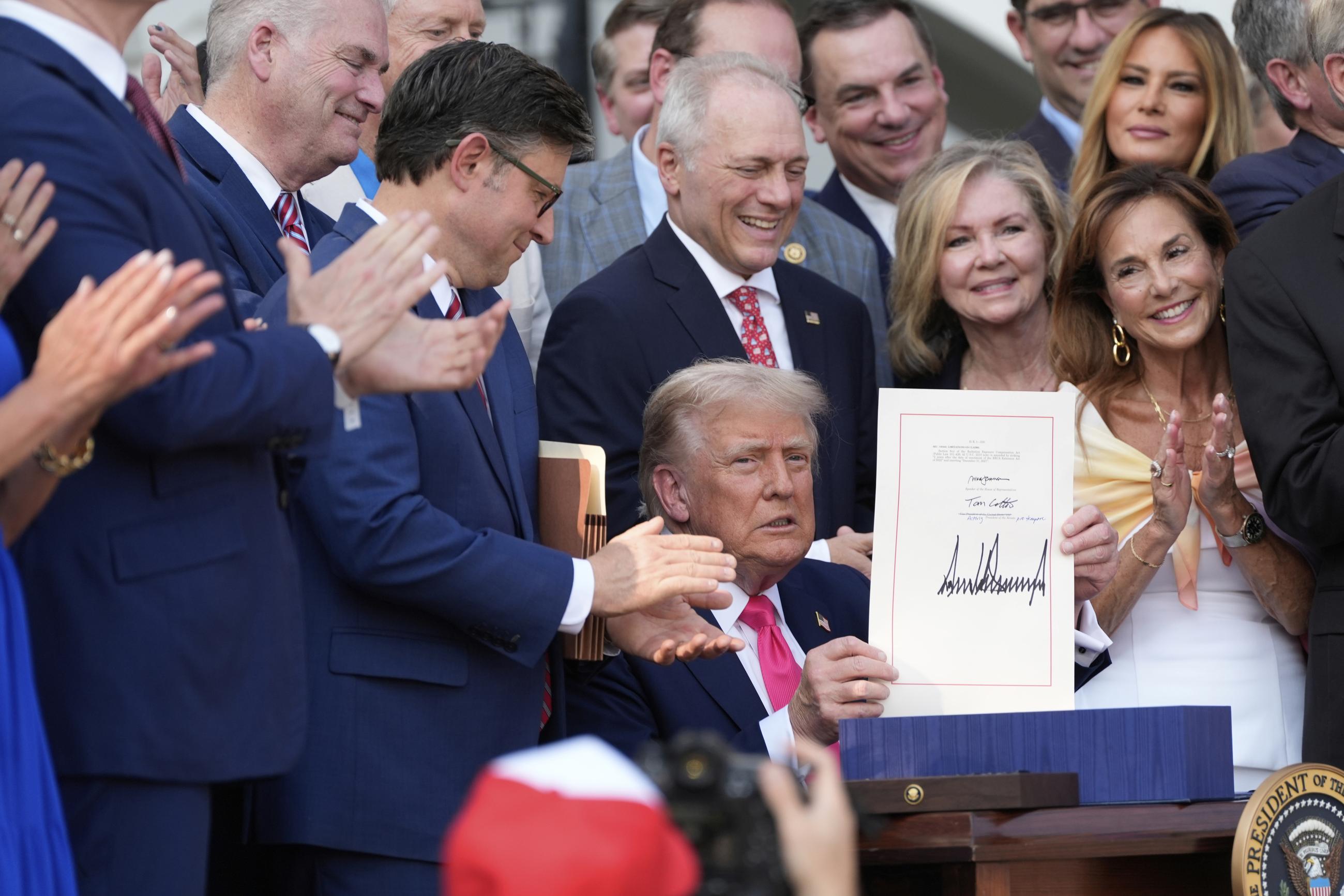
Trump has also slapped his name and image on passports, coins, paper currency, and government buildings, and ordered up highly unpopular monuments like a triumphal arch to memorialize “the Number One Attraction Anywhere in the World,” as he recently called himself.
He's created a Trump-aligned Freedom 250 group overshadowing—and outspending, with the largesse of private donors—the official America 250 organization created by Congress.
None of this would sit well with Ford, according to a prominent Republican business executive and former aide heavily involved in Bicentennial planning, who requested anonymity for fear of reprisal by Trump loyalists.
“Ford had a profound sense of modesty and personal integrity,” the former aide told National Journal. “Trump has neither. If Ford were around today, he’d be appalled at the reality-show spectacle of this self-absorbed ‘celebration.’ He would be in total disbelief anything this tacky could actually happen.”
Trump officials vigorously reject such critiques as groundless, petty, and politically motivated.
“President Trump is ensuring that America gets the spectacular birthday it deserves,” White House spokesman Davis Ingle said. “The celebration of America’s 250th anniversary is going to display great patriotism in our nation’s capital and throughout the country, and the president is proud to participate in our historic semiquincentennial celebration. Only people who suffer from a severe case of 'Trump Derangement Syndrome' would find a problem with that.”
For his part, Trump would surely dismiss Ford’s Bicentennial game plan as boring at best, lacking the pageantry and chutzpah he unabashedly craves. He’d also look askance at Ford’s unusually strong embrace of America’s diversity in his Bicentennial events as an example of "woke" nonsense.
Admittedly, by contemporary standards the Bicentennial might seem low-decibel, and definitely light on glitz. But at a historical juncture when the country needed stability and reassurance, Ford’s birthday vision met the moment.
In strategizing for 1976, Ford and his speechwriters first reviewed President Ulysses S. Grant’s performance a century earlier and were unimpressed.
The 1876 main event wasn’t even on the Fourth of July, nor in Washington, but rather on May 10 in Philadelphia, where Grant opened the Centennial Exposition, America’s first World's Fair. He was welcomed by 100,000 cheering spectators and serenaded by a 1,000-person chorus singing the “Centennial Hymn.”
Grant's remarks were brief and prosaic. His best quote was underwhelming: “While we are proud of what we have done, we regret that we have not done more. Our achievements have been great enough, however, to make it easy for our people to acknowledge superior merit wherever found.”
It wouldn’t be difficult for the 38th president to outdo the 18th, which might explain why frustrated Ford aides whispered that he was slow to engage. But in April of 1975, after visiting Boston’s historic Old North Church (“one if by land, two if by sea”), then Lexington Green and Concord Bridge, where the Revolutionary War began, Ford succumbed to Bicentennial Fever.

A collection of memorabilia and souvenirs from the 1976 Bicentennial displayed at the Ford Library and Museum
Ford Library and Museum
Instead of Grant’s single-shot format, Ford told aides to schedule multiple appearances and lectures over several days.
He stipulated forward-looking remarks; the Bicentennial shouldn’t be viewed solely as an antiquity, he told advisers, but offer continuing relevance for future generations.
Ford prescribed 10- to 12-minute drafts, and wanted them down-to-earth, reflecting his unassuming, Midwestern style.
“Noble and profound thoughts can be expressed in direct and simple words as Jefferson and Lincoln did,” a White House staff memo noted. "Any whiff of pomposity or pretentious elegance must be avoided.”
He also wanted a unifying theme, considering seven options before settling on “The American Adventure.”
Ford liked “Adventure” because “it conveyed a sense of excitement where you don’t quite know how things are going to come out in the end,” senior aide and longtime counsellor Robert Hartmann told a reporter at the time.
The Bicentennial launched on the muggy Thursday of July 1, 1976, on the National Mall, where Ford dedicated the imposing National Air and Space Museum.
“The hallmark of the American adventure,” he said, “has been a willingness—even an eagerness—to reach for the unknown. … The best of the American adventure lies ahead.”
The highlight wasn’t Ford’s uplifting text, but a snazzy high-tech assist from the Viking I spacecraft circling Mars.
Midway through the program, a signal from Viking activated a 10-foot, copper-colored boom straddling a red-white-and-blue ribbon stretched across the museum’s entrance.
With a wisp of smoke and cries of “it’s moving, it’s moving,” the arm burned through the ribbon.
“The most expensive pair of scissors that man has ever made,” Ford quipped.
That was the only instance of Trumpian-style pizzazz in Ford’s five-day itinerary. Everything else was plain-vanilla patriotism.
Over the next 48 hours, Ford inspected the yellowed originals of the Declaration of Independence and the Constitution at the National Archives, and hosted an “Honor America” gala at the Kennedy Center featuring Bob Hope, the Mormon Tabernacle Choir, Art Linkletter, and the Rev. Billy Graham.
Early on the morning of July 4, Ford helicoptered to a fogged-in Valley Forge, Pennsylvania, where George Washington’s bedraggled Continental Army suffered through the winter of 1777-8. Then he flew to Philadelphia, speaking from Independence Hall, where the Declaration was signed, to a crowd estimated at 1 million, plus a live television audience.
“The struggle for life, liberty, and the pursuit of happiness is never truly won,” Ford declared. “Liberty is a living flame to be fed, not dead ashes to be revered.”
Before returning to Washington to watch fireworks from the Truman Balcony, Ford journeyed to New York, boarding the aircraft carrier Forrestal to watch a parade of tall ships sail up the Hudson River.
By most accounts, the day lived up to Ford’s expectations.
“Rarely in the history of the world had so many people turned out so spontaneously to express the love they felt for their country,” he recalled in his memoir. “Not a single incident marred our festival. The nation’s wounds had healed. We had regained our pride and rediscovered our faith and … laid the foundation for a future that had to be filled with hope.”
Even so, Ford wasn’t finished celebrating; he couldn’t squeeze everything into four full days. So he helicoptered to Charlottesville, Virginia, for the finale—a naturalization ceremony for hundreds of immigrants in the backyard of Thomas Jefferson’s Monticello estate.
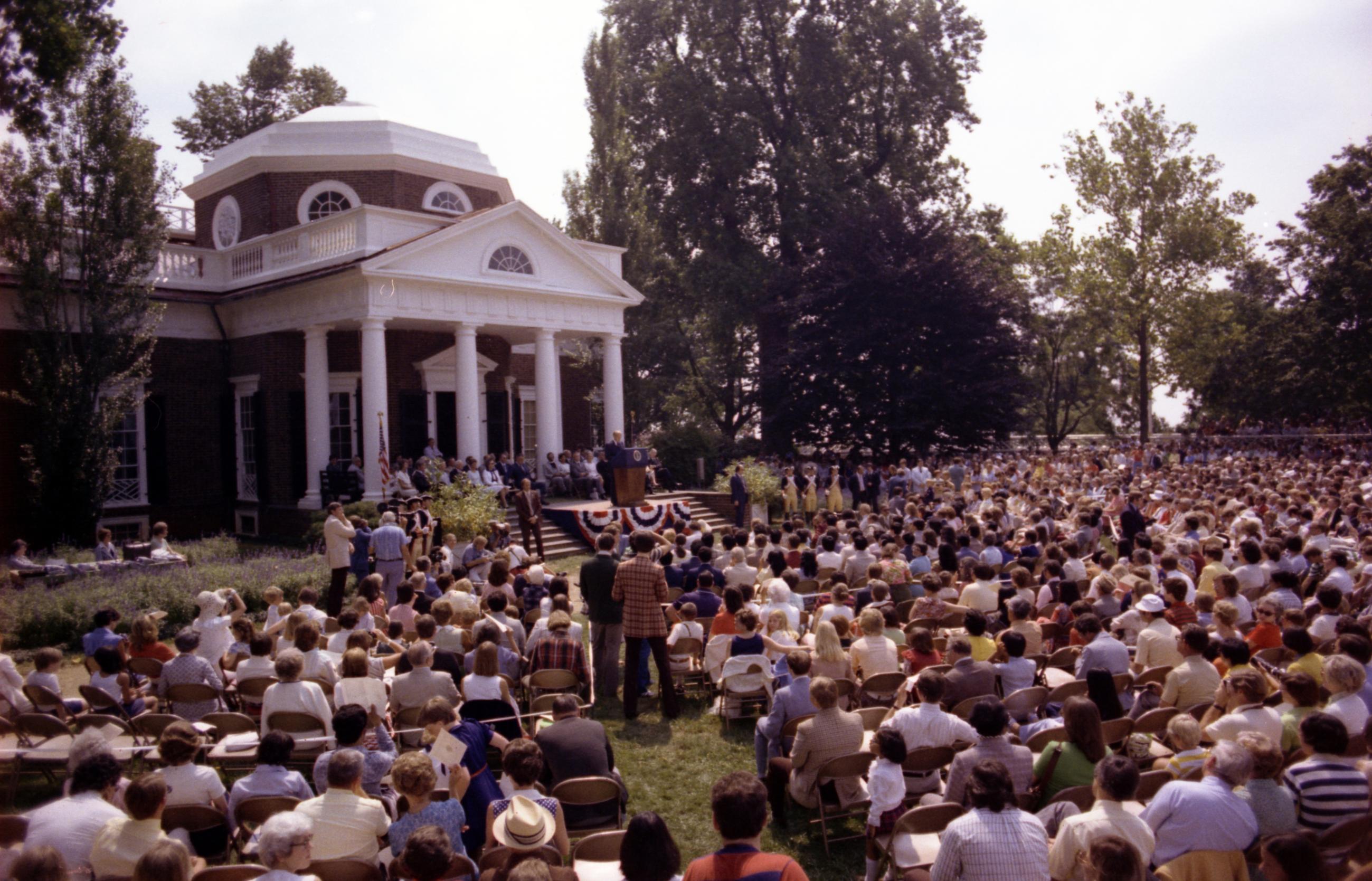
President Ford presides over a naturalization ceremony in Charlottesville, Virginia, on July 5, 1976, as part of America's Bicentennial celebrations.
Ford Presidential Library and Museum
“The July 5th speech was as good as any he gave in his presidency,” Ford biographer Richard Norton Smith told National Journal. “It’s not hard to draw an implicit contrast to today. That speech is extraordinarily relevant to our own time.”
“To be an American is to subscribe to … liberty and justice, equal rights, and equal opportunity,” Ford told new citizens. “These beliefs are the secrets of America's unity from diversity—in my judgment the most magnificent achievement of our 200 years as a nation.”
His embrace of America's melting-pot heritage wouldn’t sit well with Trump’s dogma; his Defense secretary, Pete Hegseth, has dismissed "diversity is our strength" as “the single dumbest phrase in military history.”
Two days after the Charlottesville ceremony, Ford still exuded a Bicentennial glow when welcoming Queen Elizabeth II to the White House. “Something wonderful happened to America this weekend,” he enthused. “A spirit of unity and togetherness deep within the American soul sprang to the surface in a way that we had almost forgotten.”
Even by his own admission, Jerry Ford wasn’t a great orator. But for one reading his Bicentennial texts a half-century later, his words are eloquent, inspirational, aspirational, and often moving.
That’s not the likely outcome this Fourth of July.
As in 1976, America’s 250th finds the country divided and fractious. Yet despite the then-unpopular pardon of his predecessor, Richard Nixon, Ford wasn’t a polarizing figure, unlike the 47th president.
“The mood of the country in 1976 was [also] not the best,” said Scott Kaufman, a history professor at Francis Marion University. “The celebration gave Ford the opportunity to think about 200 years of history and take the focus away from all those bad things people were feeling.”
A half-century later, Trump has the same opportunity.
“But Ford celebrated the country, not himself,” Kaufman added. “That is not what we have in the White House today. Trump cares about Trump, and his handling of 2026 has been horrifically bad. That makes it harder for Americans to come together.”