May 28, 2026, 3:53 p.m.
Democrats are turning to God as they try to win competitive races across the country.
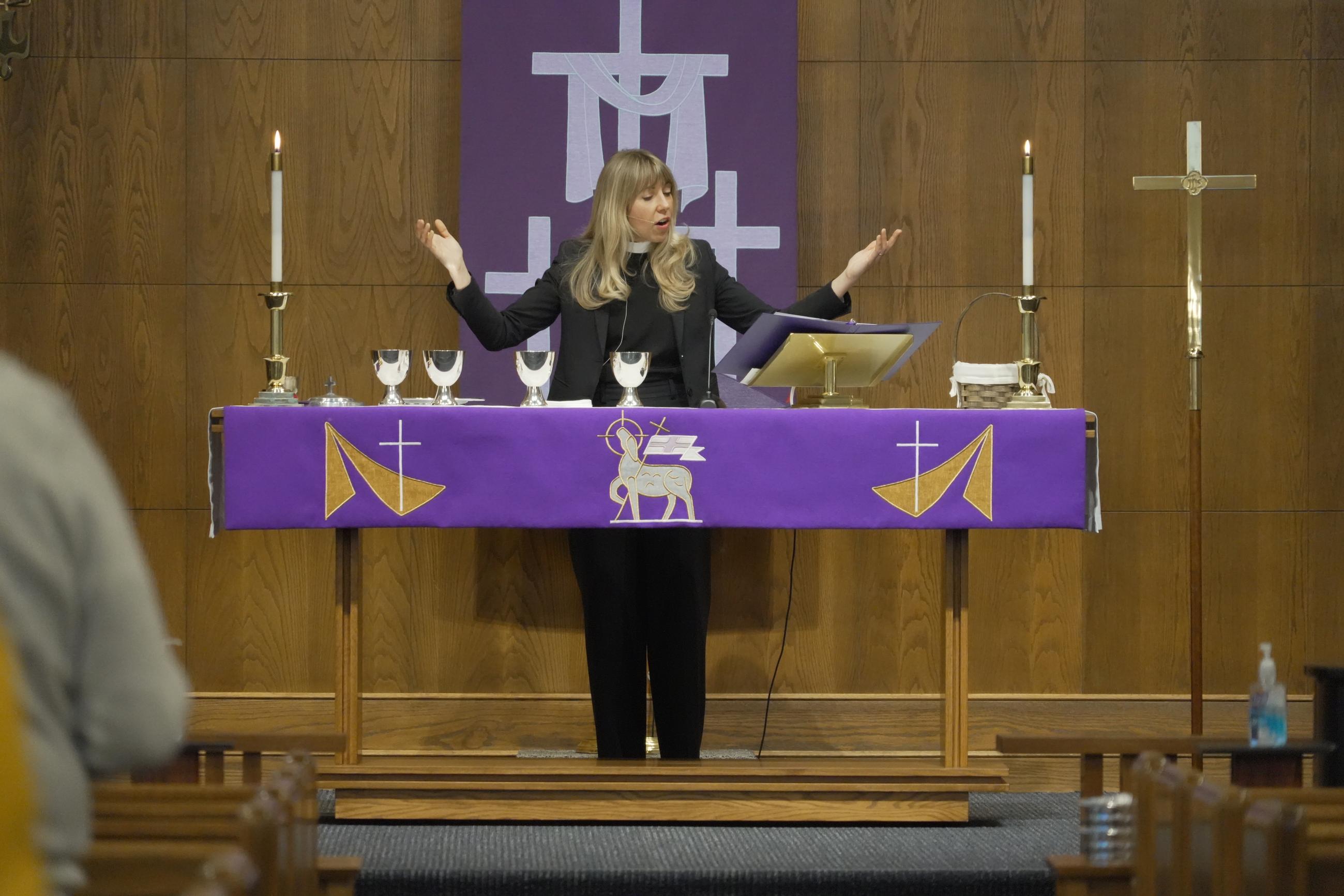
Several ministers, pastors, and faith leaders are running for seats that are crucial to Democrats winning House and Senate majorities. The districts are united by a common thread: They are all in rural America, where Democratic support cratered in 2024.
Republicans have had the perception of holding a monopoly on faith, particularly Christianity, in recent eras. Republican leaders such as House Speaker Mike Johnson speak openly about faith and the role it plays in guiding their political decisions. Survey data also suggests Republicans have a strong grip on Protestant and Catholic voters, while the religiously unaffiliated overwhelmingly associate with the Democratic Party.
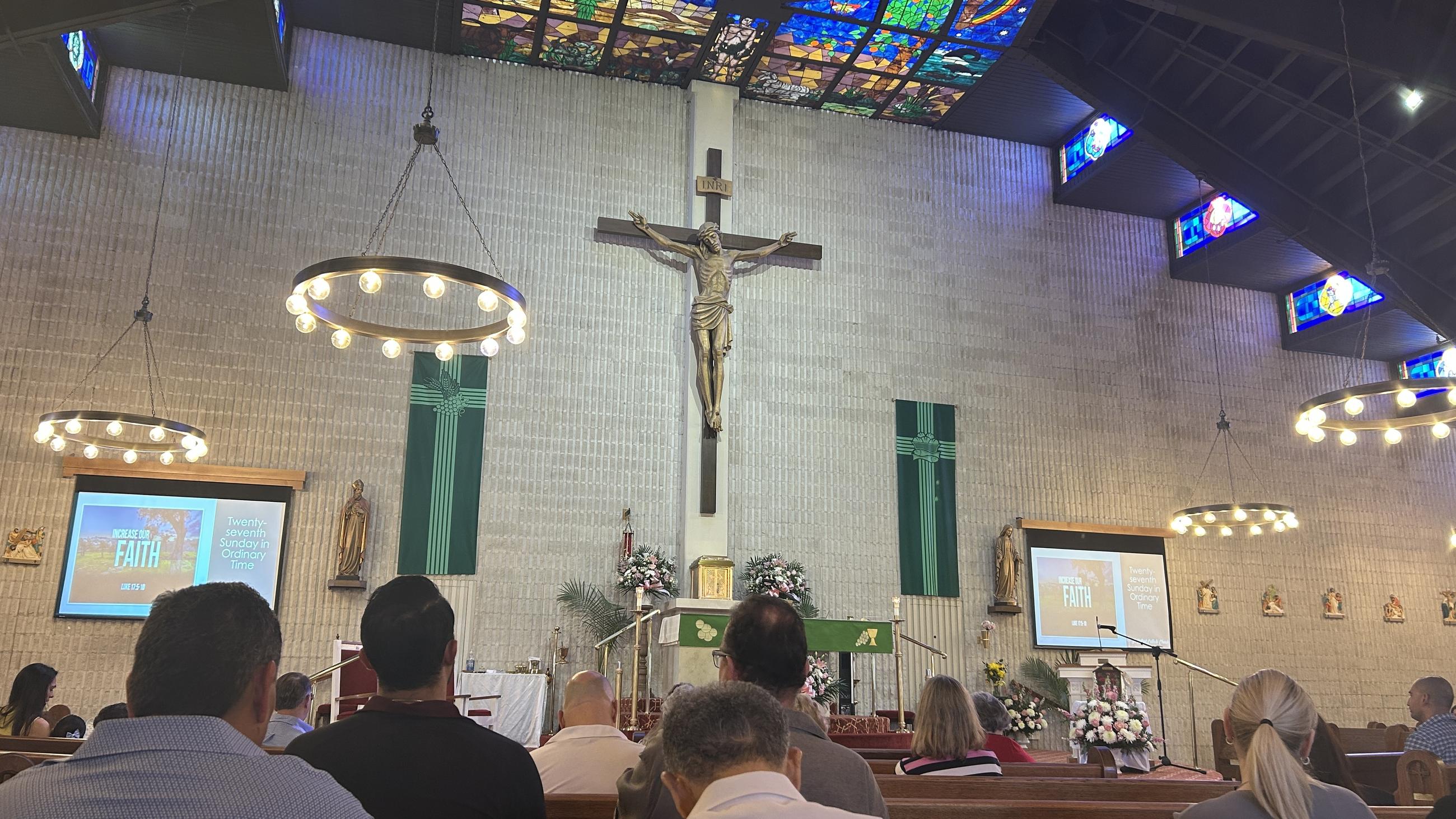
Faith leaders in Alaska, Iowa, and Kansas are trying to change that perception by trading the pulpit for the campaign trail. Of the 15 congressional seats across those three states, Democrats hold just one, a House seat in Kansas.
Kansas and Iowa are home to large populations of Protestant Christian populations. Some 70 percent of adults identify as Christian in Kansas, and 62 percent of adults are Christian in Iowa, on pace with the national average, according to data from Pew Research.
State Rep. Lindsay James and state Sen. Sarah Trone Garriott are both ordained ministers running for competitive districts in Iowa.
Trone Garriott, in an interview with National Journal, frequently referred to the biblical commandment to love thy neighbor as her call to service and ministry.
“Loving my neighbor means helping them, and I could see that the decisions made in state governments and federal government are impacting my neighbors,” she said.
Democratic Rep. Hillary Scholten of Michigan says Democrats should be more open about their faith, provided they offer an authentic testimony.
Scholten speaks openly of her faith and how it informs her service. She says candidates sometimes get nervous when discussing their religion because of the fraught and often controversial relationship between church and state, but she argues that shouldn’t stop them.
“This is not one-size-fits-all-we're-going-to-prescribe-biblical-teachings-into-law here, but at the same time I don't think that it should prevent people whom their faith is foundational to who they are from being able to talk about that,” Scholten told National Journal. “It's something that many, many Americans can relate to, and … knowing that their representative shares that same faith foundation has been a huge connector in the community for me.”
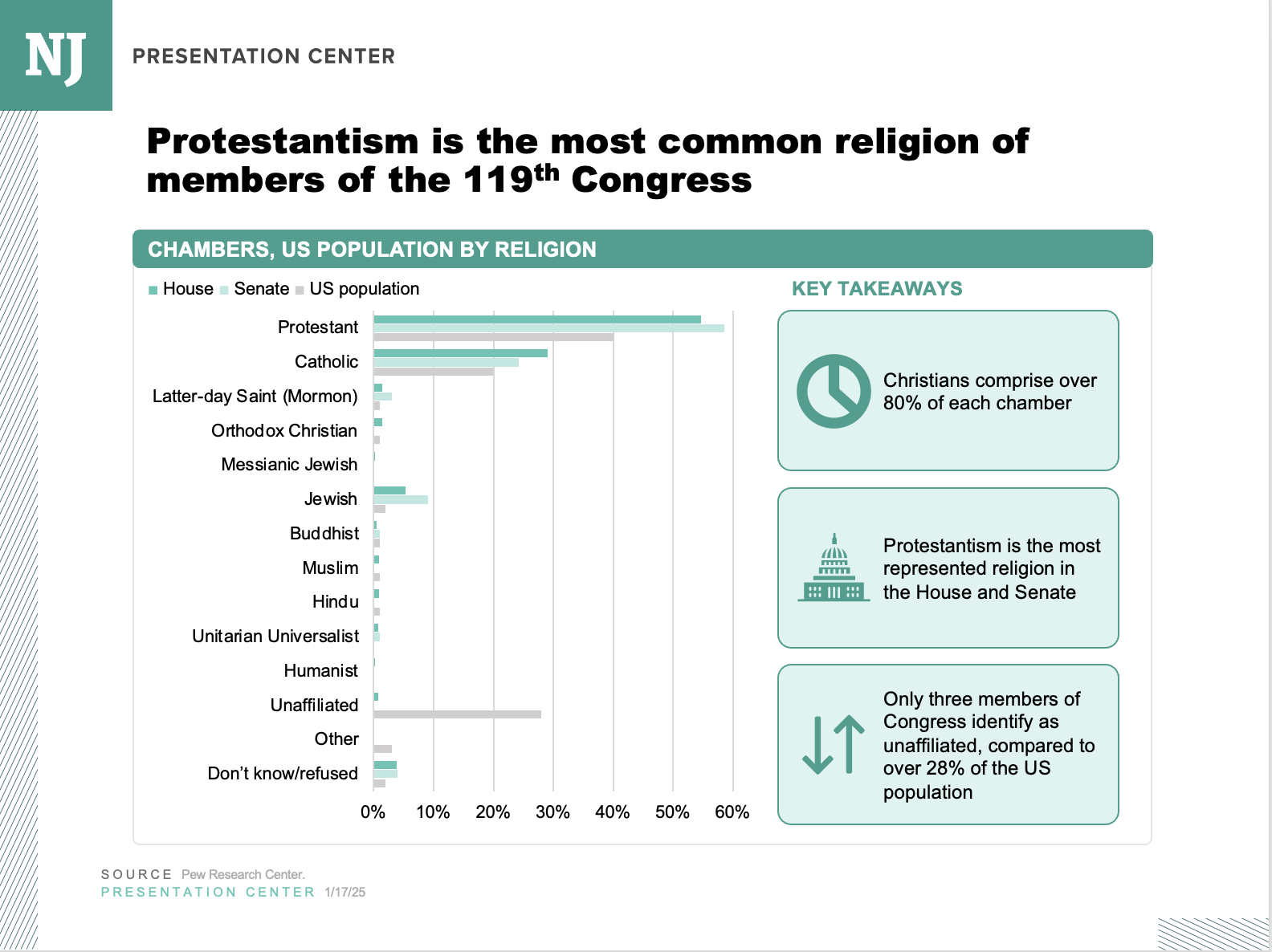
Religious breakdown of the current Congress
National Journal Presentation Center
Many of the Democratic candidates running for office have turned to the Sermon on the Mount as their motivation to run. They increasingly see the Republicans as abandoning their neighbor, particularly after the passage of the 2025 tax bill, which made significant cuts to Medicaid.
“People came up to me within my own family … and throughout the city and state … saying, ‘Why won’t anybody protect us?’” Presbyterian pastor Matt Schultz said of the bill. “As a pastor, it is my duty to stand between the attacker and the attacked.” Schultz is running for the at-large seat in Alaska.
Adam Hamilton, who leads Church of the Resurrection, the largest United Methodist Church in the country, said he felt compelled to challenge Republican Sen. Roger Marshall of Kansas after a listening tour around the state. Hamilton, who said he wanted to start a church for “critical thinkers,” says his background prepared him to enter the political arena.
“A strength of mine is the ability to listen and understand where people are coming from and to communicate in a way to hold together a congregation of roughly equal numbers of Republicans and Democrats over the last 36 years,” Hamilton said.
Democrats haven’t won a Senate seat in Kansas since 1932, the longest active streak of one party controlling both Senate seats in the country. Hamilton will need to win over a healthy swath of Republican voters in order to notch a historic upset.
Republicans, however, are prepared in turn to use candidates’ faith against them. The GOP has opened the opposition-research file on James Talarico, the Democratic nominee for Texas’s Senate race, to ding him over matters of faith. Talarico, a Presbyterian seminarian, has said a number of potentially polarizing comments at odds with certain communities of faith. That includes comments that “God is non-binary” and a biblical defense of abortion.
Just this week, Talarico in a podcast interview said that the Bible is “silent on abortion,” something Republican leaders quickly criticized. He has recently walked back some of his prior comments.
In Iowa, Trone Garriott is the nominee in the 3rd Congressional District, one of the most competitive in the country. She’s been the target of Republicans since clearing the primary field to challenge Republican Rep. Zach Nunn. Republicans have resurfaced her past comments on private Christian schools and her early work as a minister, which included participating in a satanist couple's wedding.
The Iowa legislator brushed aside the attacks.
“Zach Nunn is twisting my words, he's attacking my record, he's disrespecting Christianity, all because I had the courage to call out his record of failing the people of Iowa and shed a light on the way that he is just falling short in his role and voted for things that are making life harder on my neighbors,” Trone Garriott told National Journal.
The Republican critiques represent a potentially awkward line the Democratic faith leaders will have to walk as they try to win in redder turf: Some Democratic beliefs, such as support for abortion and same-sex marriage rights, are considered heterodox for many Christians.
“There’s always a common ground, and that’s a shared set of values. And those shared sets of values are deeply held commitments that people are trying to live out, and we may live them out differently,” James told National Journal.
“That shared value, and coming back to why that has led us to think about a policy in a certain way, I think, actually frees people up to really wrestle with the fact that when I talk about policy, it's always from a place of considering the fact that I believe that every person is made in the image of God,” she continued.
There are only two Democratic clergymen currently in Congress—Rep. Emanuel Cleaver of Missouri and Sen. Raphael Warnock of Georgia. Cleaver is likely to lose his seat this year due to redistricting, but Frederick Haynes III, a pastor in Dallas, is all but certain to win a seat this fall.
There could, therefore, be an influx of clergy in Congress in 2027, depending how November fares for these candidates.
Schultz, the Anchorage pastor, said he’s not surprised by the surge in religious leaders running for office.
“We're not jumping off the sidelines at all. We're jumping from one battle into the next, and most of us have been out here all along speaking the truth and serving the people, and our holy calling of speaking the truth has not changed,” Schultz said.
“We go into this to serve and to love people,” he said. “That's why you enter ministry: to serve people, to love people, to care for people.”