May 26, 2026, 4:07 p.m.
With his remarks last week at the Coast Guard Academy's commencement ceremonies, President Trump has achieved something no other president has pulled off. Let's call it the Grand Slam of Presidential Verbosity: He has given the longest address in each of the "Big Four" of presidential oratory: the State of the Union, the political convention speech, the Inaugural address (at least in the television age), and the graduation-ceremony address.
In all cases except the convention, the records for long-windedness were shattered in a second term that is only 16 months old. In service of winning that second term, at the 2024 Republican National Convention in Milwaukee, he blew past his own prior marks for convention loquaciousness, more than doubling the words uttered by any previous candidate not named Trump and topping his own record of 75 minutes in 2016 with a mind-numbing 92-minute performance.
In his first moments back in office, he raced past outgoing President Biden’s 21-minute effort four years earlier, giving an Inaugural Address that lasted 29 minutes and 44 seconds, almost 45 percent longer than his first Inaugural in 2017, which took only 16 minutes and 13 seconds. Only a month later, he went to Capitol Hill and spoke for 100 minutes to a joint session of Congress, falling just short of President Clinton’s record 105 minutes in 1995. That mark, though, could not survive Trump’s State of the Union address this year, when he spoke for 108 minutes to claim the top spot for his own.
Those three records were achieved in full view of the public, with millions watching on live TV, though in all cases the audience numbers were lower than those for shorter speeches. The final leg of the Garrulousness Grand Slam was achieved, for the most part, out of the spotlight, at events watched mostly by proud parents and eager graduates.
College commencement ceremonies are a relative latecomer to the world of presidential remarks. It was not until the 20th century and the 26th president that any chief executive spoke at a commencement. That was Theodore Roosevelt, who in 1902 spoke 904 words to the graduates of the U.S. Naval Academy in Annapolis. They were remarkably grim words, warning the new officers that if there is any “slackness in the performance of duty on your part” they could know “the black shame of defeat” in any upcoming war. He added, “If the Navy fails us then we are doomed to defeat.”
Roosevelt's successors were slow to embrace this new duty—there were only 11 commencement addresses in the next 44 years. It was not until the 1970s that they became the norm. In fact, President Carter's Rose Garden strategy, precipitated by the Iran hostage crisis, made 1980 the last year in which an incumbent president skipped graduation season.
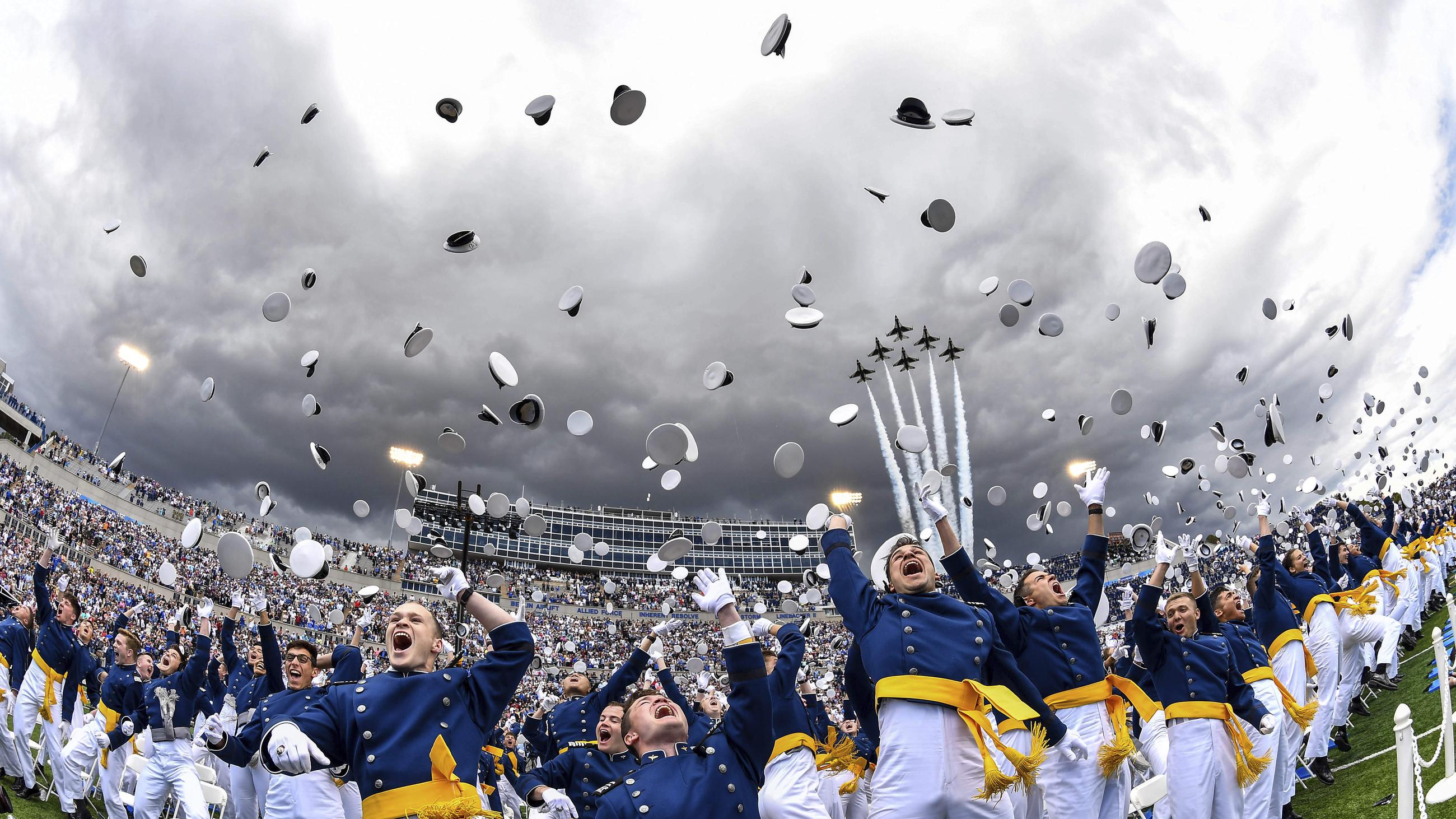
In the 12 decades since Roosevelt, the speeches have grown more polished and have come to be seen as an important staple of White House oratory and a showcase for national policy pronouncements. Presidents saw campuses as the right place to signal new policy directions. That included Franklin D. Roosevelt preparing the nation for war and denouncing isolationism in 1940, Harry Truman taking a stand against Soviet aggression in 1948, Dwight Eisenhower warning of McCarthyism in 1953, and Lyndon Johnson outlining his Great Society and committing the nation to civil rights in 1964 and 1965. More recently, George H.W. Bush used five commencement addresses in 1990 to sketch his vision for a post-Cold War world, and George W. Bush used a commencement address at West Point to make the case for preemptive war.
But after so many presidents elevated graduation speeches, Joe Biden and Donald Trump have downgraded them. Biden's remarks lacked both discipline and grand ambition.
For Trump, the commencement addresses have been reduced to a vehicle for partisan claims, assertions of victimhood, and random musings. No one else has been as partisan as Trump in these speeches, with all other presidents honoring the notion that parents there to honor their children should not be subjected to a political speech. That has been particularly true at the historically nonpartisan service academies. Yet in 2017 Trump asked the Coast Guard Academy graduates to “look at the way I’ve been treated lately, especially by the media."
"No politician in history—and I say this with great surety—has been treated worse or more unfairly,” he complained.
Last year, he wore a Trump campaign ball cap while addressing the graduating cadets at West Point and criticized Biden by name.
Having concluded his sixth graduation season, Trump has given fewer commencement addresses than any two-term president in half a century. In addition to six appearances at the graduation ceremonies for the U.S. military academies, which is now considered obligatory for any commander in chief, Trump has ventured onto only two civilian campuses in his six years in office. Both were chosen for their political safety. In 2017, he spoke at the staunchly conservative Liberty University. In 2025, he went to the University of Alabama, amid its reliably Republican environs.
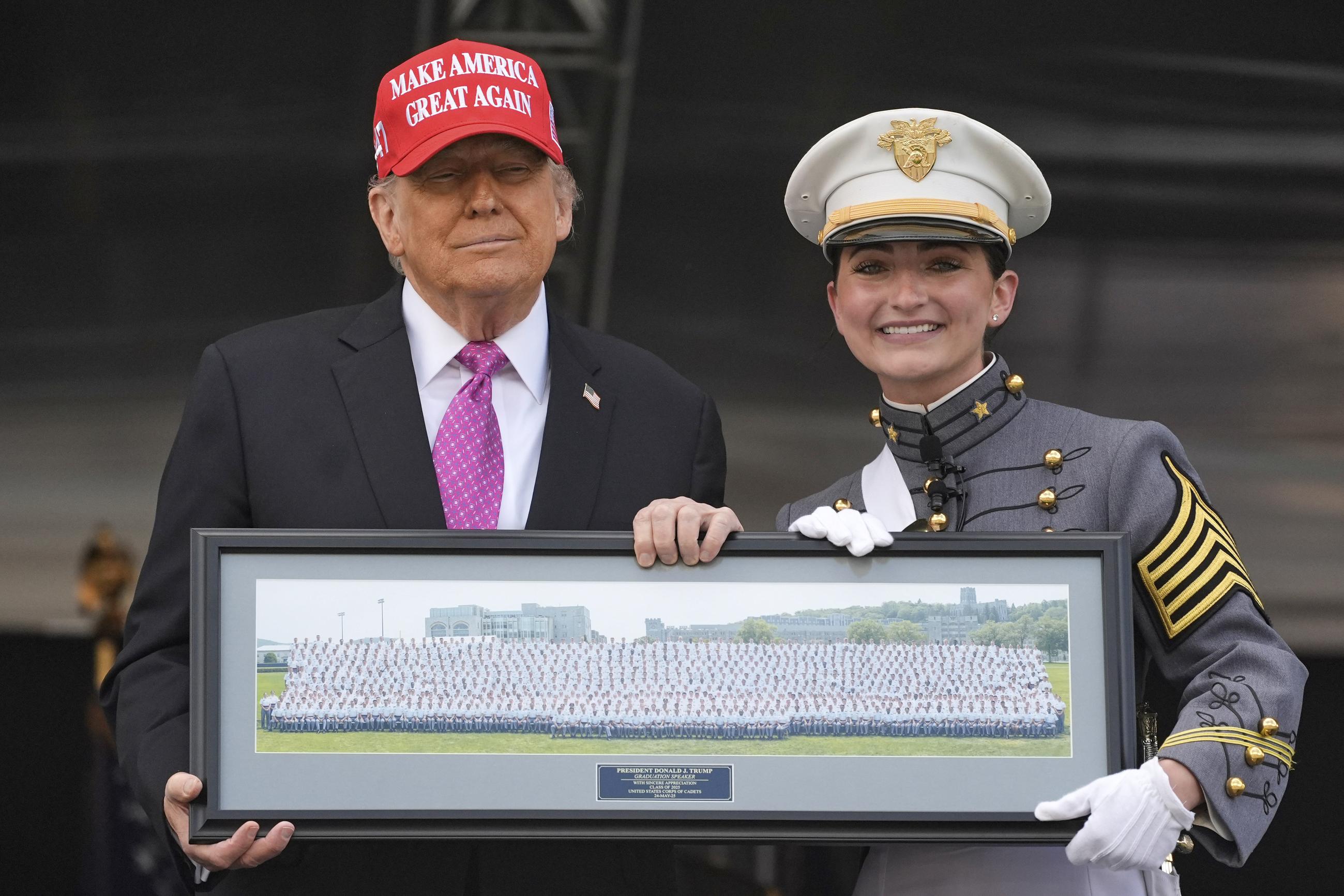
Trump at the United States Military Academy commencement ceremonies in West Point, N.Y., in May 2025 (AP Photo/Manuel Balce Ceneta)
None
Since Richard Nixon left office in 1974, only Carter gave fewer such addresses than Trump. In contrast to the timidity of Trump’s schedulers, Biden went to four non-military campuses in his four years; Barack Obama and George W. Bush each went to 16; Bill Clinton went to 17; George H.W. Bush went to 18 in one term; Ronald Reagan went to seven; and Gerald Ford went to six in his less than three years in office. Despite serving only five years and facing hostile campuses because of the Vietnam War, Lyndon Johnson spoke at 11 non-military campuses.
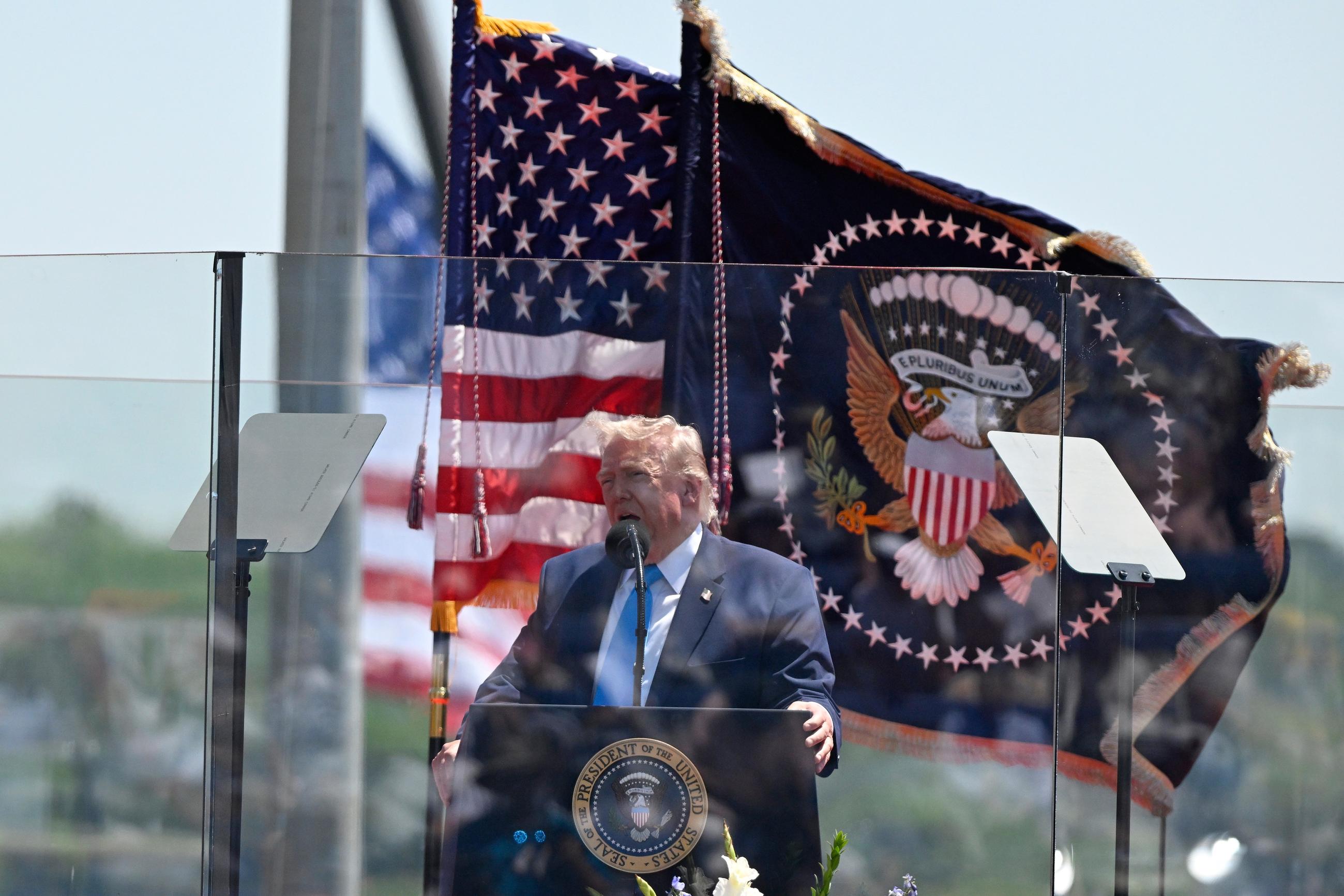
But while Trump's speeches are few, the words in them are many. Last week, he spoke for almost an hour at graduation exercises in New London, Connecticut, for the U.S. Coast Guard Academy.
Before Trump, the longest presidential commencement address was believed to be Clinton’s at Penn State University in 1996. That 5,952-word speech lasted 49 minutes and stressed personal responsibility. Trump now has left Clinton in the rhetorical dust, giving three commencement addresses in his second term that all topped 8,000 words and came close to breaking the hour mark. At the Coast Guard Academy, he spoke for 53 minutes.
The message, however, was hard to discern. The New York Times called it “mostly a mixture of jokes, high praise and written remarks about the danger and derring-do of the seafaring life the Coast Guard graduates had chosen for themselves.” But, the Times added, there also were “detours into choppy waters.”
Most surprisingly, Trump claimed he was the first president to speak twice at the Academy. In fact, two-term presidents Clinton, Bush, and Obama all had done so. In a White House where the president is his own chief speechwriter, that slipped past the in-house fact checkers. Maybe he just meant he had spoken twice as long.