
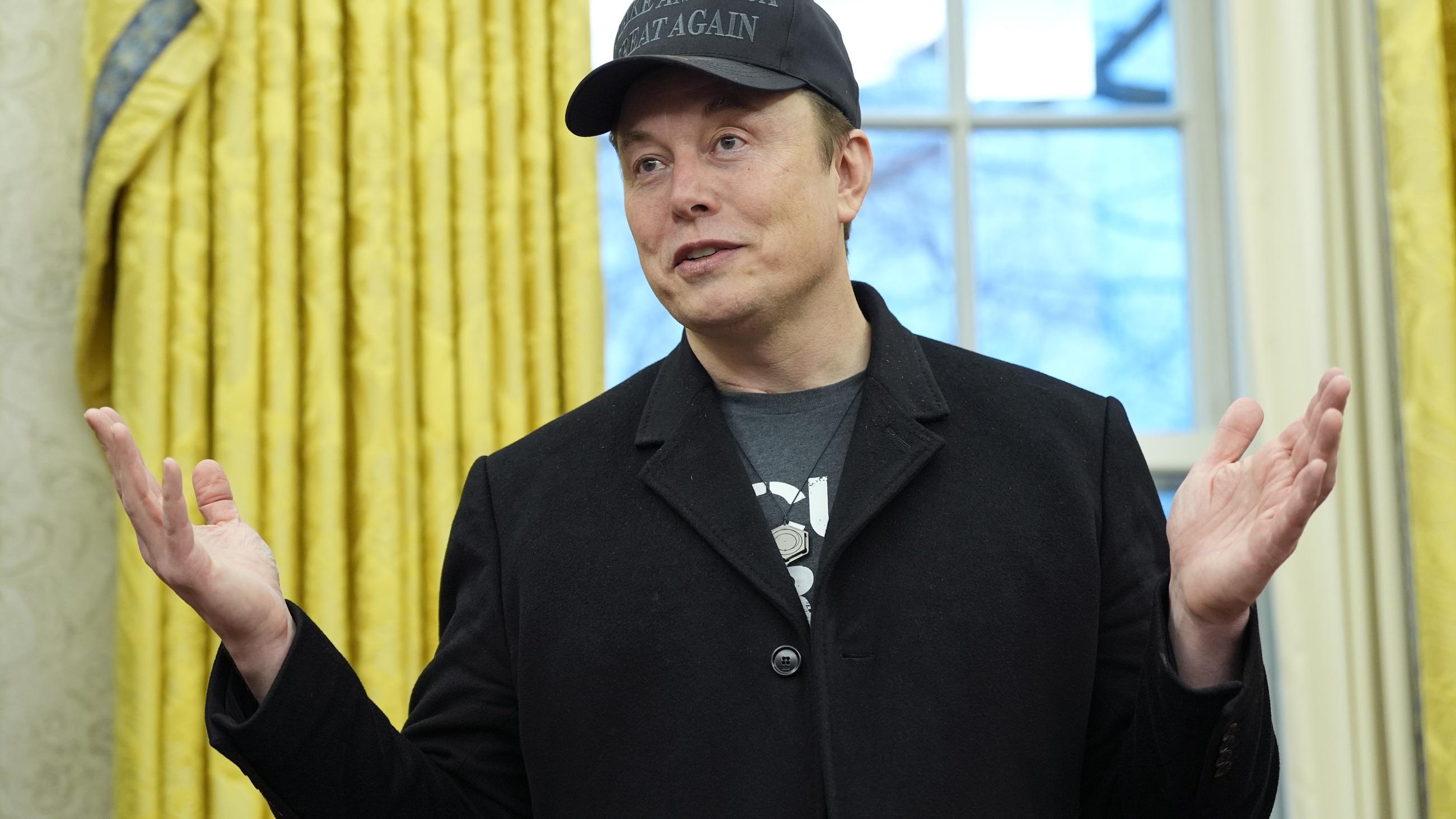
Elon Musk arrived in Washington with a black MAGA hat, mirrored sunglasses, and a promise to rip $2 trillion out of the federal budget as the head of President Trump’s Department of Government Efficiency. On the way, he picked up a chainsaw. Within four months, he was gone, leaving his budget-trimming efforts to others.
Next week marks one year since Musk’s tumultuous departure from the administration following a public fallout with the president. The chainsaw might be gone, but current and former officials, union leaders, and Democratic lawmakers say the damage DOGE inflicted remains—and could for decades. Critics say Musk left behind hollowed-out agencies, lost expertise, demoralized workers, and a government still struggling to do the same work with fewer people.
“DOGE had a damaging effect on the federal government,” said Doreen Greenwald, president of the National Treasury Employees Union, which represents tens of thousands of workers across more than 20 federal agencies. “There was a destruction of processes and policies that were in place, and many of the things that were cut were not done with any analysis or understanding about how different programs interact with one another.”
This, Greenwald told National Journal, led to “confusion and chaos.”
But conservatives pushing to rein in what they see as runaway government spending, including Senate Budget Committee Chairman Lindsey Graham, say DOGE was a necessary exercise.
“Some of it probably overshot the runway, but overall I'm glad we did it. It needed to be done,” Graham told National Journal. “We can always build on the concept of DOGE. We learned that all programs are not the same, but the effort was a noble effort. We'll see what happens.”
What happened under DOGE
DOGE embarked on a sweeping effort, including mass layoffs, agency reorganizations, contract cancellations, hiring freezes, and deferred-resignation programs that upended the federal bureaucracy.
The Education Department faced major staffing cuts and proposals to consolidate or eliminate functions such as student-aid administration and civil rights enforcement. The U.S. Agency for International Development was effectively eliminated—most of its staff were placed on leave or terminated, and many aid programs were cut or transferred to the State Department. The Consumer Financial Protection Bureau underwent reduced staffing and slowed enforcement and regulatory activity.
Other agencies felt the brunt as well. The IRS lost employees through buyouts and canceled hiring plans from the Biden administration’s efforts to expand the agency. Research, public-health, and administrative offices within the Health and Human Services Department were eliminated.
Courts later blocked or reversed some dismissals, but most workforce and operational changes remained. Despite the upheaval, the $2 trillion in cuts never materialized.
According to an analysis by the libertarian Cato Institute, which advocates smaller government, Musk was only partly successful in reaching his goal.
“DOGE did not reduce spending, but it did reduce federal employment by nine percent in less than 10 months. A decline that large has not happened since the military demobilizations at the end of World War II and the Korean War,” the study concluded. “It is important to note that DOGE’s target was to reduce the budget in absolute real terms without reference to a baseline projection. DOGE did not cut spending by either standard.”
Cato says the reason is simple: Most federal spending is devoted to entitlement programs, such as Social Security and Medicare, which can only be curtailed by Congress, “so it’s unsurprising that DOGE did not reduce spending.”
It also didn’t reduce the national debt. A year ago, the national debt was $36.2 trillion. It’s now nearly $39.3 trillion.
‘What it means to destroy the service’
Some critics of DOGE say they support the idea of improving government efficiency and cutting waste, but that the program was haphazard and blunt in its execution.
“What Musk claimed was waste, fraud, and abuse were federal workers doing jobs that needed to be done,” Sen. Elizabeth Warren, who helped create the Consumer Financial Protection Bureau, told National Journal, citing enforcement of credit-disclosure laws. “It wasn’t sexy stuff, but it’s important to the functioning of a fair economy.”
Rep. Jamie Raskin, whose suburban Maryland district includes thousands of federal employees, said the abrupt loss of institutional know-how and of key staffers also directly handicapped government missions including foreign aid, consumer protection, and scientific research.
Raskin said his constituents worry not only about their jobs, but about “what it means to destroy the service.”
Even Graham said DOGE sometimes went too far.

“One of the takeaways for me is that people would like us to try to save money up here and to be more efficient, but there's some of these programs that have value,” he said. “And some of the people in DOGE had ideological positions that were more than just trying to find waste, and some of their ideological positions didn't win the day.”
Jenny Mattingley, vice president of public policy and stakeholder engagement at the Partnership for Public Service, said that some 300,000 employees have left federal service.
“That’s a huge chunk all at one time. … The impacts across the board, big and small, are pretty vast,” she said. “The work didn’t change. Congress didn’t change the laws that require certain work to be done. … The White House just removed employees.”
Remaining employees have had to take on the workload of those who left. Mattingley said some of those workers are often “doing five people’s jobs.” Greenwald described employees being assigned unfamiliar work without a good understanding of what their task may be.
“They are not given clear guidance on expectations. They are not given proper training to accomplish new tasks,” Greenwald said. “They’ve taken away flexibility from employees, such as scheduling. Overtime is not being authorized in a clear and transparent way. It’s caused a lot of chaos for employees.”
Costs of the cuts
The aftershocks have become visible. People wait longer for help from consumer-facing agencies, such as the IRS or the Social Security Administration. A recent analysis by the Center for Taxpayer Rights found IRS telephone wait times rose more than 70 percent in February 2026 compared to the same time last year, despite handling half as many calls.
“The public still calls the government, but wait times are increasing because there just aren’t the federal employees left to answer phones. … They are pulling people out of the front door to answer phone lines, which means people aren’t getting served in those physical facilities,” Mattingley said.
“There are ways to make the government more efficient—modernizing outdated technology, improving hiring, using artificial intelligence responsibly, and identifying where work can be done better," she added. "But that requires planning. What happened with this was totally unstrategic.”

Democratic Sen. Tim Kaine of Virginia told National Journal “some agencies are realizing the DOGE guys took this too far.” In fact, he said, “they’re starting to rehire people or bring people back, because the cuts that they made were nonstrategic and foolish.”
Voice of America is a prime example.
The Trump administration gutted the agency that reported the news in dozens of foreign languages in March 2025 and placed most staff on leave. But the network quickly scrambled to recall employees from its Farsi-language service as conflict between Israel and Iran intensified a few months later. Then this year, a federal judge ordered the reinstatement of some 1,000 VOA employees. Those employees remain on administrative leave while a federal appeals court weighs arguments by the Trump administration.
Replacing the brain drain
Another long-term concern is recruitment. Federal employment has often been described as stable, mission-driven work. No longer.
“The federal government used to be—and should be—the model employer for the nation,” Greenwald said. “That is not where it is today.”
Hiring freezes, reduced workplace flexibility, shutdown threats, political attacks on civil servants, and uncertainty about agency missions have made federal service significantly less attractive. This is compounded by Trump’s push to revamp the top civil service levels from career professionals to political appointees. A recent report from the Partnership for Public Service found that the number of senior career officials in government fell by nearly 30 percent during Trump’s first year back in office, while the number of political appointees increased by 800.
In the early days of DOGE, some college students said they didn’t want to pursue careers in government anymore. The long-term recruiting effects are difficult to measure only one year out, but analysts who spoke to National Journal said the upheaval damaged the government’s appeal for young workers.
“People still want to serve,” Greenwald said. “But they’ve seen people get fired arbitrarily. So that is not a winning proposition.”
Greenwald says that the institutional knowledge lost through mass departures can be restored, but not quickly.
“I think it can be repaired,” she said. “I think it will take a long time to repair it, and it would need the proper resources and people who have the mind-set that they want the mission to continue and be successful.”
Raskin argued the solution is the ballot box: “Democratic victory in November against this gang of authoritarians, liars, hypocrites, and thieves that have taken over our government.”