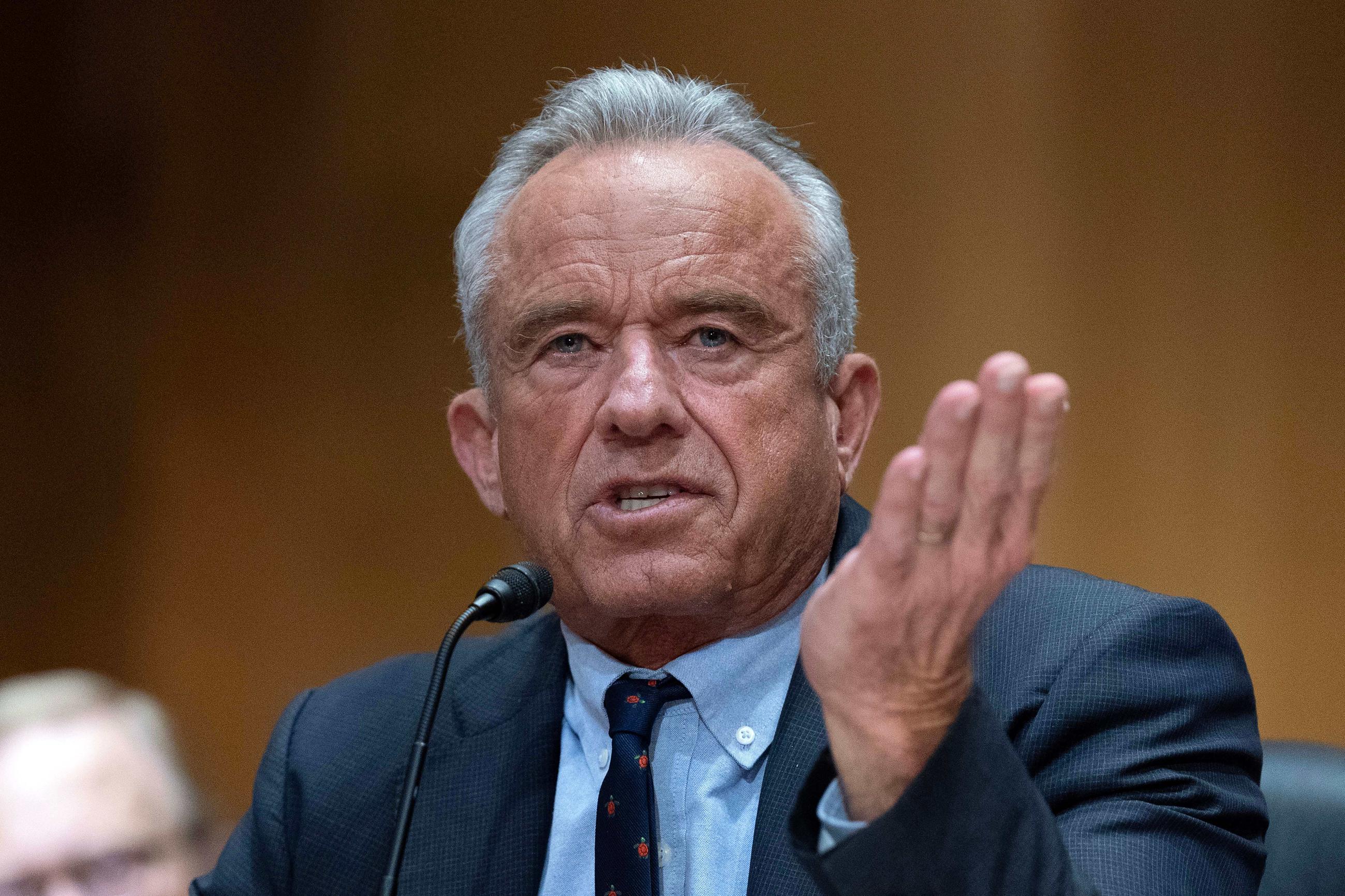
Health and Human Services Secretary Robert F. Kennedy Jr. has dismissed leaders of a key preventive-services panel, according to documents obtained by National Journal and confirmed by an HHS official.
Kennedy terminated two chairs of the U.S. Preventive Services Task Force, Esa Davis and John Wong, earlier this month—years before their terms were scheduled to end. Wong and Davis claimed that HHS officials told them they were “inappropriately appointed.” In letters from the HHS secretary, they were informed that the firings were “administrative in nature” and unrelated to their performance on the panel, according to emails viewed by National Journal.
The dismissals come at a time of upheaval across agencies under HHS, and leaves the now-eight-member panel without leadership. The former chair of the USPSTF, Michael Silverstein, finished his term in March and has not been replaced. The overhaul of leadership comes after Kennedy signaled in a series of hearings on Capitol Hill last month that he would look to “reform” the panel, alleging that it had been "lackadaisical and negligent” for the last few decades.
Under Kennedy’s reign, the panel has not met in more than a year. The task force is in charge of issuing recommendations on preventive services, such as screenings for cancer and sexually transmitted diseases, that insurers are obligated to cover. The lack of meetings has directly inhibited further coverage of preventive care for millions of Americans.
“As part of the Department’s implementation of updated governance and oversight procedures for the USPSTF and the Agency for Healthcare Research and Quality, I directed a review of current USPSTF appointments,” Kennedy wrote in separate termination letters to the two chairs. “That review was undertaken to ensure clarity, continuity, and confidence in the Department’s exercise of its appointment and supervisory responsibilities, and to protect the integrity of the Task Force’s work.”
An HHS official confirmed the firings but declined to comment further and referred to the termination letters. Davis did not immediately respond to a request for comment.
According to emails viewed by National Journal, senior HHS officials—specifically Agency for Healthcare Research and Quality Director Roger Klein and HHS Deputy General Counsel Benjamin Robles—told the two chairs that Kennedy’s decision to fire them stemmed from a recent Supreme Court decision affirming the HHS secretary’s power to remove members at will and review the recommendations they issue.
In a follow-up letter to the HHS officials, Wong and Davis sought to get further clarification on their dismissals. They claim both Klein and Robles sought to undermine their appointments as vice chairs by the Biden administration, implying that any actions they took in those roles could be invalidated.
“Any recommendation statement over that period of time theoretically could be challenged based on what they were saying,” Wong told National Journal in an interview. “All of our recommendations are based on a comprehensive scientific review of the evidence.”
Robles declined to comment, while Klein did not immediately respond to a request for comment.
However, in the formal termination letters, Kennedy emphasized that the firings were not related to the two officials’ contributions on the panel. Rather, he wrote, the decision would “help protect the Task Force and preserve confidence in the continuity and durability of its work.” Both letters encouraged Wong and Davis to reapply for panel membership during the current nomination cycle.
Wong and Davis, who served on the panel under different administrations, further questioned how the Supreme Court ruling could invalidate the tenures of appointments made by Kennedy’s predecessors.
“Importantly, Secretary Kennedy's termination letters neither state nor imply that our original appointments were somehow unlawful or inappropriate,” the pair wrote.
In response, Klein didn’t directly answer their inquisitions, but stressed that the decision wasn’t centered on the quality of the chairs’ work and that the “institutional questions the secretary has identified go to the circumstances of the appointments themselves.”
The news immediately garnered criticism from the Hill. Sen. Lisa Blunt Rochester, a vocal critic of Kennedy and a member of the Senate’s top health panel, slammed the decision in a statement Thursday.
“While this news is incredibly disappointing, it is unfortunately not all that surprising,” Blunt Rochester wrote. “RFK Jr. has a track record of tampering with independent agencies to implement his conspiratorial, scientifically unproven ideologies. Add this to the list of needlessly harmful decisions made by this administration’s top health department.”
Since April, a federal-register notice has been published soliciting nominations to replace members of the USPSTF. The deadline for nominations falls on May 23, with appointments to begin shortly thereafter in June.
However, those who monitor the group’s work closely worry the terminations risk tainting the nominations process—especially considering leadership of the panel has historically been closely involved in the process of picking new members.
“Now they’ve been summarily dismissed for reasons no one really knows—days before they’ve got to seat eight new members before June,” said Aaron Carroll, the president and CEO of AcademyHealth, a health-policy research group that tracks the work of the panel. “It's a lot that's up in the air, and it's undermining the infrastructure and rigor and transparency that has made the USPSTF as structured and effective as it has always been.”
For the last year, public health observers feared Kennedy would take an axe to the USPSTF in a similar fashion to his complete dismissal of a key vaccine-advisory panel, which he replaced with anti-vaxxers.
Instead, the USPSTF lay dormant for a year—sidestepping the three formal meetings it hosts in March, July, and November.
Much of the committee’s work now stands in limbo. There are more than a dozen draft recommendations still under review, and the panel still needs to finalize recommendation statements on a range of practices including cervical-cancer screenings and preventive interventions for perinatal depression. The panel is also legally mandated to issue an annual report to Congress that gives a review of its work and details knowledge gaps in the field of preventative care. No report was issued last year.
The panel is also working at a diminished capacity. The full committee usually has 16 volunteer members, with backgrounds in various areas of primary care ranging from behavioral health to geriatric medicine. Now, five rank-and-file members have rotated off, along with Silverstein. With Wong and Davis fired, eight members remain.
Critics of the panel have been calling for the UPSTF to hire more specialists—an effort that a number of experts fear would undermine its work. While the members often consult the guidance issued by specialty groups based on relevance to the topic at hand, appointing a specialist on the panel wouldn’t work, experts argue, because the USPSTF’s portfolio ranges widely on dozens of topics.
There is bipartisan support for the panel within Congress. Lawmakers from both parties grilled Kennedy recently on his moves to halt the task force’s work. Notably, Republican Sen. John Barrasso—a physician who rarely criticizes the administration—called Kennedy out for his plans to overhaul the USPSTF.
"As a doctor, I've relied on these recommendations over the years. ... And I believe that if more people followed the recommendations, our country would be a lot healthier," Barrasso said in April. "I'm concerned these actions show that we're not really prioritizing this important task force."