National Journal Logo
×

Welcome to National Journal!

Enjoy this premium "unlocked" content until June 6, 2026.

Continue
WHITE HOUSE FILE

No longer a 'large menu of shared ambitions' between U.S. and China

The optics were bigger than the outcomes at last week's summit, which focused not on human rights, Taiwan, or trade agreements, but rather on smaller-bore considerations like planes and soybeans.

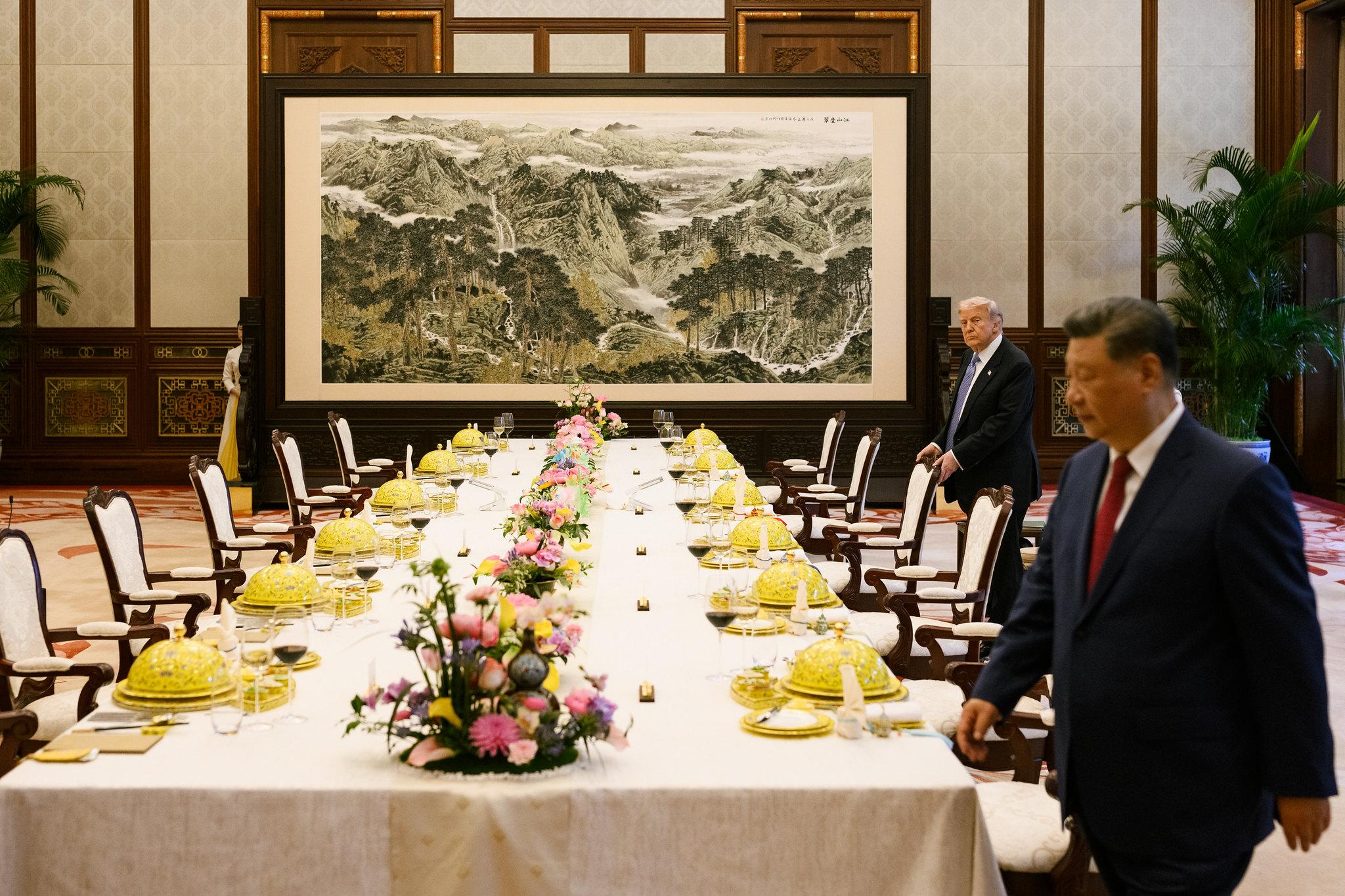
President Trump at a bilateral working lunch with Chinese President Xi Jinping at Zhongnanhai in Beijing on May 15 (Official White House Photo by Daniel Torok)
None
May 20, 2026, 1:51 p.m.

With the cheering children now quiet, the lavish banquets over, and the American CEOs back in their executive offices, the results of President Trump’s showy two-day summit in Beijing look far less momentous than the president promised when he mused upon his arrival that it could be the "biggest summit ever" or when he boasted after returning home that it was “very successful, world-renowned, and unforgettable.”

For the Chinese, who famously take a long view of history, last week’s summit between the American president and Chinese leader Xi Jinping brought few superlatives and many reminders of what a Fox News analysis called “a new Cold War with China.”

Back in the U.S., Trump has talked endlessly about deals, soybean sales, and airplane purchases, while sidestepping Xi’s stone wall on Iran and continued friction over Taiwan. Xi has barely mentioned trade, preferring to sustain the tariff truce struck by the two leaders last year.

Trump stresses his personal relationship with Xi, calling him at various points “an incredible guy,” “a tremendous leader,” “very powerful,” “very strong,” and “very smart.” He claimed, “We have a friendship, really.” In quiet contrast, Xi casts the relationship—and the summit—in geopolitical terms.

According to a Chinese readout of the talks, Xi warned Trump that if Taiwan is not handled properly “the two countries will have clashes and even conflicts, putting the entire relationship in great jeopardy.” Raising a theory that rising powers often go to war against declining powers, Xi cited ancient Greek military wisdom to ask if the two countries could avoid war and “overcome the Thucydides Trap and establish a new paradigm for relations between great powers.”

At its most basic level, Trump’s trip to Beijing was sharply different from all the visits to China by seven previous presidents, starting with Richard Nixon’s historic opening to China in 1972. Every other president raised human rights, championed democracy, tried to persuade Beijing to abide by the rules of the international system, and talked to a mix of average citizens, students, or business leaders. Two—George H.W. Bush in 1989 and George W. Bush in 2008—pointedly and publicly met with dissidents, to the displeasure of the Chinese leadership.

All that was absent last week. In its place is a narrower, more transactional relationship.

“This trip reflected how narrow the U.S.-China relationship has become,” said Craig Singleton, senior director of the China Program at the Foundation for Defense of Democracies. “Earlier presidential visits to China usually tried to carry a broader American agenda—trade and human rights, civil society—and hoped that engagement might encourage some change in China's system. That era is over.”

That change was apparent when Trump met with Xi, Singleton said. “The two sides were no longer pretending there is a large menu of shared ambition," he said. "The areas where they can meaningfully transact are smaller, and that's exactly what the summit produced: agriculture and planes, business channels, and a few carefully managed understandings.”

Throughout the visit, it was clear that the two presidents had a shared desire to avoid a public clash. But, Singleton said, “they used the theater of the summit differently."

"Trump sees personal warmth as a way to unlock deals," he said. "And Xi Jinping understands ceremony as strategy. He uses it to project parity, to buy stability, and to keep the relationship on terms that Beijing can manage.”

Xi understands that the structural realities of the relationship are more important than the personal ties between the men who currently lead their countries. “The structural frictions between the United States and China are growing in number and severity,” said Ali Wyne, senior research and advocacy adviser for U.S.-China relations at the International Crisis Group. Those frictions, Wyne said, are evident in the military, economic, technological, and diplomatic realms.

Frictions in another area also were present, though unspoken, in Beijing. China has observed the growing friction between Trump and American allies. “In China's assessment, one of the core strengths of the benevolent hegemon that the U.S. has been over decades was its system of alliances,” said Reinhard Bütikofer, senior fellow for tech policy at the Center for European Policy Analysis and a former member of the European Parliament. “And one of the weaknesses that he is probably very happy about is that this administration is systematically undermining or even tearing up the American system of alliances.”

Lest Trump forget that China wants to nurture its own alliances, Xi bookended Trump’s visit by sitting down with U.S. rivals. He met with Iranian Foreign Minister Abbas Araghchi days before Trump arrived and with Russian President Vladimir Putin three days after Trump departed. According to the Chinese foreign ministry, Xi and Putin have met at least 50 times.

“Putin and Xi have come to the conclusion that they are stronger together than apart,” said Christopher Walker, vice president at CEPA. “This is reflected in Beijing’s position on the war in Ukraine. They’re absolutely not neutral.”

Trump preferred to turn a blind eye to that, instead showcasing the CEOs he had bundled into Air Force One. “Taking CEOs to China fits his belief that business leaders and commercial deals and personal diplomacy can translate into leverage,” Singleton said. “The problem is strategic confusion. China is not impressed by U.S. CEOs. Xi’s goal is not to recreate the old business-led engagement model.”

Noting the so-far disappointing announcements out of the summit, he added: “The underwhelming deliverables tell the story here. Apart from the Boeing announcement, which was smaller than some of the bigger numbers floated before the summit, there was not a wave of CEO-driven deals. The business optics were bigger than the business outcome.”

To Walker, Putin’s arrival and the unimpressive sales announced are a reminder that the U.S.-China relationship is about far more than the sales of planes and soybeans and fights over tariffs.

“This is inarguably still a competition," Walker said. "It's a competition about the way the world will be ordered. It's a competition about whose governance vision will set the standard globally. And unless the U.S. and its like-minded allies are willing and focused on competing and engaging on this level, we're destined to lose ground.”

No cheering children, state banquets, or visiting CEOs can change that reality.

Welcome to National Journal!

Enjoy this featured content until June 6, 2026. Interested in exploring more
content and tools available to members and subscribers?

×
×

Welcome to National Journal!

You are currently accessing National Journal from IP access. Please login to access this feature. If you have any questions, please contact your Dedicated Advisor.

Login