In 2004, Rep. Mac Collins of Georgia sought to flip an open Democratic-held Senate seat. His efforts were futile. He placed third in the Republican primary behind future Sen. Johnny Isakson and future presidential candidate Herman Cain. He didn’t concede in the race.
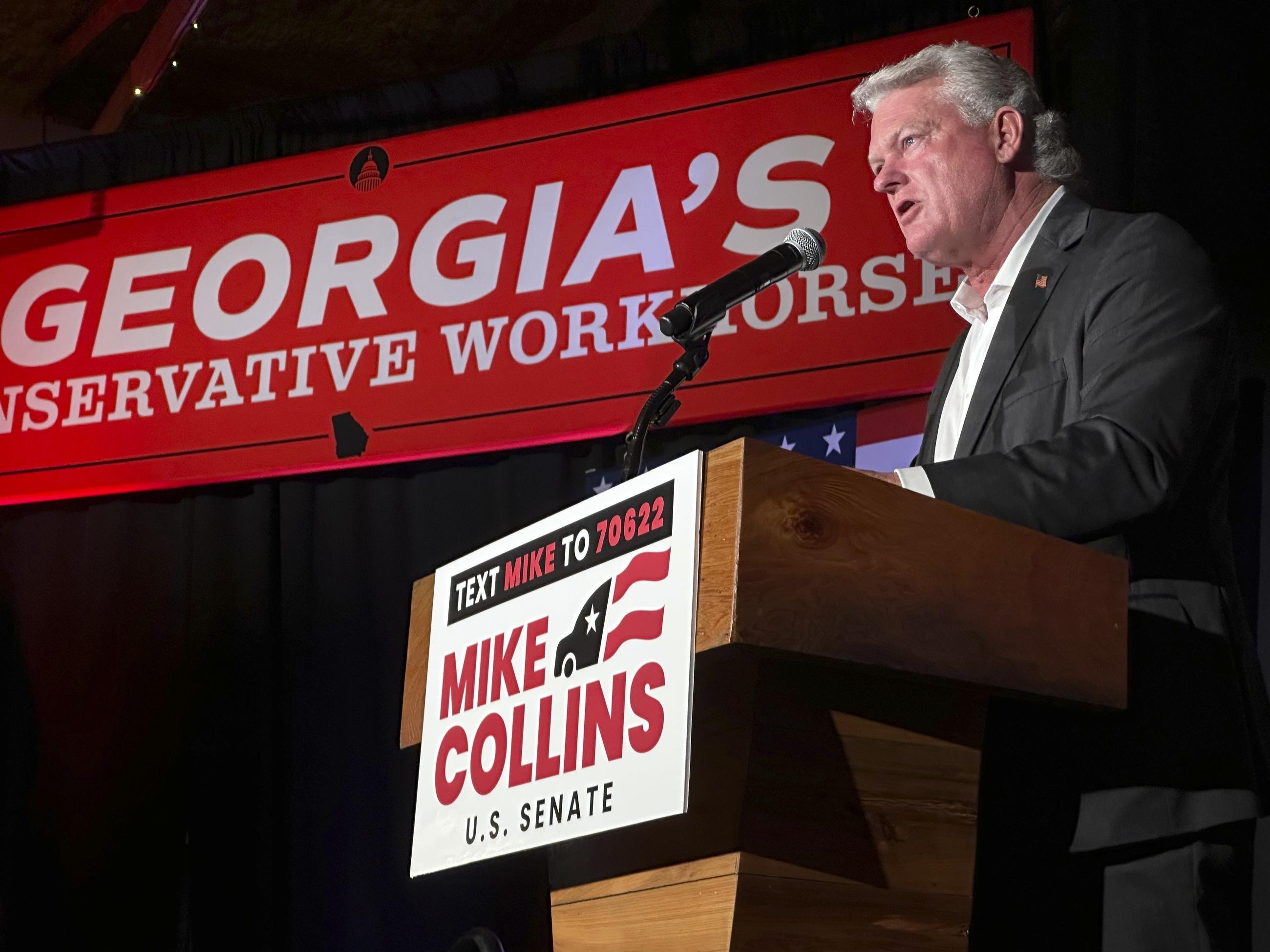
Twenty-two years later, the late Mac Collins’s son is a leading contender in the GOP primary to take on Democratic Sen. Jon Ossoff.
“I got to learn from the grassroots side of it, and we were always grassroots,” Rep. Mike Collins told National Journal in an interview. “Even my dad. He was just the type of person—he'd rather get in a car and drive around and meet people. And I think that a lot of people miss that, and they see that in us.”
Collins is carrying sizable support from his fellow Georgia Republicans into Tuesday's primary despite his brief time in Congress. Even amid Rep. Buddy Carter’s massive ad spends and Gov. Brian Kemp’s aggressive support for former Tennessee football coach Derek Dooley, several polls show Collins slightly ahead of his two opponents.
President Trump hasn’t dipped into the Peach State primary, potentially forcing the three-way contest into a June 16 runoff that prolongs an already brutal race. Collins says he is confident he’ll qualify for the runoff while Carter and Dooley battle for a second spot.
“We’ll be in first place,” Collins said. “You know, I keep telling folks there's still an opportunity with the number of undecideds out there that we could finish this thing in May and get on with what the real mission is. … And the mission is to put a Republican in that seat.”
The GOP’s mission to flip the seat has turned into a messy battle between the three candidates, who each held roughly $1.7 million on hand as of late April. The bruising primary could siphon away money better spent in a general election against Ossoff, who has a war chest of $32.5 million.
Republicans—especially those hailing from Georgia—acknowledge that Ossoff is a tough opponent to beat and that they will need a strong candidate who’s able to match the incumbent’s ground game.
“As much as I think he votes wrong, he's also a consummate politician,” said GOP Rep. Rich McCormick, who hasn’t endorsed in the race. “He’s gregarious, intelligent, well-spoken, and he does all the things that I take pride in: constituent services, outreach, reaching out to people that you don’t normally reach out to.”
Senate Republicans initially saw their premier candidate in Kemp, but the governor ultimately declined to run for the seat. Kemp had said he would work with the president and GOP leadership to coalesce behind a single candidate after the primary, but he broke that agreement to back Dooley, spurring a bruising fight for the party’s nomination.
A Peach State cobbler
Collins has been able to build relationships over the last three years and convert them into political support from inside and outside the lower chamber.
“He came to my district, knocked doors for me, and all that,” said Rep. John McGuire of Virginia, who unseated former House Freedom Caucus Chair Bob Good in 2024. “He helped me in a very big race.”
Apart from his MAGA credentials and his controversial social media presence, Collins argues he can build the strongest coalition in November. The congressman notes his spearheading of two bills with bipartisan support under both Trump and former President Biden. One of those bills was the Laken Riley Act, which requires the detention of illegal immigrants accused of theft, burglary, and violent crimes. Ossoff voted for the measure, which Trump signed into law last year.
“I never compromised my conservative values,” Collins said. “I've got the most conservative record of anybody running in this race.”
Carter, serving his sixth term in Congress, hasn’t kept pace with Collins’s endorsements. Instead, he’s staking his campaign on electability, arguing he carries the least baggage in a general election.
“You've got to put your best player on the field, the one who gives you the best chance of winning,” Carter told National Journal in an interview. “That's why we've got to vet our candidates now.”
Carter is blanketing the airwaves with his criticisms of Carter and Dooley. One ad criticizes Collins for a pending ethics complaint against his office over misused taxpayer funds. Another spot slams Dooley for not voting in 2016 and 2020, arguing he didn’t vote for Trump in either election.
“I would submit to you that Mike Collins—his support has been eroding consistently, and I think he has peaked,” Carter said.
Carter is backing up his electability message with his own money, loaning his campaign $3 million. His campaign has spent $7.9 million on ads this cycle, according to the nonpartisan ad-tracking firm AdImpact. The Dooley and Collins campaigns have spent $788,000 and $734,000, respectively.
Out-of-state allies have provided Collins air support. Win It Back PAC, a group affiliated with the pro-Collins Club for Growth, started airing a six-figure ad last week that accuses Carter of holding a “RINO record” on immigration in Congress. Fellowship PAC, a crypto super PAC with ties to Tether and Cantor Fitzgerald, has spent $228,000 on pro-Collins ads.
Kemp is Dooley’s biggest cheerleader as the political novice tries to set himself apart from his congressional foes. As Carter and Collins clashed at last month’s debate, Dooley pitched a broad anti-Washington message to voters.
“We’ve seen a rise in careerism, we’ve seen a rise in corruption, but mostly it’s the inaction where we’re yelling and screaming and we’re not working together to deliver results for the people of Georgia," Dooley said at the debate.
Hardworking Americans Inc., a Kemp-aligned group, has reserved $2 million to boost Dooley and highlight the governor’s endorsement ahead of Tuesday.
Differing runoff scenarios
Republicans aren’t all in agreement on Collins’s chances in a runoff against either Carter or Dooley. One Republican strategist familiar with the race told National Journal a Carter-Collins runoff could be more competitive if Trump is unwilling to choose between two House members.
“Any time you've got as slim a majority as we've got here in the House and you've got two members of the conference who are running against each other, then it makes it difficult to choose between one or the other,” Carter acknowledged.
Ryan Mahoney, a former Kemp operative unaffiliated with the Senate race, said that a Collins-Dooley runoff could see the governor’s network of donors and allies rally behind Dooley as Kemp barnstorms the state with him over the next four weeks.
“I think in a runoff election the Kemp network, and I've worked in that network for a long time, is unmatched statewide,” Mahoney said. “To be able to get people to turn out advantages Derek Dooley.”
Others, however, say they aren’t confident that Dooley will qualify for a potential runoff. Two House Republicans from Georgia told National Journal they expect Dooley will place third on Tuesday, with one saying, “It just doesn’t appear that he’s campaigning.”
Some Republicans also note that the second-place finisher could benefit from a runoff. Georgia’s last two governors—Kemp and former Gov. Nathan Deal—finished second in their primaries during their initial runs before winning their runoffs.
“The second place is usually the better place to live,” said a House Republican from Georgia. “You usually have a lot of angst by those that are in second and third place, and so they tend to congregate around the second place. All that saying, it’s all about turnout.”