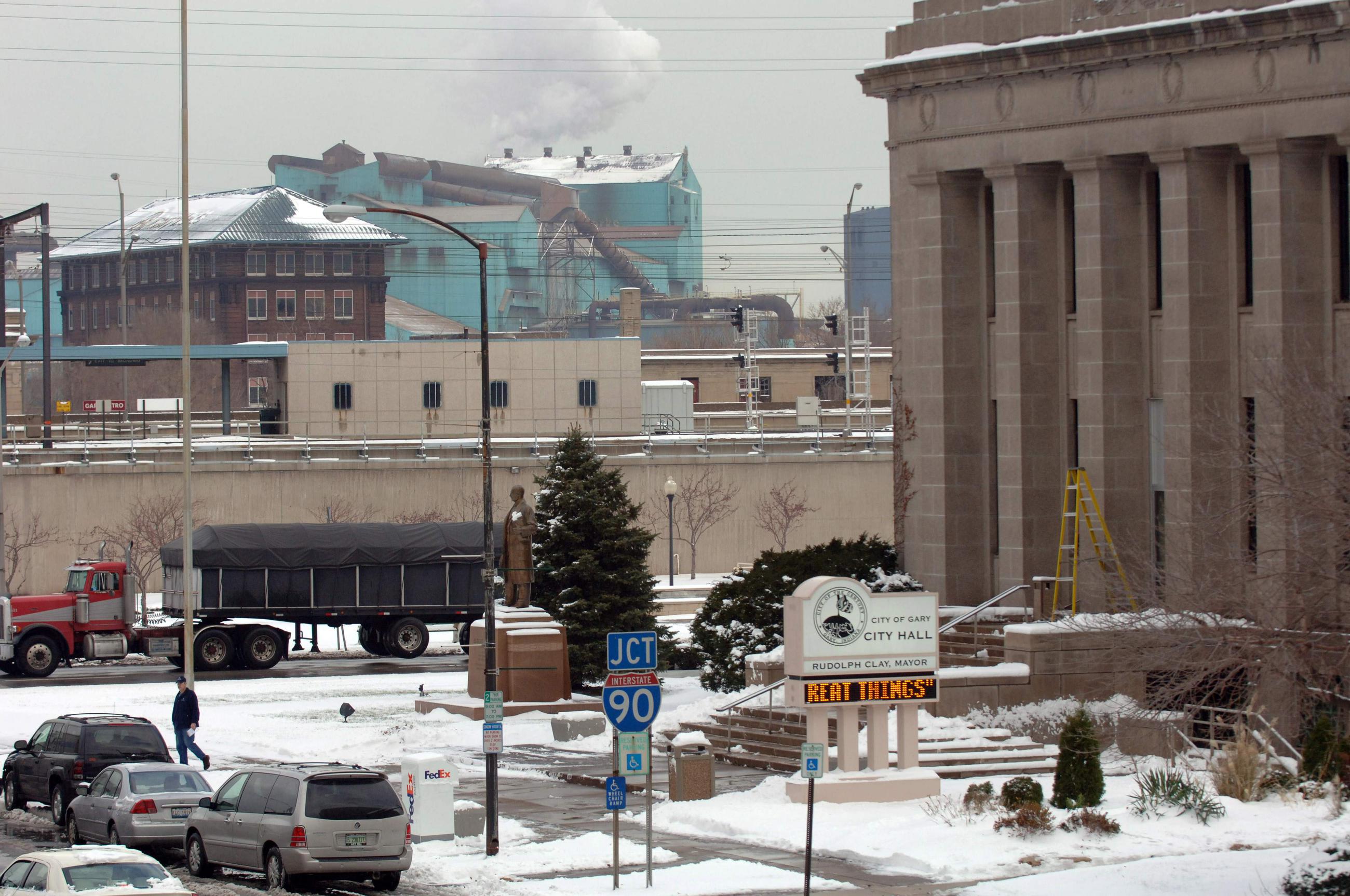
Northwest Indiana is on the precipice of a comeback after years of economic stagnation, poverty, and crime. The region, anchored by the city of Gary, has seen population increases after years of decline, particularly in its more suburban—and traditionally—Republican areas.
As the Democratic Party continues to hemorrhage working-class support, Republicans see opportunity in a seat they haven’t won in nearly 100 years.
Blue-collar wins
As the region’s demography shifts, its politics have as well. Historically a Democratic stronghold, Northwest Indiana has steadily shifted to the right in recent years. After President Biden carried Indiana’s 1st Congressional District by 8 points in 2020, Kamala Harris won it by less than half a point, or 1,300 votes, in 2024.
That said, presidential gains have not yet translated to success in the race for Congress. Democratic Rep. Frank Mrvan has represented the area since 2021, winning his seat after longtime Rep. Pete Visclosky stepped down. Republicans had a chance to flip the seat in 2022, and invested heavily there as Biden’s midterms initially shaped up to be a fruitful year for Republicans, but their standard-bearer Jennifer-Ruth Green lost by about 4 points in what turned into a nasty and expensive affair.
The district hasn’t elected a Republican in more than 96 years, but Republicans have been optimistic about flipping the seat soon. Maybe it won't be this cycle. But some in Washington believe they’ll have the seat by the turn of the decade.
And if Republicans don’t manage to flip it by 2030, the redistricting bell again will toll after the decennial Census. At that point, if trends hold, it’s likely the district will be drawn in Republicans’ favor, giving them the extra seat in the Hoosier State that eluded them in 2025.
As for this year, Washington and Indiana Republicans have coalesced around Barb Regnitz, who they say has the winning ingredients to turn the seat red.
Regnitz launched her campaign at the end of October, just as the ultimately unsuccessful redistricting movement in the Hoosier State heated up. She infused her campaign with a loan of $1.5 million, pledging to spend another $500,000 if needed.
Despite the noise of redistricting, which would have all but guaranteed Republicans this seat had the map passed, Regnitz said she wasn’t deterred by state Republicans' rejection of the bill.
“That was motivation for me. That was not discouraging for me,” Regnitz told National Journal in an interview.
Her campaign caught the attention of National Republican Congressional Committee Chairman Richard Hudson, who told National Journal in a statement that the “momentum is real” to flip the seat.
“With a fundraising advantage and Hoosiers fleeing today's radical far-left Democrat Party, Republicans are on offense to flip Indiana’s 1st Congressional District,” Hudson said.
But one GOP operative in the Hoosier State, who requested anonymity to speak freely, said interest in the seat has come from Washington, not Indiana.
Given the shrinking number of competitive seats, the seat is a logical choice to put on a fundraising or target list, but in-state momentum has always been lacking, the strategist said.
Randy Niemeyer, a Lake County councilman and GOP chairman who was the 2024 Republican nominee for the 1st District, says he has spent the last few years trying to address that issue.
Niemeyer told National Journal that the GOP apparatus in the region has struggled to get the “campaign infrastructure built that will turn a voter contact into an actual vote.”
“What I learned myself is that the Republican infrastructure that exists in D.C. that tries to weave itself into these competitive races is extremely disconnected from the reality on the ground,” Niemeyer said. “The messaging, the decisions on where money is spent, how it's spent, the teams that we build around us, are all kind of used to that national Republican mechanism that I see as extremely out of touch with the reality on the ground here in this district.”
The party began fielding serious candidates in 2022 to try to break the perpetual Democratic vise grip on the seat, but it hasn't quite cracked the code yet.
That hasn’t stopped Regnitz, a Porter County commissioner and first-time congressional candidate, from taking the race seriously.
“I’ve always taken the most challenging path, and to me that is so invigorating. It’s so exciting,” she said.
Aside from political considerations, Regnitz, in her role as a county official, has also thought about the changes happening in Northwest Indiana, a region that is looking to bounce back after decades of economic stagnation.
An American Dream come true?
Since its founding, Gary was held up as a shining example of American dynamism. J.P. Morgan’s U.S. Steel founded the city in 1906. Just seven years later, the Commerce Department—in collaboration with U.S. Steel—produced a film that used the city to illustrate the American dream.
An American in the Making showed an immigrant’s journey from Europe to build a career at the plants in Gary.
The silent propaganda film stresses the safety of the mills, a major concern in those years. And what good is a film without a little romance: The immigrant, taking evening classes as he assimilates into American culture, wins the heart of his teacher.
“Six years later the working man and his family are happy and prosperous,” a title card late in the film reads. It cuts to the man and his now-wife sitting at dinner with their son.
U.S. Steel’s Gary Works plant drove the majority of the industry, contributing 70,000 steel jobs to the local economy at its peak in 1979. That success attracted other steel-related companies such as American Bridge, American Sheet and Tin Plate, and National Tube. The city had no secondary industry. Lake County, home of Gary, peaked in 1970 with a population of nearly 550,000.
Northwest Indiana has endured some growing pains over the half century since then. Or rather, shrinking pains. From 1970 to 1990, the county’s population decreased by 13 percent, according to an analysis by Micah Pollak, an economics professor at Indiana University Northwest.
The decline of the region mirrored the decline of the steel industry. By 1990, steel jobs had shrunk to 27,000. That number cratered to fewer than 12,000 over the next 30 years. As the jobs left, so too did Gary’s people. The population decreased from nearly 180,000 in 1960 to less than 70,000 by 2023.
As population withered, the demography of a once booming industrial hub transformed. The city, which was once a thriving, diverse amalgamation of the American Dream, began to hollow out. The immigrant families who had flocked to Gary from Mexico, Poland, Slovakia, Serbia, Italy, Russia, Hungary, and more in the early part of the century to work at the steel mills fled. The city’s historically Black population was unable to move after years of segregation. As the population declined and aged, household income decreased.
In short, Northwest Indiana was poor.
Renewed revitalization
The shifting demographics and frustrations with globalization have helped Republicans make inroads. With the decline of the steel and manufacturing industry, residents moved to Gary and the surrounding area in search of affordable housing, many commuting to jobs in nearby Chicago.
The outskirts of the district, Porter and LaPorte counties, have leaned Republican in recent years, bringing this seat closer and closer to the battlefield. But Lake County, home to Gary, has remained Democratic and allowed the party sustained success in the area. Gary, a city that is more than 70 percent Black, drives that success. The city supported Harris by 70 points in 2024, but it had the second lowest turnout rate in the county, a sign there wasn’t much enthusiasm for the Democratic ticket.
Those on the ground in Northwest Indiana want to change the region’s reputation and turn it into a hub for people to live, work, and raise a family. But they also want to continue to capitalize on the allure of its proximity to Chicago, one of the largest city economies in the world.
As more people cross from Illinois into the cheaper suburbs of Indiana, the demography has slowly but steadily shifted. It’s part of why Republicans think they can make the inroads necessary to flip the seat. GOP gains with the working class are another big factor. While he got romped in Gary, President Trump lost Lake County by just 6 points and won both LaPorte and Porter. If Democrats can’t revive a winning message for working people, Republicans hope this district will eventually fall in their lap like so many others throughout the country.
Those new people and industries, Republicans hope, will deliver them a district that was for so long an afterthought. Though known for its working-class ethos, the region continues to suburbanize. Steel still remains an important part of the culture, but it has become a more nostalgic symbol in the years since its great decline.
That’s what makes the region so unique. It’s an area caught in the growing pains of modernization while trying to revive what once was. This liminal space makes the ground fertile for Republicans, if they can project a winning message.
Gary Mayor Eddie Melton, on the other hand, is trying to claim that ground for Democrats. A former state legislator, Melton was elected in 2023 after he ousted the incumbent in the Democratic primary by 18 points. Melton, a native son of Gary, said he wanted to return to the city to help advance the policies he advocated for in Indianapolis.
“I truly felt that Gary needed leadership that was going to be able to not only implement but execute a lot of the policies I helped get passed,” Melton told National Journal.
That agenda includes the city’s hallmark development project, the construction of the Lake County Convention Center, which is expected to generate thousands of jobs in the construction and hospitality sectors.
“It’s almost a dream come true,” said Melton, “having this vision as a legislator and now bringing that vision to life and executing it every day."
Transit has been a key element in this updated revitalization effort. The Indiana Regional Development Authority was created 20 years ago to focus on reenergizing some of the “underutilized” transportation assets, the group’s president and CEO Sherri Ziller told National Journal. The RDA has focused on development projects at the Gary/Chicago International Airport, as well as a major $1.5 billion commuter-rail expansion that formally debuted at the end of March.
Ziller says she is optimistic the region will reap the reward in due time.
“In 2016, the RDA projected $2.7 billion in new development catalyzed by the expanded commuter rail access over the next 20 years,” she said. "Because what we are trying to do is capitalize on our proximity to Chicago.”
Matt Wells, the president of One Region NWI, a coalition of local civic and business leaders focused on economic growth and diversification in Northwest Indiana, said he’s met an increasing number of people who moved to the region from across the country. As the nature of work continues to change, including an increase in remote work, Wells sees the area as a naturally attractive place. And with a relatively painless commute to Chicago—generally 45 minutes or less via train from the Gary-Hammond area—leaders want to leverage that proximity.
“Professional scientific and technical services is the fastest growing occupational cluster in Northwest Indiana,” Wells told National Journal. He said new opportunities in health care, education, and construction have contributed to an increase in the number of people coming to work there.
“From just a political strategy standpoint, we always have to be cognizant of multiple layers—both the local, state, and federal levels—because this intersection has a lot of different stakeholders,” Wells said.
This isn’t the first time the city banked on outside investments to save the day. In the 1990s, Donald Trump promised to build a riverboat casino in Lake Michigan.
“We’re going to build something that this area, and that includes Chicago, that this area has never seen,” Trump said at the time. “It’s going to be first-class, it’s going to be world-class.” The future president sold the project as bringing hundreds of jobs to a blighted area. At a press conference in Gary, construction workers held up signs that read “Trump + Gary = Jobs.”
The casino opened in 1996, but the facility was short-lived. Trump Casinos filed for bankruptcy in 2004, and the riverboat was sold to Barden and renamed Majestic Star II in 2005.
Decades later, Trump is again trying to leave his mark on the city.
Tariffs, steel, and the Gary Bears?
Last year, the Trump administration approved a sale of U.S. Steel to Nippon Steel. The $14.9 billion deal includes a $3.1 billion investment in Gary Works, the largest integrated mill in the United States. Trump has made the sale, coupled with major steel tariffs, a centerpiece of his domestic economic agenda.
Trump levied a 25 percent steel tariff during his first term in hopes of boosting American manufacturing, with mixed results. The tariffs helped spur job growth in the steel sector, according to the Brookings Institution, but the cost was passed on to consumers, who paid about $900,000 more in prices.
Last June the president announced a steel tariff rate of 50 percent. Tariffs have become something of a rallying cry for the downtrodden manufacturing industry, but whether they produce results is a different question.
“I think when people hear ‘tariffs’ they say they think it’s a good thing,” said James Paul Old, professor of political science at Valparaiso University. “They think that’s a protective base for the big industry here, but I don’t think it necessarily helps the district economically because we have such a diverse economy.”
Old said that in spite of a dynamic economy, “steel is still symbolically important.”
The tariffs received mixed reviews, but the district’s Democratic representative supports them.
“The Section 232 steel tariffs are critical for our national security and the economic strength of the American steel industry, including the members of the United Steelworkers and all members of organized labor and our workforce,” Mrvan said last year.
The region has also been part of a national cultural conversation recently as the storied Chicago Bears consider a move across state lines to Indiana. Indiana legislators passed a bipartisan offer to lure the Bears to Hammond if the team can’t reach an agreement for a proposed Arlington Heights, Illinois, stadium.
The development has people on the ground giddy at the prospect of a major attraction in the area. Supporters say it would help boost industry.
“The direct economic benefit is significant, but the indirect multiplier is enormous,” said Wells, pointing to potential development opportunities for housing, retail, and hospitality.
Even if the Bears don’t arrive, Wells said the region has already won.
“The earned media for simply being a serious contender for something like this has been priceless,” he said. Wells said that by showing the area can compete for a major league franchise, the campaign for the Bears has changed public perception.
“I think everybody has realized and taken to heart that we can compete at this level and we can win,” he added.
Regnitz, as she attempts to win the 1st District race, says she’s encouraged by the progress in the region but recognizes the work ahead.
She says the question for the region is: “How do we keep our young people here?”
Maintaining stability over the next several years will be determinative to Northwest Indiana's return to prosperity.
But hope abounds.
“I think we've got a great national story to tell,” Melton said.
“Gary will be the greatest comeback story in American history.”