National Journal Logo
×

Welcome to National Journal!

Enjoy this premium "unlocked" content until June 30, 2026.

Continue

‘A shared bond’: How three freshman senators are trying to fix health care

Alsobrooks, Blunt Rochester, and Kim reveal how personal loss is driving their work to reverse health care cuts, save Obamacare, and possibly oust RFK Jr.

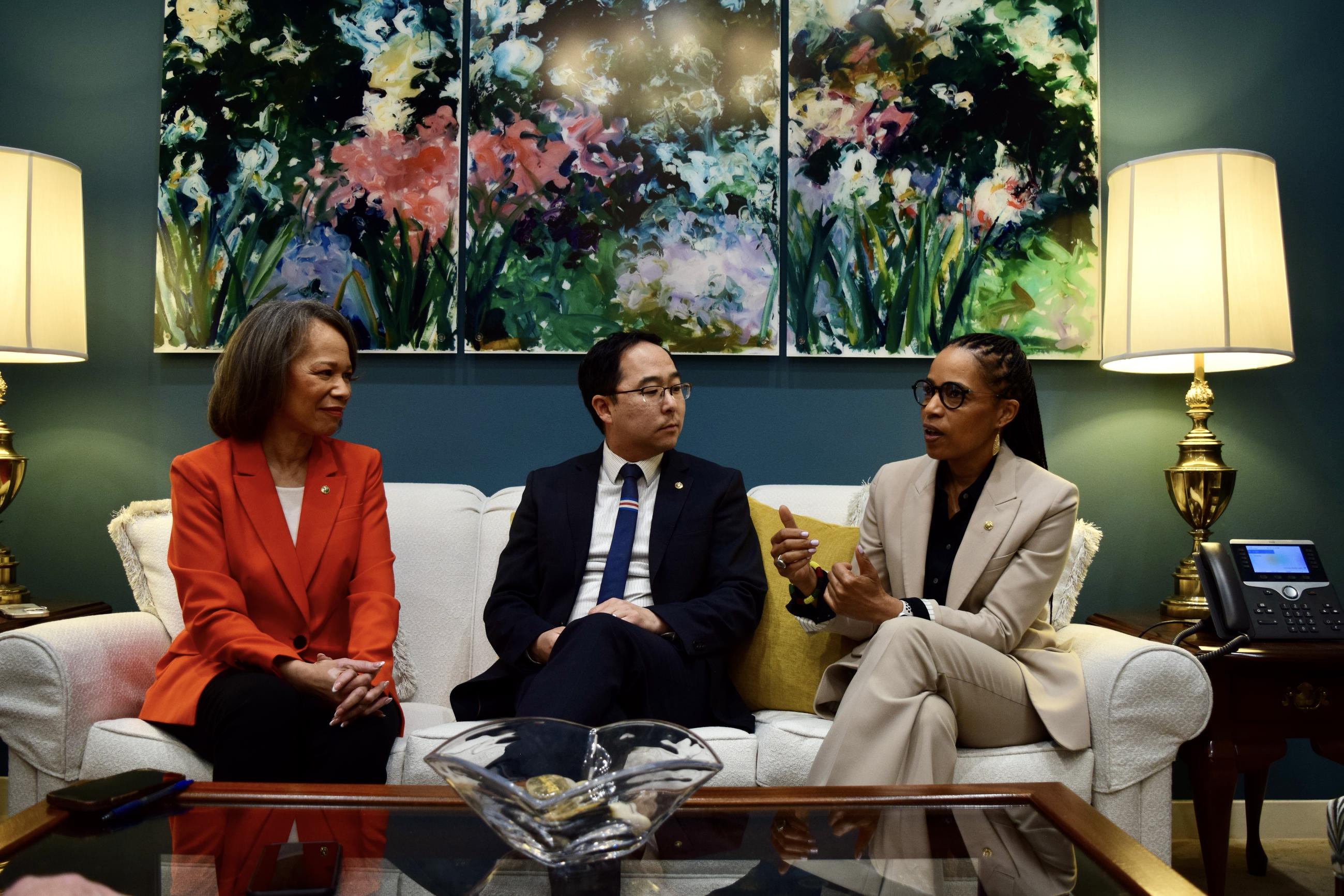
Sens. Lisa Blunt Rochester and Andy Kim listen as Sen. Angela Alsobrooks talks about her priorities for health care. (Photo by Taameen Mohammad)
Taameen Mohammad
Add to Briefcase
Nancy Vu and Ledyard King
April 30, 2026, 8:31 p.m.

For three freshman Democratic senators, health care has always been a guiding light of their politics. But when it affected their fathers, it got personal.

Sen. Lisa Blunt Rochester of Delaware lost her dad in 2024 while she was campaigning for the Senate seat she would win later that year. Sen. Andy Kim of New Jersey delivered his maiden speech in January about his father’s ongoing battle with Alzheimer's disease. Sen. Angela Alsobrooks of Maryland said goodbye to her father earlier this month, losing not only a patriarch but also his wife’s primary caregiver.

The three senators, who call themselves friends, sat down in Blunt Rochester’s office with National Journal this week to recount their shared loss, how they want to turn that grief into policy, and how they want to reform a health care system they say was already broken by the time the Trump administration returned and, they say, made it worse.

Each of the three, who sit on the Health, Education, Labor, and Pensions Committee, generally agreed on fixes but also mentioned different approaches: Alsobrooks wants to impeach Health and Human Services Secretary Robert F. Kennedy Jr., Blunt Rochester wants to make health care systems more accessible and less complicated, and Kim is focused on making prescription drugs more affordable.

They are using what Alsobrooks calls their “lived experiences” to further their goals on health care. But don’t mistake their freshman status to mean they’ll stand on the sidelines of any looming fight.

“The conventional wisdom is that freshmen are not supposed to speak the first year,” Blunt Rochester said. “We didn’t get through the first week at caucus.”

Reversing health care cuts

When asked about their health care priorities if Democrats were to take back the Senate, Kim and Blunt Rochester were adamant about reversing the GOP’s successful attempt to weaken the Affordable Care Act through Medicaid cuts that are set to be enacted through the “One Big Beautiful Bill” Act, and the expiration of enhanced premium tax credits earlier this year. Both former House members started their congressional careers during the first Trump administration’s push to repeal Obamacare.

“Medicaid cuts, those are going to kick in over the course of this next year, and people are really going to feel [it],” Kim said. “There's several [hospitals] in New Jersey that are telling me they're not sure they can keep their doors open.”

Alsobrooks, who represents a deep-blue state with thousands of current and former HHS workers, said the top priority was removing Kennedy.

“Well, first, we need to get rid of RFK Jr., to find a way to impeach him or do something,” the Maryland Democrat said. “That’s a real active threat.”

An attorney, Alsobrooks stands as a political outsider compared to the other freshman lawmakers. She previously served as the executive of Prince George’s county, where she directed the county’s response to COVID. While not a public health expert, Alsobrooks led a more cautious approach towards reopening businesses and lifting stay-at-home restrictions, as the area continued to be a hotspot compared to other counties in Maryland.

“I’ve worked with politicians who are doing public health work—and the thing that strikes me most about the senator is she’s not a public health person. She’s a lawyer,” said George Askew, the county’s former deputy chief administrative officer for Health, Human Services, and Education under Alsobrooks. “But she’s very smart. She's very meticulous and careful about how she reads the science and understands the science.”

The public health work showed Alsobrooks the direct importance of an effective vaccination campaign—putting her at odds with the current administration’s efforts to undermine vaccines.

Impeaching RFK Jr.

Under HHS Secretary Kennedy, the nation has seen a resurgence of measles, with over 1,792 confirmed cases reported in late April. The country’s childhood vaccination schedule has been completely overhauled to mimic Denmark’s, lessening the amount of recommended shots in arms before kids turn 18.

Early into Kennedy’s reign, Alsobrooks became the first lawmaker to call for his ouster. The senator laid out a 54-page report outlining the upheaval at HHS—detailing specific potentially illegal actions that could be a basis for impeachment proceedings.

But stars would need to align for any such proceedings to begin. While one resolution to impeach Kennedy has been introduced in the House, it went nowhere with Democrats in the minority. That could change after the 2026 elections—although there are no active current conversations among the Senate Democratic caucus about impeachment, according to Alsobrooks.

“There’s no big appetite of people talking about impeaching RFK Jr.,” the Maryland senator said. “I will fully take this one on.”

Still, as Blunt Rochester quipped: “She ain’t alone.”

Democrats in the House—where impeachment proceedings would have to begin—have been cautious about going after the president again after the Senate failed to convict him twice in his first term. They have been more eager to go after Cabinet members.

While Kim and Blunt Rochester didn’t quickly sign off on the idea of impeaching the president, they both agreed that Kennedy shouldn’t be in office. Both lawmakers signed onto Alsobrooks’ resolution of no confidence in the HHS secretary.

Not all Democrats are on the same page on how to deal with Kennedy in the next Congress, but they have tried to hold him accountable through committee hearings. During the secretary’s testimony in front of the HELP Committee last week, the trio grilled him on the president’s proposed cuts to disability programs, Kennedy's moves to undermine vaccines, and his past statements arguing that Black children with ADHD should be sent to a farm to be “reparented.”

“We sit next to each other, so it's kind of interesting when we're having these hearings to even hear what each other's saying,” said Blunt Rochester. “If Andy finished a question and didn't get an answer, then to be able to pick up [the line of questioning]—I think that kind of camaraderie has been helpful.”

A new generation of leaders

While the senators hail from different backgrounds, they all belong to the "sandwich generation," raising families and caring for aging parents.

Kim, whose father suffers from Alzheimer’s disease despite having dedicated his life to find a cure for the neurological disease, said he had confided in Alsobrooks during a late-night vote-a-rama. In their conversation, he described an experience of rushing back and forth between caring for his ailing father and his work as a legislator. Not only did he worry about providing the best care, he worried about the cost of care he could provide—despite being a sitting U.S. senator.

“We're not talking theoretically about how we think this impacts a family,” Alsobrooks said. “We're literally living through many of the issues that we are helping to put forward.”

These experiences helped to color their push for affordability, which has become the Democrats’ midterm mantra amid the Trump administration’s tariff wars and federal cuts. To emphasize the point, Kim is currently filming a documentary on his life working simultaneously as a lawmaker and caregiver.

Kim discusses his father's struggle with Alzheimer's disease as Blunt Rochester and Alsobrooks listen.
Kim discusses his father's struggle with Alzheimer's disease as Blunt Rochester and Alsobrooks listen. Taameen Mohammad

Last October, the freshman Democratic senators hosted a meeting in Blunt Rochester’s office to strategize on how to get out of a shutdown over the looming expiration of enhanced premium tax credits. Blunt Rochester and Kim leveraged their relationships from their four and three terms in the House, respectively, to help drive inter-chamber, bipartisan negotiations—inviting moderate Republicans to discuss a plan to renew the subsidies.

The subsidies expired after failed negotiations, but both senators' bicameral relationships could propel legislative dealmaking between the two chambers, they say. Kim said he and Blunt Rochester enjoy “strong, personal relationships with Hakeem Jeffries and others.”

Their bipartisan bona fides could herald a new class of Democratic dealmakers, a group that is slowly shrinking in the Senate with the retirements of Sens. Gary Peters and Jeanne Shaheen. Kim has large legislative wins to tout: a bill he introduced a month after he was sworn in to the House cutting prescription-drug costs for seniors was signed into law with the 2022 Inflation Reduction Act. Not to be outdone, Blunt Rochester secured language in a 2026 funding bill reining in the pharmacy-benefit managers many blame for driving up drug costs.

The Delaware Democrat even has Republican admirers.

“We're in a bipartisan prayer breakfast together, and I just respect the heck out of her,” said Sen. Roger Marshall, a senior member of the HELP Committee. “She has a depth of knowledge, which is very helpful on all these issues.

Alsobrooks can tout her own health care victories. As county executive, she was able to secure funding for the first cancer center and the first mental health and addiction facility in the area.

A protégée of former Sen. Tom Carper, Blunt Rochester served as Carper’s deputy secretary for Delaware’s Department of Health and Social Services, overseeing constituent access to Medicare and Medicaid. She’s worked with Senate Finance ranking member Ron Wyden on a measure that not only extends the enhanced premium tax credits for several years but would restore funding for the Navigator program, which helps to educate and enroll people on the ACA marketplace.

With all her experience, she still found navigating the health care system on behalf of her father confounding.

“We were trying to get help, and [my father] had long-term-care insurance. My sister—one is a professor, the other is an engineer—and I'm a senator, and we couldn't figure it out,” Blunt Rochester said. “It shouldn't be that hard. People shouldn't be denied, denied, denied for things and then get sicker and sicker and die.”

Diversity in the ranks

As the party begins to pivot toward life after Trump, none of the three said they have settled on a presidential candidate for 2028.

The ideal candidate “might not have shown up yet,” Blunt Rochester said.

Some in the party have suggested the nominee should be a white, straight, Christian male as a way to win back the voters lost to Trump. But Alsobrooks asserted that diversity is a problem that Republicans face, not Democrats, especially when their freshman class stands as the most diverse in recent history. And Kim argued that the party should embrace—not abandon—diversity.

“When I was on the House side, I was on the select committee on the coronavirus crisis. I was the only Asian American on that panel,” he said. “I saw how the government wasn’t putting out information about the coronavirus in different languages, and that impeded the ability for different communities to understand what to do and how to be able to get government support in different ways.”

Kim is the first Korean American in the Senate, while Alsobrooks and Lisa Blunt Rochester are not only the first Black female senators to represent their respective states, but also to serve simultaneously in the upper chamber.

It wasn’t always easy. When Kim initially ran for Congress in New Jersey’s 3rd District, which Trump had won, people advised against it, noting that it was a largely white district with a small percentage of Asian voters.

“They said it was impossible for me to win, and I found that to be really humiliating and deeply disappointing to hear that type of effort to basically try to tell me what I am or am not capable of accomplishing simply because of the color of my skin and my last name,” Kim said. “And I hope me and others have helped show that I have every bit as much right to represent that congressional district or the state of New Jersey or anywhere.”

Blunt Rochester lamented how hard it’s been to diversify the Senate, and emphasized why that evolution needs to continue.

“As a person who has been 'the first' and 'the only' in rooms, there's something to be said about a pipeline and bringing more in,” she said. “We're not a monolith. We think differently on some issues—all three of us—but we also, even as freshmen, have a shared bond.”

Welcome to National Journal!

Enjoy this featured content until June 30, 2026. Interested in exploring more
content and tools available to members and subscribers?

×
×

Welcome to National Journal!

You are currently accessing National Journal from IP access. Please login to access this feature. If you have any questions, please contact your Dedicated Advisor.

Login