Rep. Jason Crow has a “very long list” of grievances he wants to take up with the Pentagon.
For now, the Colorado Democrat can’t do much as a member of the minority besides vocally criticize Defense Secretary Pete Hegseth, vote against the war in Iran, and rail against the administration’s record $1.5 trillion defense budget request. But if Democrats retake the House in this fall’s midterms—as polls suggest and forecasters predict—Crow could be swinging an important gavel next year as chair of the House Armed Services Intelligence and Special Operations Subcommittee.
So what would he do?
“Where should I even begin?” the former Army Ranger and Bronze Star recipient told National Journal recently. “We have to end endless conflict and put the American people back in the driver's seat to decide when we send our sons and daughters to war. Let's begin there, right? We need to actually take a look at this ballooning defense budget. They are just throwing billions of dollars at the defense industrial complex, buying things that our military isn't even asking for. And not only is it cheating the American taxpayer, but it's actually not making us any safer, and it's not delivering the defense capabilities that the Pentagon's even asking for.”
Crow is one of a number of Democrats poised to take over key committees and subcommittees next year, assuming the House flips. (The Senate is widely expected to stay under GOP control, though it’s not the slam dunk it once was.)
To slow President Trump’s agenda or hold the administration accountable, a Democratic majority would have the power to subpoena administration officials (a certainty), impeach the president (likelier by the day), or impeach some of his Cabinet members (depends who’s left).
Key to that will be the margin Democrats wield in the lower chamber. The bigger the advantage, the bolder they’ll be. But even if their margin is a single seat, the president will have to navigate an uncooperative House eager to block many of his moves.

And it will depend on who controls who takes the reins of key committees. National Journal looked at who’s in line to chair a number of important panels if Democrats take back the House and what it could mean for their areas of jurisdiction. That could change depending on who decides to campaign for the gavel. For now, here are some key folks to watch, and why:
Rep. Jamie Raskin
The ranking member of the Judiciary Committee, who served as lead manager in Trump’s second impeachment, has been an influential voice against the administration’s aggressive efforts to shrink the size of the federal workforce (many of whom are his constituents) and undermine the civil service. The constitutional scholar from Maryland has been an outspoken critic of Trump’s business and diplomatic ventures, calling them self-enriching deals that line the pockets of the president, his family, and his allies, and violate the Emoluments Clause.
As Judiciary chair, Raskin would wield enormous oversight of federal courts, regulatory reform, anti-trust moves, and government-surveillance programs—areas that intersect with the president’s agenda of expanding executive power. If a Democratic-controlled House decides to impeach Trump a third time or go after Justice Department officials such as FBI Director Kash Patel, Raskin is the likely leader of that effort.
Rep. Robert Garcia
Only in his second term, the former mayor of Long Beach has quickly risen in the Democratic caucus as an outspoken and media-savvy critic of the administration. In his role as ranking member of the Oversight Committee, Garcia has emphasized the need for government accountability and has frequently criticized what he describes as conflicts of interest and abuses of executive authority.
As chair, Garcia would control one of the House’s most powerful investigative bodies. He would be given the authority to look into the Trump administration’s conduct across all federal agencies, and would have subpoena power over executive officials and influence over watchdog investigations. If Democrats reclaim the House, Garcia would be at the forefront of efforts to scrutinize Trump-era governance, much as current chair James Comer went after President Biden.
Rep. Rosa DeLauro
Don’t let the purple hair distract you. Serving in her 19th term, DeLauro is a seasoned pro and an important name to look out for in the 120th Congress. As the Appropriations Committee’s ranking member, the Connecticut Democrat is in line to reclaim the gavel she surrendered in 2023 when Republicans took the House. She is an advocate of labor protections, and health and education funding. She has been essential in negotiating major government-funding packages and pandemic-relief measures.
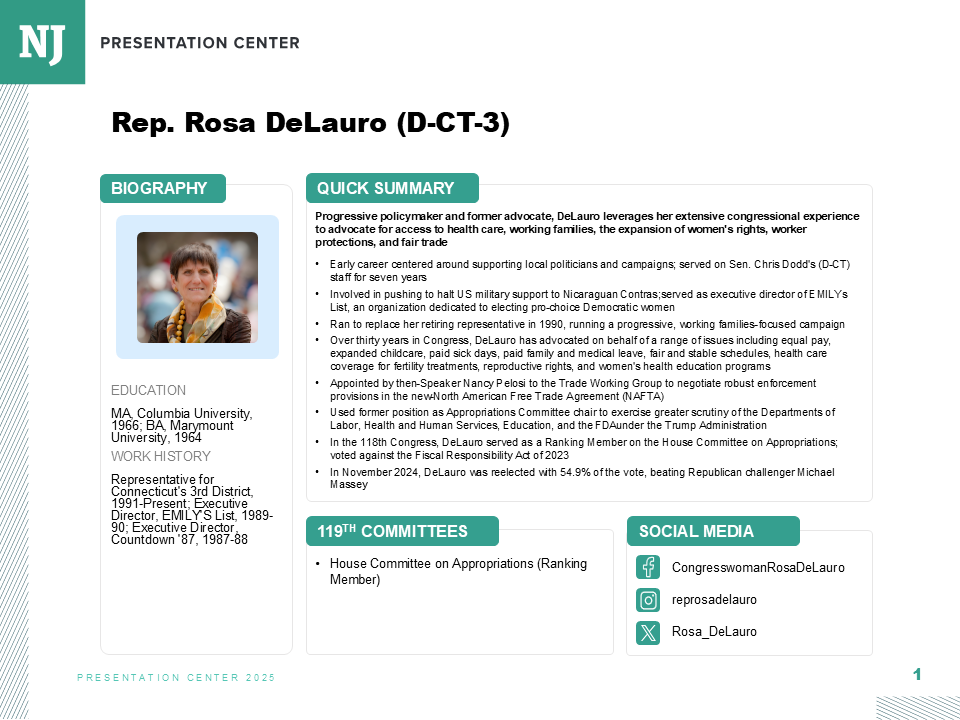
As chair, DeLauro would be the most powerful Democrat on Capitol Hill when it comes to determining the fate of Trump’s budget, with influence in setting funding levels for just about every agency. If there’s a shutdown (there were three this fiscal year, including the ongoing impasse over the Homeland Security Department), she’ll be in the middle. Simply being able to restrict funding for administration priorities that the Democrats oppose places her as a highly important counter to the president’s agenda.
Rep. Adam Smith
The 15-term Washington state Democrat is the ranking member of the Armed Services Committee. He has been a leading Democratic voice on defense policy, U.S. involvement in Afghanistan and Ukraine, and Pentagon accountability. While he favors robust military spending, he also has often called for oversight of Pentagon programs, including “acquisition reform,” for regulation of AI, and for restraint in conflicts.
As chair, Smith would scrutinize Hegseth’s management, potentially launching investigations, as well as holding high-profile oversight hearings and drafting the annual National Defense Authorization Act, which would give Democrats leverage over defense spending and the administration’s national security agenda. Though he has been a vocal critic of the Defense secretary, including his involvement in the Signal chat scandal last year, he has stopped short of seeking his impeachment.
Rep. Bennie Thompson
Thompson, who has represented Mississippi’s 2nd District for more than 30 years, is one of the longest-serving members of the House. He is the top Democrat on the Homeland Security Committee and previously served as chair. He also led the January 6 select committee, directing the investigation into the U.S. Capitol riot.
If Democrats retake the House, Thompson would be in line to reclaim the chairmanship, giving him oversight of the administration's most controversial agencies: Customs and Border Patrol and Immigration and Customs Enforcement. He would have authority to hold hearings, issue subpoenas, and investigate administration policies on immigration enforcement, border operations, Federal Emergency Management Agency disaster response, and more.
Rep. Frank Pallone
The longtime New Jersey progressive is set to reclaim the gavel on the Energy and Commerce Committee, whose bulging portfolio includes trade, communications, energy, environment, and health. Look for Pallone to make aggressive moves on drug pricing (the Garden State is home to pharmaceutical firms), Superfund sites (no state has more on the toxic-site list), and offshore oil drilling.
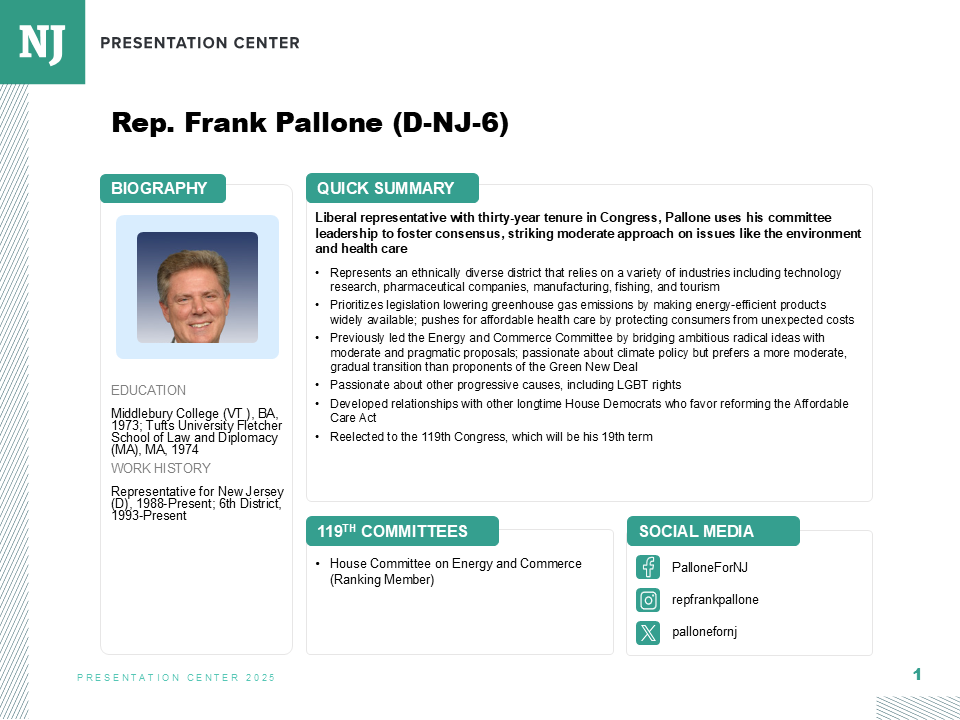
Pallone will be a central figure in the fight against the Environmental Protection Agency’s aggressive deregulation, notably on climate-related fronts, and on health care. Serving his 19th term, Pallone touts his role in passing the 2010 Affordable Care Act, which has been a target of the Trump administration.
Rep. Jason Crow
In addition to Armed Services, Crow sits on the Intelligence Committee. He’s focused on national security oversight, veterans’ issues, and the conduct of U.S. special operations forces. A critic of executive overreach in foreign policy, Crow was selected as an impeachment manager to present the case against the president during Trump's first impeachment trial in the Senate.
Rep. Pramila Jayapal
The Washington state Democrat is one of the most prominent left-leaning voices in the House. The five-term lawmaker chairs the Congressional Progressive Caucus, which she organized as a bloc to move leadership leftward. Jayapal is also a leading proponent of Medicare for all, immigration protections, and student-debt relief.
She currently sits as the ranking member of the Judiciary Subcommittee on Immigration Integrity, Security, and Enforcement. Holding that gavel in the next Congress would give her direct oversight of immigration-enforcement agencies, detention policies, and border-security actions of which she’s been sharply critical. She would also be able to press the administration on its use of executive authority for immigration.
Rep. Linda Sanchez
Representing California’s 38th District, Sanchez is a senior member of the Ways and Means Committee, where she is the ranking member for the Trade Subcommittee. She has focused on labor standards in trade agreements and sustainability of supply chains, co-founding the Congressional Labor and Working Families Caucus. As subcommittee chair, Sanchez would hold oversight authority over Trump’s sweeping tariff regimen. With trade relationships increasingly strained, she could push for more limits on Trump’s use of unilateral authorities in imposing tariffs and reshaping trade policy without congressional approval.
Rep. Henry Cuellar
The longtime Texas lawmaker, who represents a border district, is one of the most conservative Democrats in the caucus. He has focused on immigration-enforcement and border-security funding, often breaking with his party on those issues.
Poised to lead the Homeland Security Appropriations Subcommittee, Cuellar would play an important role in deciding how federal funds are allocated across agencies responsible for border operations, disaster response, and domestic security. That perch would give him influence over the administration’s immigration crackdown, with humanitarian concerns important to the party’s base. Observers will be watching whether his centrist credentials—and a 2025 pardon from Trump for bribery charges—might temper his scrutiny of the administration.