National Journal Logo
×

Welcome to National Journal!

Enjoy this premium "unlocked" content until April 11, 2026.

Continue
WHITE HOUSE FILE

Trump's crusade to 'gerrymander the boundaries of polite society'

The president's comments on the death of Robert Mueller continue his long assault on civility.

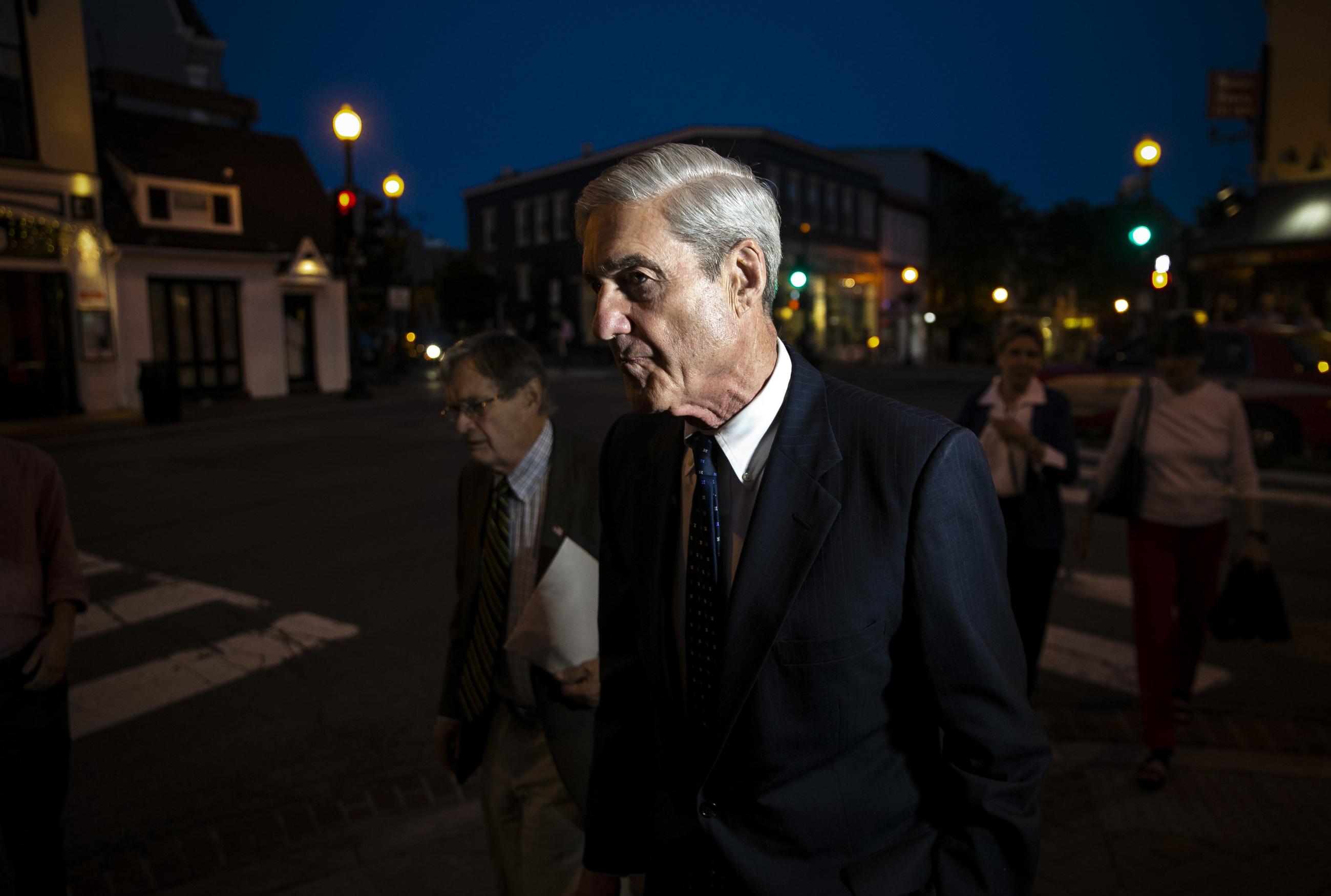
Special Counsel Robert Mueller in May 2019 (AP Photo/Al Drago)
None

Want more stories like this?

Subscribe to our free Sunday Nightcap newsletter, a weekly check-in on the latest in politics & policy with Editor in Chief, Jeff Dufour.

March 25, 2026, 6:59 p.m.

Saturday was a banner day for President Trump’s seeming crusade to rewrite the presidential rules of civility.

At 1:21 p.m., he used Truth Social to post a historically callous reaction to the death of a political foe, coldly responding, “Good, I’m glad he’s dead” at the passing of Robert Mueller. Eight hours later, Arkansas Gov. Sarah Huckabee Sanders, who was Trump’s press secretary in his first term, told a story about her former boss.

“Speaking of the F-word, President Trump introduced my daughter Scarlett to that word at a White House family Christmas party,” she recalled in a speech to the Gridiron Club's annual dinner. “I said, ‘Mr. President, you can’t say that in front of her. She’s only 5.’ He replied, 'Shit. Welcome to the real world.'”

Neither the chilling remark on Mueller, the former FBI director who drew Trump’s wrath when he led the investigation of his Russian ties, nor his use of profanity in front of a child were out of character for the president.

Last year, he reacted harshly to the murder of film director Rob Reiner and his wife. In 2018, he had a similar reaction to the death by cancer of his political foe, Sen. John McCain.

Also, his public use of profanity is well-known. He used the F-word on the South Lawn last June when talking about Israel and Iran violating a ceasefire; he confirmed in December that he had called several nonwhite and poor nations “shithole countries”; and he called President Biden a “son of a bitch” both last year and at a 2023 rally.

That Trump’s “real world” includes such crudeness is no surprise 10 years after he descended the escalator in Trump Tower and entered presidential politics. That eight-hour period on Saturday demonstrated again just how different Trump is from all his modern predecessors when it comes to his behavior, public comportment, and the norms of civility.

The contrast is particularly sharp with the three prior Republican presidents. Ronald Reagan was famed for his willingness to maintain respectful relationships across the aisle. To keep his spirit alive and combat today’s meanness, the Ronald Reagan Presidential Foundation and Institute in 2023 formed a new Center on Civility and Democracy.

Reagan's successor, President George H.W. Bush, may have been the most courteous and civil of all modern presidents. He used his Inaugural address in 1989 to declare “the age of the offered hand.” Turning to the Democratic leaders on the stage, he said, “To my friends—and yes, I do mean friends—in the loyal opposition—and yes, I mean loyal: I put out my hand. I am putting out my hand to you, Mr. Speaker. I am putting out my hand to you Mr. Majority Leader.” His son George W. Bush used his own Inaugural address to “affirm a new commitment to … civility, courage, compassion, and character.” His own presidential center has now launched an “Advancing Civility” initiative.

“Stepping forward even a few terms, it looks very much like a different Republican Party,” said Keith Bybee, author of How Civility Works. Bybee, a law professor and director of the Institute for the Study of the Judiciary, Politics, and the Media at Syracuse University, sees Trump’s latest outburst as both a case of “strategic incivility”—changing the subject away from the war and the economy—and a “deeper effort to redefine what constitutes the baseline of respect in our public life.”

Trump, of course, is not solely responsible for the decline in national civility. Almost eight years before he became a candidate, there was a jaw-dropping comment after a death in Cleveland. When Perry Kucinich, the youngest brother of then-Rep. Dennis Kucinich, died in late 2007, an online poster commented on the Plain Dealer story, “Good. Another dead liberal.”

It was that kind of venomous online commentary that eventually forced the Plain Dealer and many other outlets to eliminate open commenting on stories and remove comments from stories already published. Chris Quinn, editor of the Plain Dealer and Cleveland.com, announced the change in 2020. “Comments have been our biggest flashpoint,” he said. “Anyone getting their impression of our region from comments on our site would think we are the grumpiest, meanest people in America.”

That reality forced most newspaper editors to make similar decisions, though some now are considering restoring them with AI moderation.

Today, that kind of jarring commentary on a death comes not from an anonymous poster but from the most powerful officeholder in the world. The public internalized it right away: Only six months into Trump's first term, the Marist Poll found that 70 percent of Americans thought civility had gotten worse with him as president.

The Pew Research Center found last year that only 29 percent of the country considers him a good role model. In a similar poll in January 2024, 40 percent called Biden a good role model.

Trump's attack on Mueller was not the shock it might have been before his churlish reactions to the deaths of McCain and Reiner. Perhaps more shocking was the timidity and silence of most of the Republican establishment, which once cheered Reagan and the two Bushes.

About the only national Republicans who criticized Trump’s Mueller post were Sen. Thom Tillis of North Carolina and Rep. Don Bacon of Nebraska—both of whom are retiring at the end of this Congress.

“What’s significant is how so many of the president’s followers are falling in line,” observed Bybee, saying what Trump is doing is similar to reapportionment. “He is seeking to gerrymander the boundaries of polite society.”

Unknown, he said, is how Trump’s actions will affect the younger generations watching him today: “Are people going to start adopting this understanding of what constitutes appropriate behavior in their own lives?” No one has an answer to that.

What We're Following See More »

WASHINGTON (AP) — Judge orders Trump administration to halt construction of $400 million White House ballroom unless Congress OKs plan.

— Phil Lewis (@phillewis.bsky.social) March 31, 2026 at 3:13 PM

Welcome to National Journal!

Enjoy this featured content until April 11, 2026. Interested in exploring more
content and tools available to members and subscribers?

×
×

Welcome to National Journal!

You are currently accessing National Journal from IP access. Please login to access this feature. If you have any questions, please contact your Dedicated Advisor.

Login