President Trump's nomination of Casey Means to be surgeon general is stalled in the Senate—in what is shaping up to be a body blow for the Make America Healthy Again movement she champions along with Health and Human Services Secretary Robert F. Kennedy Jr.
A Senate Health, Education, Labor, and Pensions Committee vote on the nominee has yet to be scheduled following her confirmation hearing before the panel last month. And it won’t, as long as Republicans on the committee—specifically Sens. Susan Collins and Lisa Murkowski—continue to harbor concerns about Means’s qualifications to be the nation’s doctor, sources tell National Journal.
These senators are particularly unhappy about the nominee’s refusal during her Feb. 26 nomination hearing to broadly encourage constituents to get vaccinated—a key issue that has ignited conflict between the moderate Republicans and Kennedy.
“I think it's fair to say that there are others on the committee that have shared some concerns, and so if there's one Republican that has issues it makes it tough to move somebody out of the committee,” one Republican senator on the committee, who was granted anonymity to speak freely on the issue, told National Journal.
Means, a darling of the MAHA movement and a Kennedy ally, has faced scrutiny for lacking the credentials that have previously been required of past surgeon generals, including an active medical license and experience serving in the U.S. Public Health Service Commissioned Corps—an agency of uniformed officers charged with protecting and promoting the safety of the general public. The surgeon general oversees the USPHSCC.
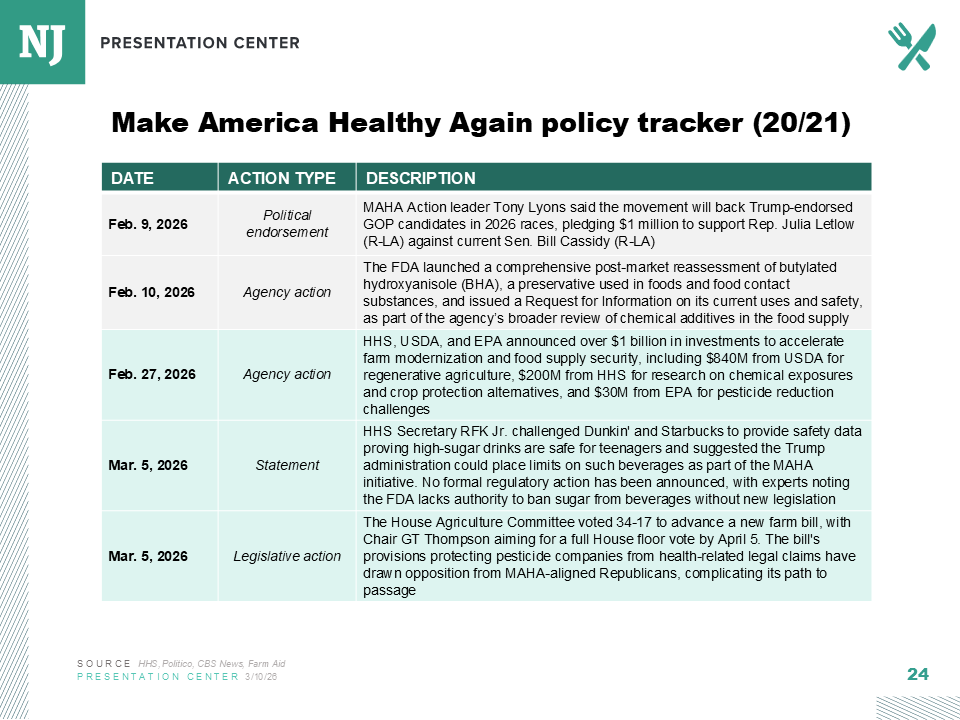
Means’s inability to win confirmation would be the most visibly significant setback for the MAHA movement, and Kennedy's efforts to upend decades of traditional medical policy over vaccines and nutritional guidelines. Cracks have already emerged between the MAHA movement and Trump’s MAGA base—particularly over the use of industrial pesticides by farmers—but Means’s rejection could signal MAHA’s eroding influence over Republicans.
“If people recognize that the MAHA movement is a key component of the Republican Party, I think they need to vote her in,” said Vani Hari, a prominent MAHA influencer otherwise known as “Food Babe.” “Otherwise, they're going to lose the soul of the MAHA movement. And I think that's really at risk here.”

A Senate HELP Committee spokesperson declined comment.
No plans to withdraw nomination
The HELP Committee is made up of 12 Republicans and 11 Democrats. Just one Republican opposing the nomination puts it in limbo. Further complicating Means's confirmation is that one of the panel's Republican members—Sen. Markwayne Mullin—is in his own confirmation process to lead the Homeland Security Department. That would remove a “yes” vote for Means until another GOP senator takes his place on the panel.
It’s unclear whether Means would have the votes to clear the Senate floor if she were to make it out of committee. At least one Senate Republican outside the panel has indicated they’re a “hell no” if the nominee reaches the floor, telling National Journal they have concerns about the nominee’s lack of qualifications following the hearing. Sen. Mitch McConnell—who is retiring—already voted against Kennedy over his anti-vaccine rhetoric.
An HHS official told National Journal the White House and HHS have no plans to withdraw the nomination.
“These senators are simply engaging in an attempted character assassination,” the official said. “Casey’s given voice to MAHA moms and has communicated a vital public health message that people voted for, that we need to fundamentally transform our health care system to promote healthier lifestyle, not sick-care.”
White House spokesperson Kush Desai said the Trump administration remains firmly behind the nominee.
“Dr. Casey Means’s elite academic credentials, research background, and advocacy on America’s chronic disease epidemic will make her a critical asset for President Trump’s push to Make America Healthy Again,” Desai said in a statement. “The administration continues to have productive conversations with the Senate to advance Dr. Means as our next surgeon general, and the White House looks forward to her swift confirmation.”
It's rare but not unheard of for nominees to get a hearing but no vote. It happened twice under President Biden: Neera Tanden (nominated as head of the Office of Management and Budget) and Sarah Bloom Raskin (nominated for the Federal Reserve Board) both withdrew after it was clear they wouldn't get a favorable recommendation from the Senate panels vetting them.
Vaccine concerns work against Means’s nomination
What seems to be at issue are Means’s unusual résumé compared to past surgeon generals and her refusal to broadly advocate for vaccination, a position that would carry important weight coming from the nation’s doctor. Means’s testimony last month further underlined that she would look to boost Kennedy’s anti-vaccination efforts, rather than serve as a check to them.
During her hearing, Means said she believes “vaccines save lives” but declined to answer directly whether she’d widely recommend inoculation against diseases such as the flu and measles, particularly amid an uptick in measles cases across the country.
“I’m not an individual's doctor, and every individual needs to talk to their doctor before putting a medication in their body,” Means said in February. “I absolutely am supportive of the measles vaccine, and I do believe vaccines save lives and are an important part of the public health strategy.”
Ahead of the hearing, Democrats and some Republicans were skeptical of the nominee. Following the hearing, a few moderate Republicans were still concerned about her answers—particularly Murkowski and Collins.
“It troubled me that she was having so much difficulty answering what I thought was a pretty straightforward question,” said Murkowski, who voted to confirm Kennedy last year. She noted that in Kennedy's hearings “he made certain assurances about vaccines that, in fairness, I'm not seeing being kept.”
Kennedy has led a dramatic overhaul of the childhood vaccine schedule—reducing the amount of vaccines children receive and modeling the schedule to resemble Denmark’s. And while the secretary has recently focused more on nutrition and reining in the food industry, the vaccine issue has become a sore spot for Republicans heading into the midterms.
“I want to know whether she will take the approach that Dr. Oz has taken in telling people to get vaccines,” Collins told National Journal last month, referring to Centers for Medicare and Medicaid Services Administrator Mehmet Oz.
Although Means pledged not to make vaccinations a key part of her message if she were to be confirmed, it seems to be the primary obstacle to her nomination.
During her hearing, Collins brought up concerns about excerpts in Means’s book, Good Energy, in which she encourages readers to try psilocybin-assisted therapy and says she was inspired to try psychedelics. Collins has made combating drug overdoses and addiction a key priority during her political career.

"Illicit drug use remains a huge problem in this country, and this didn't happen in your teen years, according to your book," Collins said, before asking if the nominee stood by her previous comments and how she would talk to the public about drugs.
Means responded that what she may support as a private citizen “is, in many cases, different than what I would say as a public health official."
Cassidy has not scheduled a vote
HELP Chair Bill Cassidy has declined to comment on whether he would support the nominee or when he would put the nomination up for a markup. Cassidy is facing a tough reelection bid in Louisiana this cycle following his 2021 vote to convict Trump over charges of inciting an insurrection following the Jan. 6 Capitol riots.
The stalling of the nomination hasn’t gone unnoticed. Hari, who was present for Means’s hearing, has asked her followers to call the offices of Murkowski and Collins and demand that they support the nominee.
And the lack of a nomination markup has been a target of campaign ire from Cassidy’s Trump-endorsed primary challenger, Rep. Julia Letlow. The congresswoman dinged the chairman for refusing to state where he stands, claiming the senator is “stalling” the nomination.
Cassidy rebuffed the claims, stating his responsibility as chairman takes precedence over campaign squabbling.
“When you are a committee chair, you have responsibilities and must behave responsibly,” he said. “When you're not, you can say things which are foolish. It’s easy to carp when you don't have responsibility; it’s easy to speak irresponsibly.”
Others noted the tough predicament the Louisiana Republican is in, as he'd likely face blowback for any perceived departure from the Trump administration’s agenda after years of criticizing the president.
“But you know what good committee chairs do? They don't out their members who are generally with them,” said another Republican senator. “They just inform the administration that they may not have the votes. And in the normal course of business, that allows for a quiet withdrawal.”