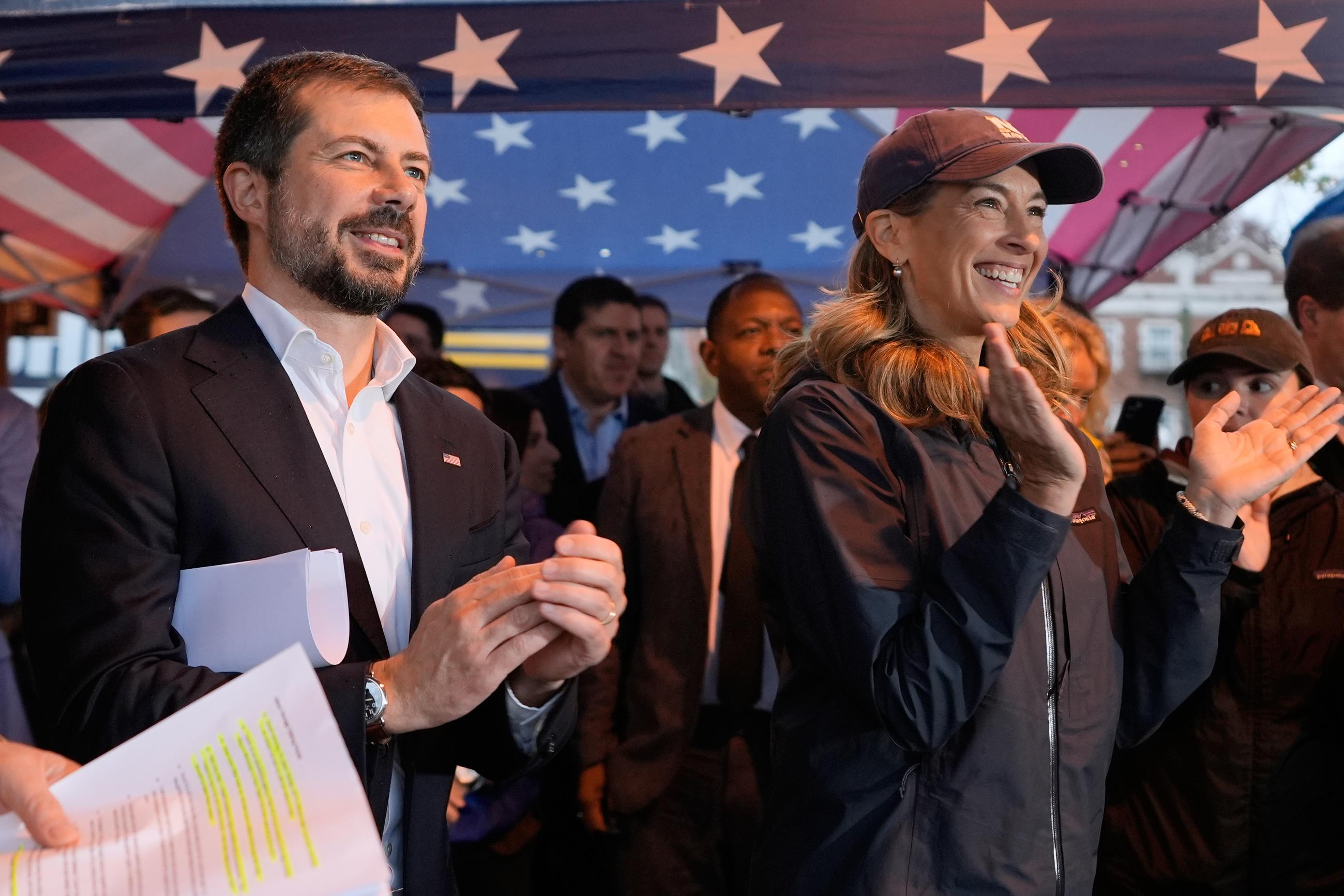
Now out of office for a year, former Transportation Secretary Pete Buttigieg is tanned, rested, and ready for the midterms.
After opting against a run for the open Senate seat in Michigan, Buttigieg is one of a handful of Democrats rumored to have 2028 ambitions who does not currently hold elected office. To maintain his national presence—a challenge as he grapples with his involvement in the Biden administration—he’s hitting the stump and rolling out endorsements ahead of the midterms.
In the last two weeks, he has swung through New Hampshire with Rep. Chris Pappas as he runs for Senate, stumped with Sandra Jauregui in Las Vegas as she campaigns for lieutenant governor of Nevada, and appeared alongside Bob Brooks, a blue-collar Democrat running in Pennsylvania’s 7th District.
Buttigieg’s “goal is to be as helpful as possible to the campaigns he’s backing while demonstrating to Americans—and his own party—that we’re not campaigning to return to the status quo in D.C.,” a source close to Buttigieg told National Journal.
Also unlike many in the 2028 field, Buttigieg has run a presidential campaign before. Several of his endorsements this cycle stem from relationships formed during his 2020 campaign. Jauregui and California Lt. Gov. Eleni Kounalakis, two candidates Buttigieg has endorsed this cycle, endorsed him in 2020.
“He’s a particularly effective messenger and is very in demand in a lot of these purple areas,” Jennifer Holdsworth, a Democratic strategist who ran Buttigieg’s race for Democratic National Committee chair in 2017, told National Journal.
These trips to early states coincide with his flurry of endorsements, which range from battleground House candidates like Rebecca Cooke in Wisconsin to mayoral candidates in Seattle and Mobile, Alabama.
His earlier experience as mayor of South Bend, Indiana, “absolutely still informs the things he talks about,” Holdsworth said, adding that he has tried to campaign in a way that shows the importance of both local and national politics.
“You might look at all that’s going on in Washington and throw up your hands because the truth is there’s only so much we can do about that for the next three years,” Buttigieg said at a rally in October for Abigail Spanberger's successful gubernatorial campaign in Virginia. “Or you could remember the importance of the fact that our system places so much power in the hands of the people you are about to elect: state leaders.”
Buttigieg is not the only national figure to get involved in these races. Illinois Gov. J.B. Pritzker, Kentucky Gov. Andy Beshear, and Sen. Ruben Gallego joined Spanberger on the campaign trail last fall. Pritzker and Sen. Cory Booker appeared alongside Jauregui last month.
“It’s very all-hands-on-deck across the party,” Holdsworth said.
In some ways, Buttigieg is running a shadow campaign at a disadvantage. Unlike Pritzker, Beshear, or California Gov. Gavin Newsom, he can’t generate 2028 buzz through any official actions that would have a real effect.
“You don’t get to make news just by putting a statement out,” longtime Democratic strategist Steve Schale told National Journal.
Buttigieg also hasn’t announced a book tour, another tried-and-true method for presidential shadow campaigners.
Other potential 2028 candidates have another opportunity to preview their campaigns that Buttigieg doesn’t: a reelection race. Booker, Pritzker, Pennsylvania Gov. Josh Shapiro, and Maryland Gov. Wes Moore are all seeking reelection this cycle, despite rumors swirling that they will seek the presidential nomination in 2028.
But these candidates, Schale said, are in an awkward middle ground with voters unsure if they will serve full terms upon reelection or leave partway through to run for president.
Candidates out of office like Buttigieg don’t have to worry about missing narrow votes or taking controversial ones. Unencumbered by official responsibilities or a voting record, they can dedicate all their time to appearing on podcasts and hitting the stump without accusations that they’re abandoning constituents.
Along with his consistent appearances on cable news shows, which helped launch him to political stardom during his first presidential campaign, Buttigieg has popped up on an array of podcasts and given talks at universities including Duke and Lehigh.
“There’s a lot more avenues to be heard,” said Democratic strategist Rodell Mollineau.
On the stump, Buttigieg has not shied away from discussing his role as Transportation secretary, despite voters' negative perceptions of the Biden administration, though he does not always mention former President Biden by name. Some Biden administration alumni running for Congress have avoided mentioning their time with the former president.
Buttigieg said at the rally for Spanberger that when she was in the House, they “worked side by side to deliver the biggest infrastructure package in modern memory, delivering hundreds of improvements across Virginia alone.” Speaking in Charlottesville, he boasted of the funding for the local airport and for replacing gas lines there. He had a similar line while stumping for Mikie Sherrill's gubernatorial campaign in New Jersey, pointing to $16 billion in funding approved for the Hudson Tunnel Project.
“He has his own brand, he’s a thoughtful politician, and his voice in the race among many others will make for a more robust Democratic primary,” Mollineau said.
Currently holding political office is by no means the only path to the presidency. Donald Trump famously sailed into office without any political experience whatsoever. Former President Obama ran as a freshman senator against Hillary Clinton, who by then was a two-term senator and the former first lady. Biden, who had a storied political career before becoming president, was also out of office when he launched his 2020 campaign.
“Two of the last three presidential elections have showed that the things that maybe we believe are important might not necessarily be tracking with what general-election voters believe are important,” Mollineau said.