March 4, 2026, 7:12 p.m.
In failing to address the nation in the days after launching military operations against Iran, President Trump broke sharply with post-World War II precedent, rejecting the example of the past 12 presidents and echoing the approach of the one president who didn’t try to rally Congress or the public behind his war plans—and grew to regret it.
Where other presidents took to TV for somber explanations of why they had sent American troops into harm’s way, usually with prime-time presentations from the Oval Office, Trump once again did it his way.
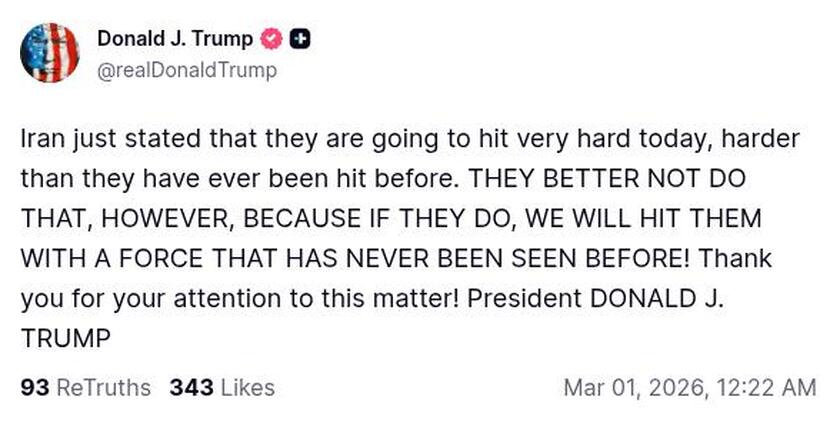
That meant remaining at his Florida resort, Mar-a-Lago, and largely staying out of public view. The attack on Iran began at 1:15 a.m. EST Saturday morning. At 2:30 a.m., the president, tieless and wearing a USA ball cap, released a video statement to his Truth Social account. At 4:35 a.m., he posted to that account an accusation that Iran had tried to defeat him in 2020 and 2024. Twelve hours later, at 4:37 p.m., he posted that Supreme Leader Ali Khamenei had been killed. Shortly after midnight, again on Truth Social, he warned Iran not to retaliate “BECAUSE IF THEY DO, WE WILL HIT THEM WITH A FORCE THAT HAS NEVER BEEN SEEN BEFORE!”
Other than his appearance at a fundraiser for MAGA Inc. on Saturday at Mar-a-Lago, Trump was out of sight until Sunday when he returned to Washington.
The audience for these posts was decidedly smaller than if he had delivered an address from the White House. He has 1.8 million followers on Truth Social. His State of the Union address last week drew 32.6 million viewers, according to Nielsen. In 2011, President Obama’s announcement of the death of Osama bin Laden had 56.5 million watching, and about half that, 25.6 million, watched his speech on military strikes against Libya.
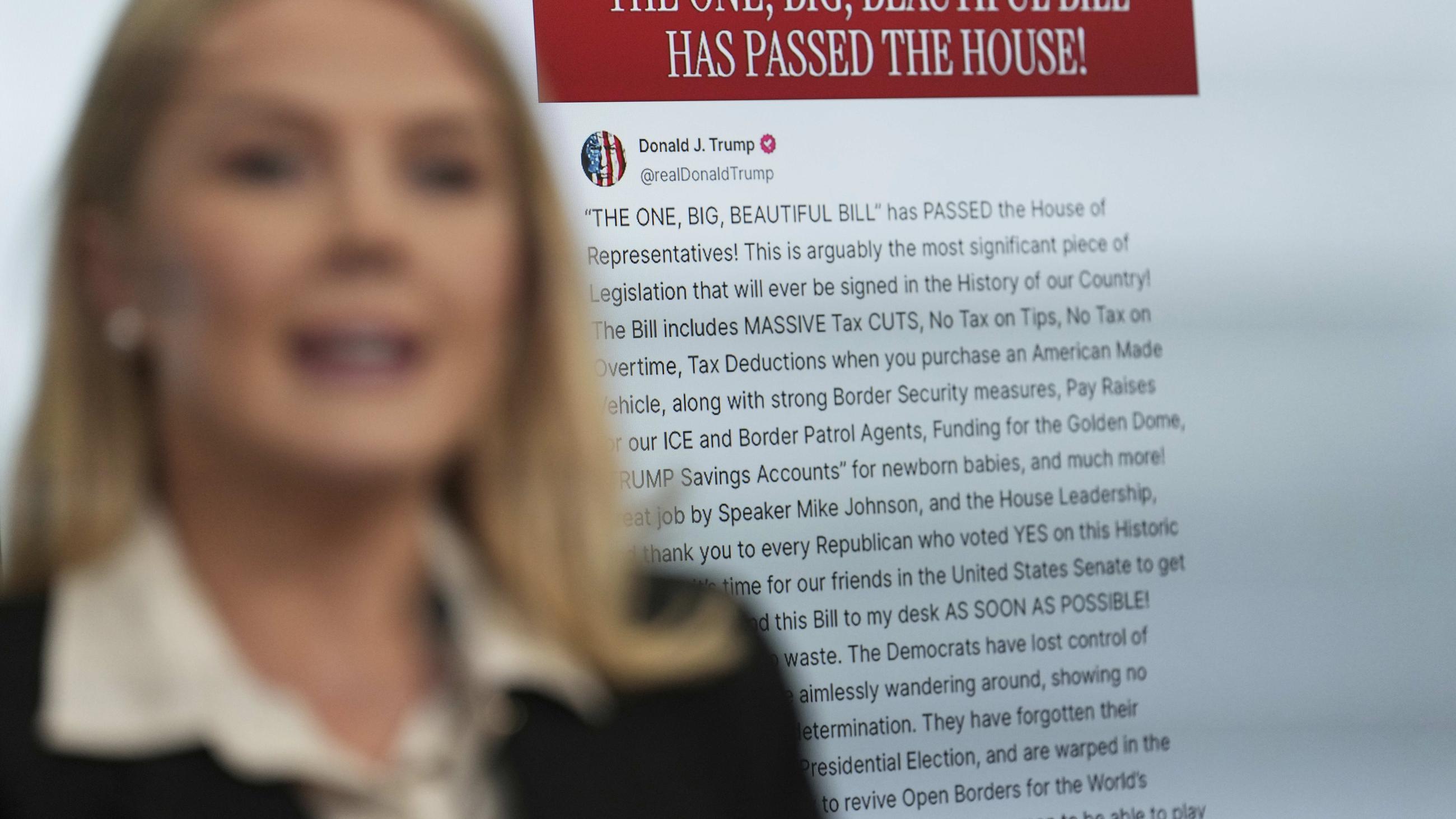
Those earlier presidents believed the solemnity of the Oval Office setting and the reach of a prime-time address helped them build support for their war policy both among the public and in Congress. That has not been Trump’s priority. His message after the Supreme Court ruled against him on tariffs was one he first voiced during the campaign: “I don’t need Congress.” The same holds for foreign policy. Asked if he would ever request authorization for war with Iran, he told RealClearPolitics, “No, I do not believe so.”
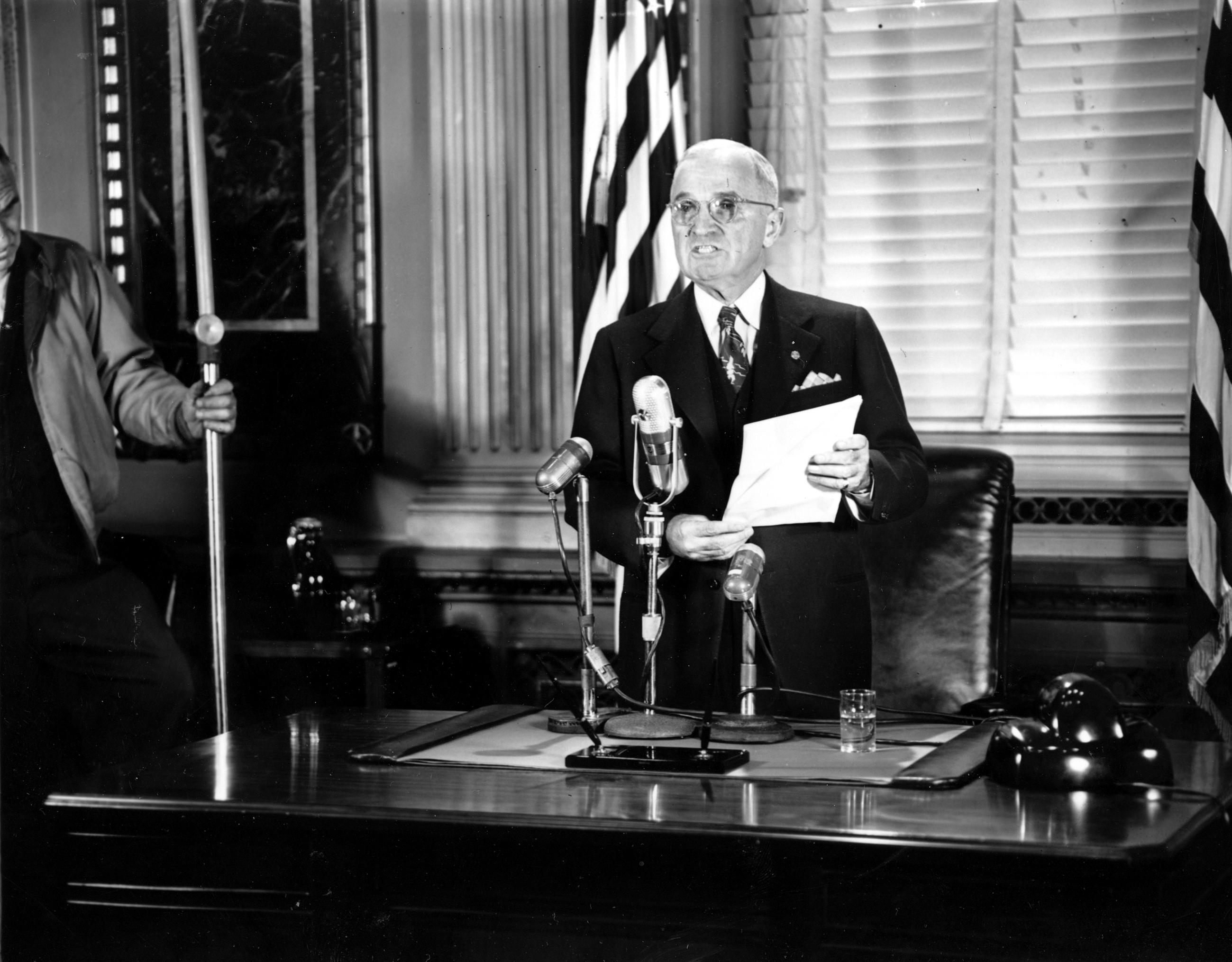
In that, he has a role model in one wartime president—Harry Truman. In 1950, Truman sent troops to Korea without heeding advice to go to Congress for approval or address the nation. According to historian Michael Beschloss in his 2018 book, Presidents of War, Truman reasoned he was acting not as president but “as commander-in-chief of our forces in the Far East.” He decided not to seek public support because he worried about spreading a “war psychosis.”
In 1951, he made his view of Congress’ role in war-making clear, telling reporters, “I don't ask their permission, I just consult them.” Beschloss quoted him as saying he liked President James Polk “because Polk regularly told Congress to go to hell on foreign policy matters.”
But, Beschloss concluded, Truman’s approach led to plummeting poll numbers and a hostile Congress when the war news soured.
That Trump did not take advantage of the State of the Union to make more than a cursory pitch on Iran and did not seek the larger audiences available from a White House address is in keeping with his response after his earlier actions as commander in chief this term.
Since returning to office, Trump has ordered lethal strikes against targets in Somalia, Iraq, Yemen, Iran, the Caribbean Sea, and the Pacific Ocean. In recent decades, those actions would trigger Pentagon or White House briefings with officials outlining the casus belli, the reason the military was used. In this administration, though, disclosures of those strikes were decidedly Trumpian—either triumphant announcements on Truth Social or remarks to reporters.
The first operation, 12 days after the inauguration, featured airstrikes in Somalia (announced on Truth Social). The next month saw a “precision airstrike” against an Islamic State leader in Iraq (Truth Social and X). Then came naval and air bombardments against Yemen’s Houthi rebels (Truth Social). On June 22, U.S. warplanes joined Israel in striking Iranian nuclear facilities (Truth Social). On Sept. 2, Trump launched the first of many attacks on boats departing Venezuela that he contended were carrying drugs. He mentioned the strike to reporters in the Oval Office, with follow-up postings from the State Department X account and Trump’s Truth Social account. And on Jan. 3, when "Operation Absolute Resolve" resulted in the capture of Venezuelan President Nicolás Maduro, Trump made the announcement early in the morning on Truth Social, followed by a press conference later that day at Mar-a-Lago.
White House press secretary Karoline Leavitt told The Washington Post that Trump was “very busy” on Saturday and Sunday and believed “the most effective way for him to get that message out … was by a Truth [Social post], and obviously it was a statement heard around the word.”

This photo provided by the White House, which has been partially blurred, shows President Trump talking with CIA Director John Ratcliffe, Secretary of State Marco Rubio, and White House Chief of Staff Susie Wiles at Mar-a-Lago in Palm Beach, Fla., during Operation Epic Fury on Saturday. (Daniel Torok/The White House via AP)
None
White House communications director Steven Cheung was more biting when New York Times reporter Peter Baker noted that the president did not return to the White House to address the nation. “Imagine being a reporter so consumed with Trump Derangement Syndrome that he wants President Trump to mimic the failed policies of the past,” Cheung posted on X. “The truth is that President Trump spent the majority of his time monitoring the situation in a secure facility, in constant contact with world leaders, and made multiple addresses to the nation that garnered hundreds of millions of views.”
George Edwards III, who has extensively studied presidential communication strategies, said there is no post-Truman precedent for Trump’s handling of Iran. “I can’t explain the fact that he just went silent over the weekend. I don’t know what was in his head,” said Edwards, the Jordan chair in presidential studies emeritus at Texas A&M University.
“If he could get the public on board at the beginning, that encourages more support in Congress," he added. "And the more he has Congress saying this is a good idea, then the more stake they have in the success of the program and the less likely they are to abandon him early if things go bad. He’s very good with people who agree with him. But in this case, a great portion of the country does not agree with him. … So when you start getting more casualties, that’s not going to be helpful for Donald Trump.”
One veteran of the George W. Bush and Bill Clinton National Security Councils, who asked to speak on background, said Trump's decision to wear a ball cap for his initial announcement “underscores how unconventional his entire approach has been to this."
"He has deviated from the customary script in more important ways: failing to build support in Congress, failing to build support among allies, failing to make a case to the public.”
That, he said, will not matter if the operation succeeds quickly. “But,” he added, “if this becomes costly, then we will learn whether the Trump way is a better way. Every other president has needed the rally that comes from mobilizing the public to sustain public support when the going got tough."