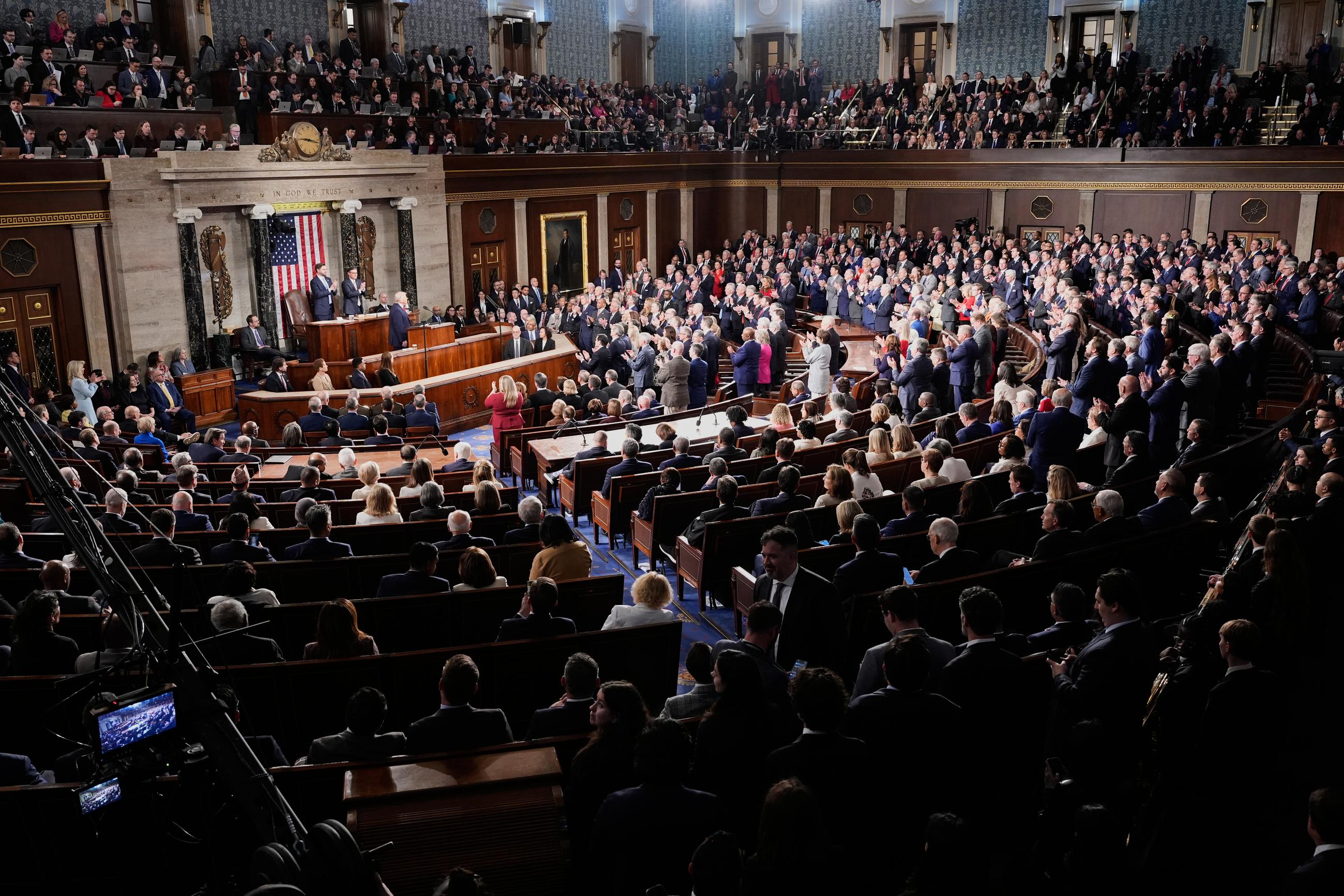

Though President Trump didn’t roll out any grand proposals during his record-setting State of the Union address Tuesday, he did assign Congress a honey-do list of tasks he wants completed in the coming months.
The president pressed lawmakers to codify drug prices, revamp the nation’s voting rules, and restrict undocumented immigrants from being licensed to drive commercial vehicles. He urged them to ban members from insider stock trades and fund the Homeland Security Department, whose workers have been responding to weather emergencies without pay.
“Tonight I’m demanding the full and immediate restoration of all funding for the border security, homeland security of the United States, and also for helping people clean up their snow,” he said in the speech.
For a president who’s spent the first year of his second term finding ways to bypass lawmakers, it was a rare acknowledgement that he might need their help on a few things. The question is whether they’ll accede to his wishes.
Let’s look at the five big asks Trump made of Congress Tuesday and the chances they are fulfilled this year:
- Passing a DHS appropriations bill: Very likely
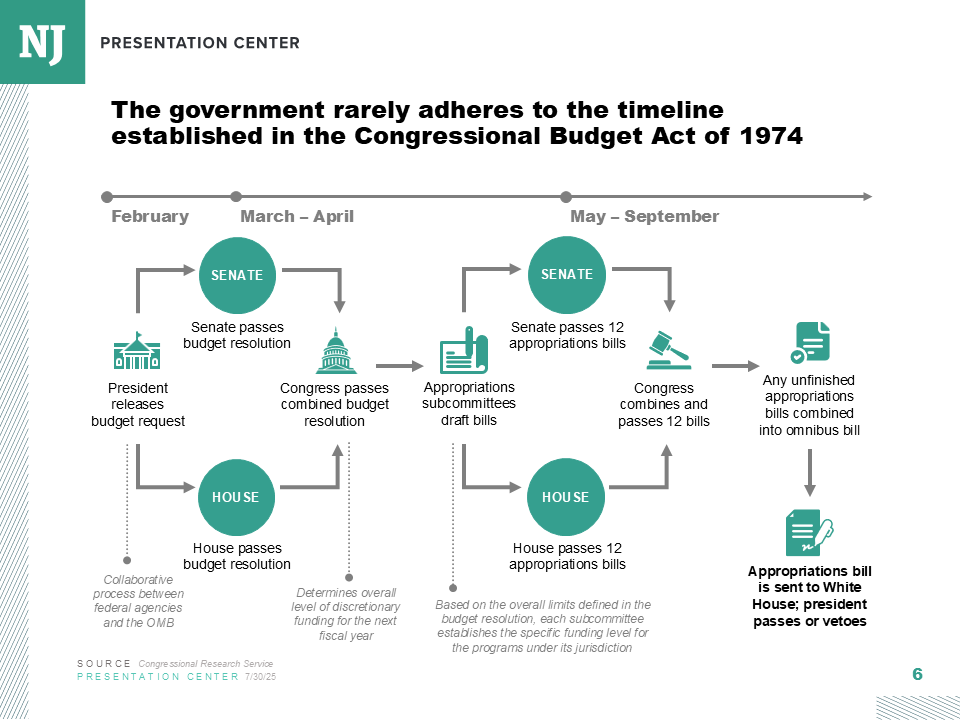
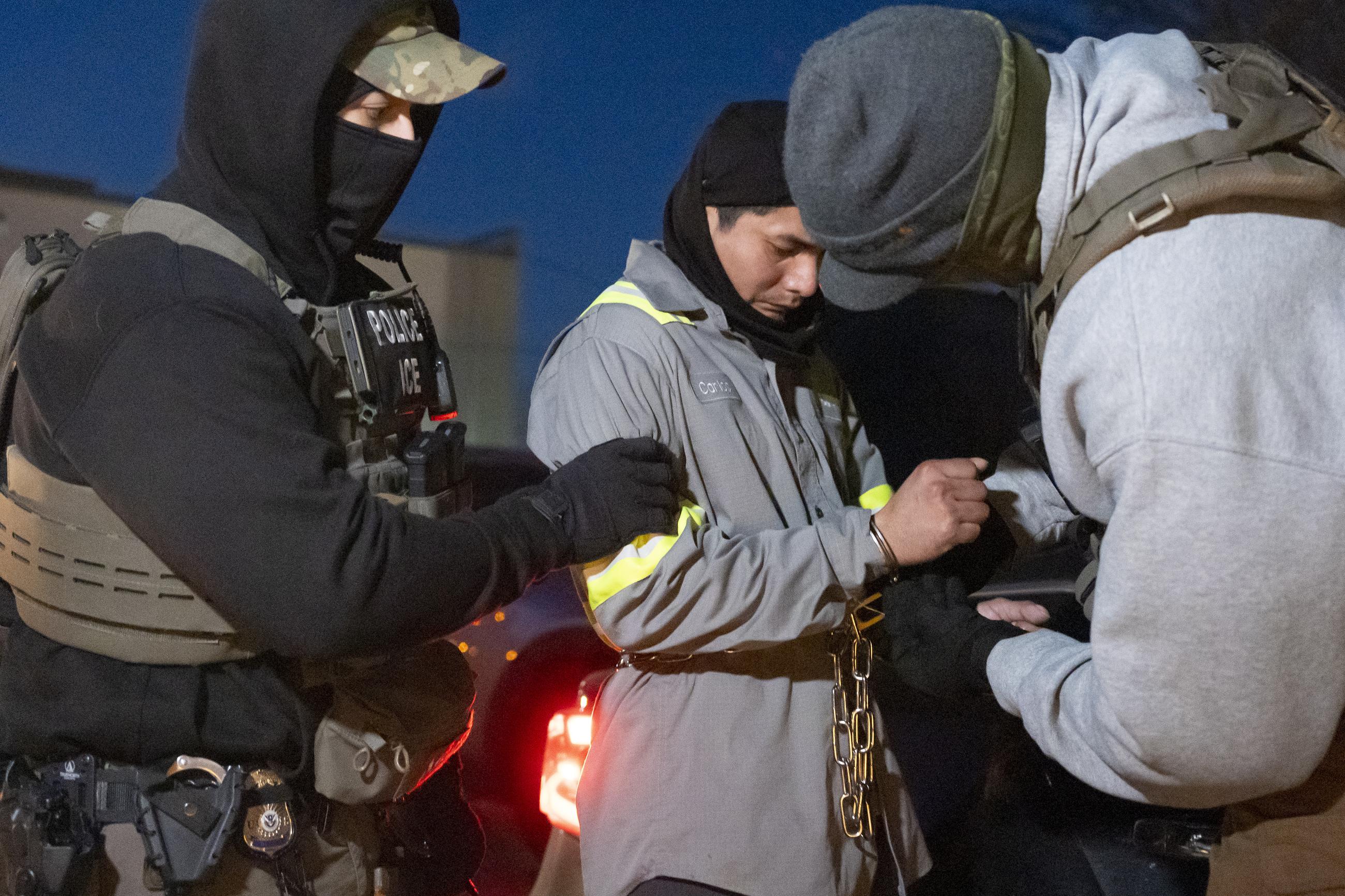
Democrats want conditions placed on Immigration and Customs Enforcement agents—including no masks, body cameras, and strict use-of-force rules—before they’ll agree to fund the department. But they have very little leverage, because last year’s One Big Beautiful Bill included $75 billion for ICE. So shutting down DHS means not paying Transportation Security Administration workers at airports, or Coast Guard personnel, or Federal Emergency Management Agency staff, without hurting ICE.
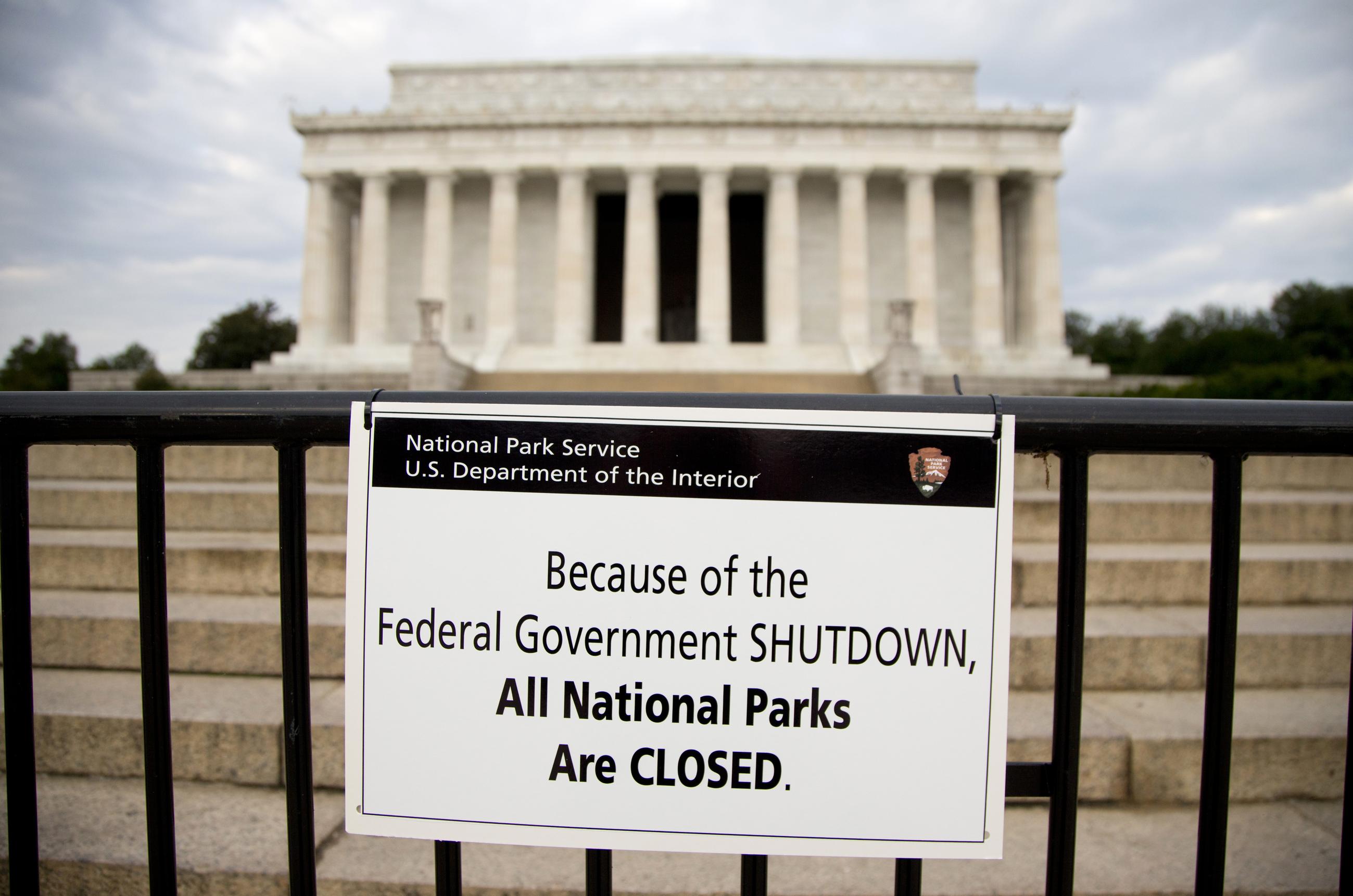
At some point, airport-security checkpoint lines will get longer and applications for disaster aid will take more time to process. Those pressure points are likely to send Senate Democrats back to the negotiating table and, as in the 43-day government shutdown, convince enough of them to pass a funding bill.
- Codifying drug prices: Possible
Trump called on Congress to “codify my most-favored-nation program into law,” a reference to the deals he announced with a number of pharmaceutical companies in December.

While lowering drug prices attracts bipartisan support, the president faces stiff headwinds: GOP lawmakers who are averse to price controls, the lack of a concrete legislative proposal that lawmakers could rally around, and distrust from Democrats (amplified during an election year) given Trump’s record of undoing some Biden initiatives to cut prices.
“If the president were actually serious about further reducing prescription drugs, he would come back and try to both expand the power of Medicare to negotiate prices for drugs and expand that whole idea of drugs generally," Sen. Chris Van Hollen told National Journal. "There’s no reason that only Americans who are on Medicare should have their diabetes drug costs capped. But he’s not serious. … If the president has a viable plan to actually reduce the cost of prescription drugs, show it to us.”
- Preventing lawmakers from insider stock trading: Doubtful
The president in his speech pushed for passage of the Stop Insider Trading Act to “ensure that members of Congress cannot corruptly profit from using insider information.”
Despite its catchy title, good-government groups like Citizens for Responsibility and Ethics in Washington oppose the GOP-led measure, saying it “fails to prohibit many types of private transactions including stock purchases of private companies, cryptocurrency purchases, commodity purchases, certain corporate bonds and exchange traded funds.” They’re getting behind a more restrictive bill led by Democrats with far more bipartisan support, the Restore Trust in Congress Act. That bill, they contend, “effectively bans members of Congress from buying, selling and owning stocks and their equivalents and ends the conflicts of interest that have plagued Congress for far too long.”
Trump’s push for the more partisan measure likely dims its already long-shot chance of passage despite broad public support for stiffer guardrails on congressional wealth-building. And many Democrats recoil when the person who's exhorting them to act has himself made billions of dollars in just his first year back in the White House.

“It would be nice if the most corrupt president in American history would comply with some of these rules,” Van Hollen said.
- Barring states from issuing commercial drivers’ licenses to undocumented immigrants: A long shot at best
Trump pushed for a measure known as the Dalilah Law, named after a 5-year-old California girl severely injured when a tractor-trailer driven by an undocumented immigrant smashed into her stopped car in 2024. In his speech Tuesday, Trump blamed President Biden’s “open-borders” policy.
It would: limit trucking licenses to U.S. citizens, lawful permanent residents, and certain work-visa holders only; revoke any license issued to anyone here illegally or foreigners with temporary status; and require states to administer knowledge and skill tests in English only.
Its chances appear bleak, not only because partisan divisions in Congress regarding anti-immigration legislation are so wide but also because GOP Sen. Jim Banks only introduced the bill Wednesday. Even legislation with broad bipartisan support would have a tough time reaching the president’s desk this year given competing priorities and the limited legislative calendar.
- Revamping election laws through the SAVE Act: Will not happen
The House passed the Safeguard American Voter Eligibility Act earlier this month along party lines (one Democrat voted for it). It would require voters to provide documented proof of U.S. citizenship when registering to vote and photo identification to vote in federal elections.
The measure’s critics say it would significantly suppress voting, especially among low-income Americans who are less likely to have a government-issued ID and married women whose last names might not match their birth certificates or passports—a claim that’s been dismissed as “fear-mongering” by the White House.
Republicans would need at least seven Democrats to cross the aisle and end an expected filibuster on the measure, a tall task considering that moderates such as independent Sen. Angus King have signaled their opposition.