National Journal Logo
×

Welcome to National Journal!

Enjoy this premium "unlocked" content until March 28, 2026.

Continue

Vaccines, ethics concerns complicate surgeon-general nomination

Casey Means’s mixed answers in a hearing on Wednesday left most Democrats—and some Republicans—concerned about slotting the MAHA champion to be the nation’s doctor.

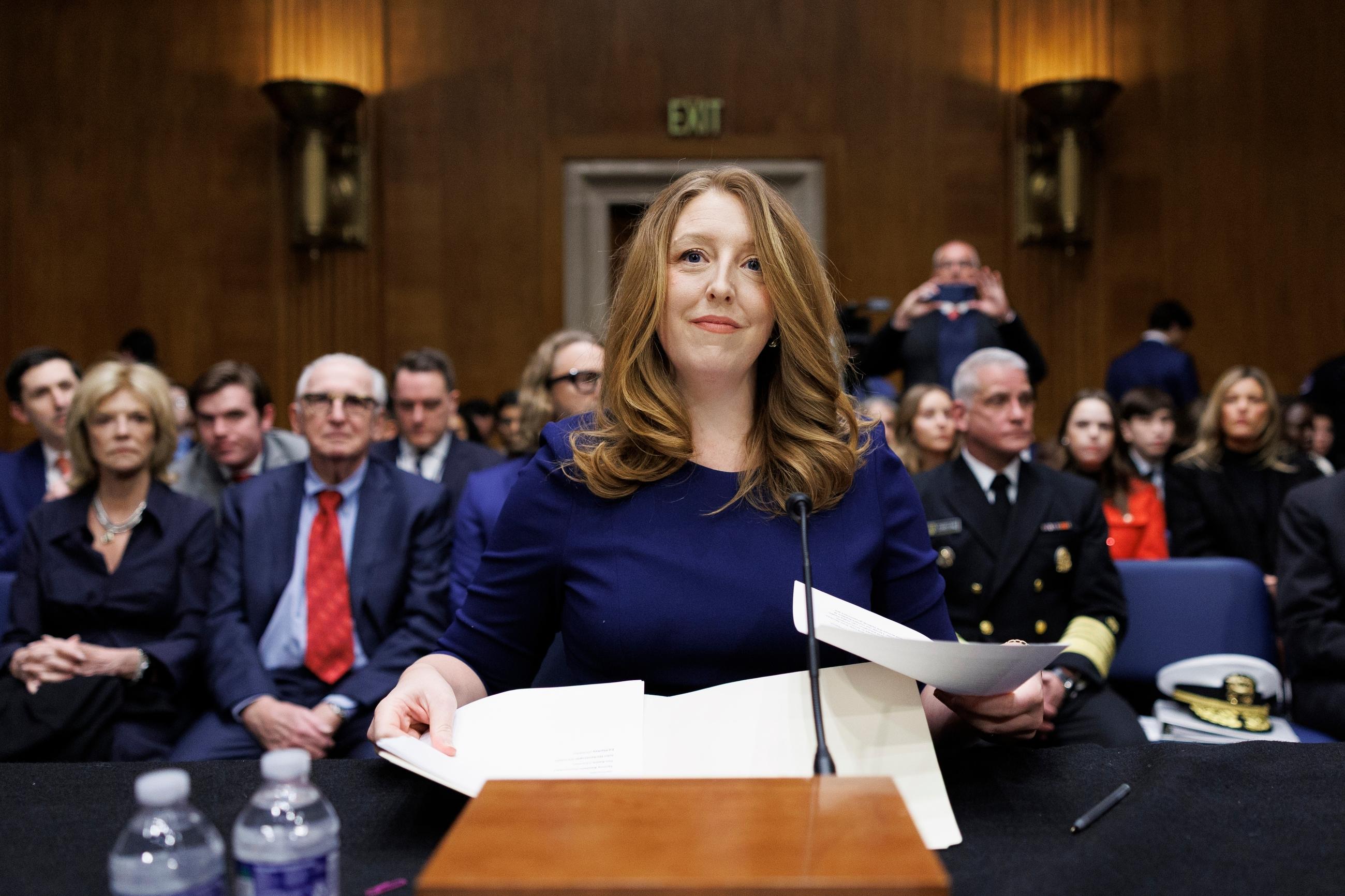
Surgeon-general nominee Casey Means takes her seat at the start of a Senate Health, Education, Labor, and Pensions Committee confirmation hearing on Wednesday. (AP Photo/Tom Brenner)
None

Want more stories like this?

Subscribe to our free Sunday Nightcap newsletter, a weekly check-in on the latest in politics & policy with Editor in Chief, Jeff Dufour.

Add to Briefcase
Nancy Vu
Feb. 25, 2026, 7:35 p.m.

Casey Means was grilled Wednesday morning by the Senate health committee responsible for her confirmation to be the nation’s doctor. Her answers did not allay remaining concerns about the nominee’s stances on vaccines and potential financial conflicts of interest—even among more-moderate Republicans whose support will be key to confirming her.

Members of both parties on the Health, Education, Labor, and Pensions Committee probed the unconventional surgeon-general nominee on issues ranging from vaccines, abortion medication and oral contraceptives, and pesticides, to her financial ties with several health care companies. Means, who served as a wellness entrepreneur and a key adviser to Health and Human Services Secretary Robert F. Kennedy Jr. during his 2024 presidential campaign, has made combating chronic disease and questioning medical institutions a key part of her brand.

Her contradictory and mixed answers on vaccines in Wednesday's testimony left most Democrats—and some Republicans—concerned at the prospect of slotting her into a job where she would serve primarily as the nation’s spokesperson on public health guidance. While Means stated that she believes “vaccines save lives,” she declined to directly answer whether she’d widely recommend inoculation against diseases such as measles—amid an uptick in cases across the country that puts the U.S. at risk of losing its status as a nation which eliminated the disease.

“I’m not an individual's doctor, and every individual needs to talk to their doctor before putting a medication in their body,” Means said. “I absolutely am supportive of the measles vaccine, and I do believe vaccines save lives and are an important part of the public health strategy.”

When questioned by HELP Committee Chairman Bill Cassidy about her views linking vaccines to autism—a claim debunked by several medical studies—Means doubled down on her vow to further study a link between the two.

“The reality is that we have an autism crisis that’s increasing, and this is devastating to many families,” Means said. “We do not know as a medical community what causes autism. … Until we have a clear understanding of why kids are developing this at higher rates, I think we should not leave any stones unturned.”

The anti-vaccine rhetoric has become a sore spot for some Republicans as the Make America Healthy Again agenda remains a wild card heading into the midterms. While some of the movement’s focus on nutrition and reining in the food industry remains bipartisan, HHS's more controversial recent moves targeting the country’s vaccine infrastructure aren't polling as well—threatening to undermine Republicans’ messaging on health care.

The MAHA influence—which President Trump credits with helping him win the election—was on full display in the Dirksen hearing room Wednesday morning. Along with staffers and members of the public, the audience was also filled with Means’s family members, including her brother, HHS adviser Calley Means, and wellness influencer Vani Hari, otherwise known as “Food Babe.”

Some moderate Republicans relayed still-persisting concerns about the nominee's answers on vaccines—potentially complicating her road to a smooth confirmation.

“It troubled me that she was having so much difficulty answering what I thought was a pretty straightforward question,” said Sen. Lisa Murkowski, who voted to confirm Kennedy earlier last year. “I think, in fairness, on the issue of vaccines, I really do want to go back and see some of these responses that she made.”

Sen. Susan Collins—who also voted to confirm Kennedy—noted that Means's testimony alleviated some concerns, but not all.

“I want to know whether she will take the approach that Dr. Oz has taken in telling people to get vaccines,” the Maine Republican told National Journal, referring to Centers for Medicare and Medicaid Services Administrator Mehmet Oz.

The surgeon general is known throughout the public health world as the nation’s “top doctor,” instrumental in communicating health guidance on a plethora of issues ranging from smoking to mental health. The position is also responsible for overseeing the U.S. Public Health Service Commissioned Corps—a group of some 6,000 uniformed public health officials.

Means doesn’t hold the traditional credentials of past surgeon generals, including an active medical license and experience serving in the USPHSCC, a fact that was raised during her hearing and previously by former surgeon generals. And during her testimony, Means stated she does not plan on reactivating her license because she is not expected to see patients in her role if she’s confirmed.

Senate Health, Education, Labor, and Pensions Committee Chairman Bill Cassidy holds his head as Casey Means testifies on Wednesday. (AP Photo/Tom Brenner)
Senate Health, Education, Labor, and Pensions Committee Chairman Bill Cassidy holds his head as Casey Means testifies on Wednesday. (AP Photo/Tom Brenner) ASSOCIATED PRESS

Democrats forcefully pressed the nominee on a range of issues—notably, potential financial conflicts that could arise from her investments in different health companies. Sen. Tammy Baldwin zoomed in on her ties to companies such as Genova Diagnostics—which reached a $43 million settlement with HHS’s Office of Inspector General to resolve allegations that it had violated the False Claims Act and billed for “medically unnecessary lab tests.” Means accepted $10,000 for promoting the company, according to Baldwin.

“It's troubling because the surgeon general must be someone that the public can trust, and someone who does their homework before accepting money or lending credibility to a company,” the Wisconsin Democrat said to Means. “And for me, this raises questions about your judgment.”

At least one Republican agreed that these conflicts of interest should be taken seriously.

“The issue of conflict is something that I think we all need to take very, very carefully into consideration,” Murkowski said after the hearing.

A number of Democrats told National Journal that their ethics concerns still lingered after the hearing, and that they will oppose the nomination.

“It’s not believable to me that she has no idea that she has been systematically violating [Federal Trade Commission] policy,” said Sen. Chris Murphy. “In no way will I support her.”

What remains to be seen is whether moderate Republicans would look to oppose Means. Collins and Cassidy are up for tough reelections this year—and bucking the Trump administration at a time when their relationships with the president are tenuous could further complicate their chances of remaining in office.

Cassidy, a physician whose vote to confirm Kennedy has caused him a number of political headaches, and who has publicly feuded with the HHS secretary over vaccinations—subjected Means to intense questioning over her views on the HPV vaccine. Last month, HHS overhauled the childhood vaccine schedule to recommend only a single dose of the HPV vaccine, despite the Food and Drug Administration’s approval for a two- and three-dose series.

The Louisiana Republican also probed Means on her stances on oral contraceptives and the abortion pill mifepristone. Means stated that oral contraceptives should be “widely accessible,” but cautioned that, as with any medication, both oral contraceptives and mifepristone carry “significant risk.”

“We need to make sure that women are empowered with information and informed consent before getting on a medication that is often prescribed for several years without follow-up,” Means said.

Republican Sen. Jon Husted and Democratic Sen. Ed Markey further probed Means on her past comments criticizing the use of pesticides—a moment that epitomized the clash between the interests of MAGA and MAHA. While a number of MAHA supporters have called for ending the use of pesticides due to its links to cancer, neurological disorders, and endocrine disruptions, farmers have decried any ban on the chemicals, arguing that their use is necessary for food production.

Markey questioned whether the Trump administration is completely aligned with Means’s views on pesticides following the White House’s executive order last week calling for an adequate domestic supply of glyphosate, an herbicide often found in Roundup weed killer.

“I think that we are in a very complicated moment for agriculture and food,” Means stated. “We cannot overturn the entire agriculture system overnight. That would hurt farmers, it would hurt food prices. This is a national security decision.”

Markey noted her past comments calling the chemicals cancer-inducing.

“I’m disappointed to see you back away from your efforts to protect American families,” the Massachusetts Democrat said.

Some details of the nominee’s private life may also come back to haunt her. Collins brought up concerns about excerpts in Means’s book, Good Energy, in which she encourages readers to try psilocybin-assisted therapy and says she was inspired to try psychedelics.

"Illicit drug use remains a huge problem in this country, and this didn't happen in your teen years, according to your book," Collins said, before asking if the nominee stood by her previous comments and how she would talk to the public about drugs.

Means responded that what she may support as a private citizen “is, in many cases, different than what I would say as a public health official."

While the nomination hearing did get tense at certain moments, some Democratic senators agreed with Means’s push for more oversight into the way food is made and sold in the U.S., as the administration looks to define "ultraprocessed foods” and close loopholes at the FDA that allow for little regulation into how food is sold on the market.

And Means agreed with HELP ranking member Bernie Sanders when he suggested she use her position to speak against television advertisements promoting junk food. Still, when asked later if Sanders would support the nomination, the progressive senator said he would oppose it due to her views on vaccines, along with other issues.

The hearing is the first step in the process, with the panel meeting at a later date to consider the nomination. If Means makes it out of committee, she will then face a larger floor vote in the Senate.

Welcome to National Journal!

Enjoy this featured content until March 28, 2026. Interested in exploring more
content and tools available to members and subscribers?

×
×

Welcome to National Journal!

You are currently accessing National Journal from IP access. Please login to access this feature. If you have any questions, please contact your Dedicated Advisor.

Login