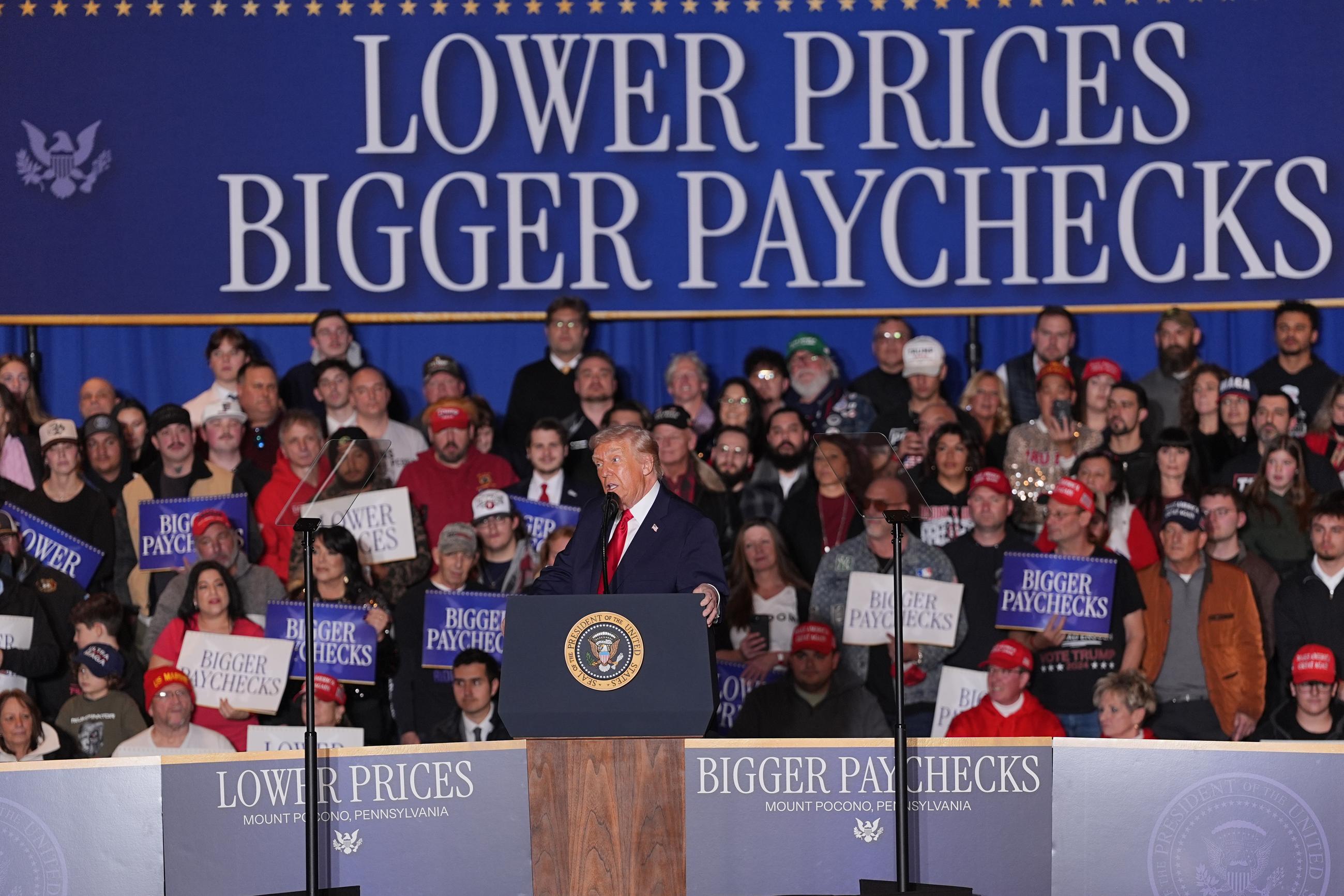
Neither the Framers of the Constitution nor President Reagan, the Great Communicator who put his own stamp on the annual address, could possibly recognize the show that President Trump orchestrated Tuesday night as a State of the Union.
In Article II, Section 3 of the Constitution, the Framers simply stated that the president “shall from time to time give to the Congress Information of the State of the Union.” Exactly 200 years later, in 1987, Reagan added a little touch of show biz to the speech, which by then had been on television for 40 years and in prime time for 22 years.
Tuesday night, Trump took that little touch of show biz and amped it up to 11. In completing the transition from a policy address to a reality television show, though, Trump—to use a TV term for when a show relies too heavily on gimmicks—may just have “jumped the shark.”
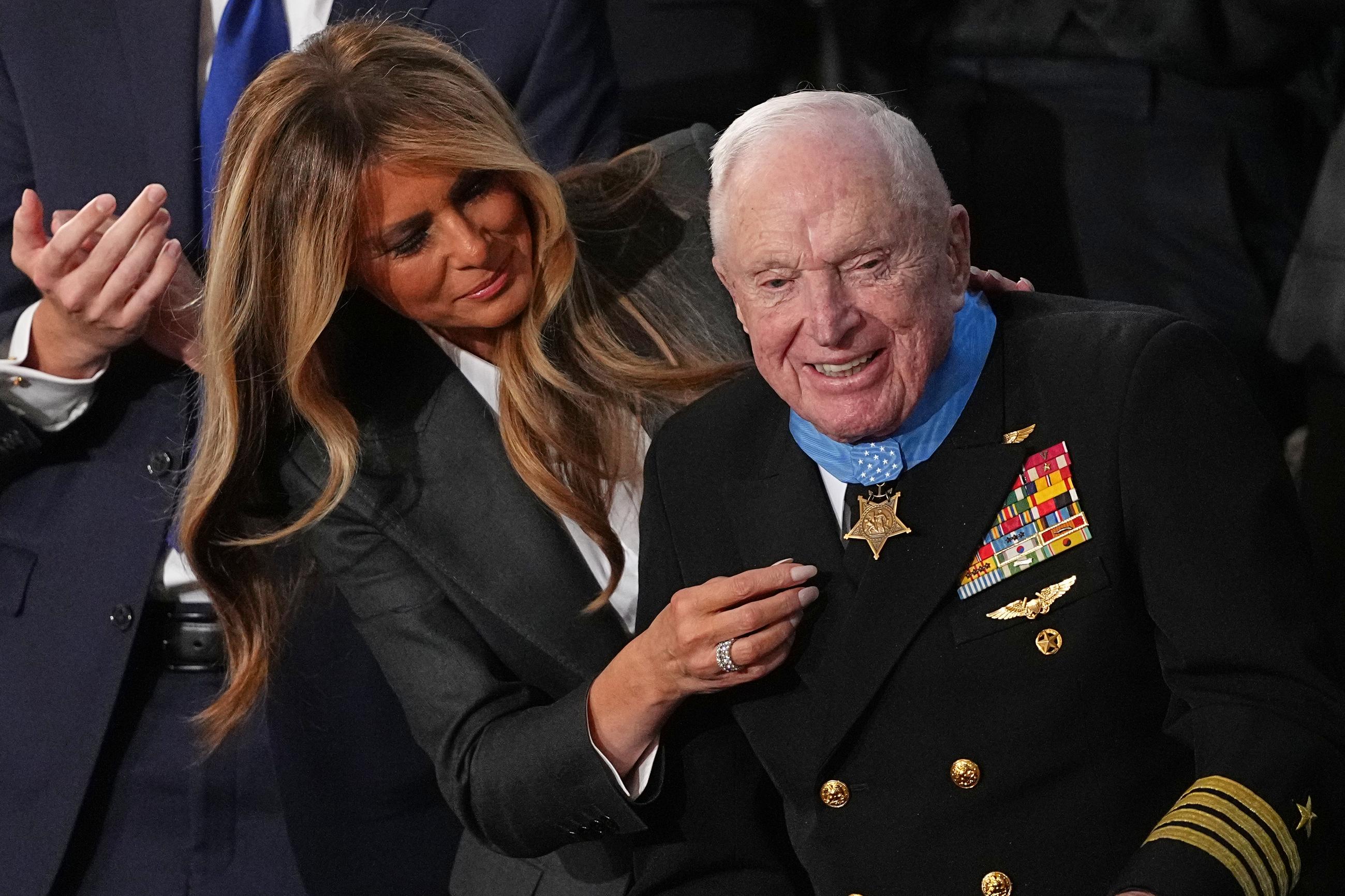
The gimmick, mastered by Reagan and copied by the last six presidents, is the use of heroes, splicing them throughout the address as human props to dramatize policy points, tug on heartstrings or, as perfected by Trump, engender anger at other groups.
The heroes also are known as “Skutniks,” a nod to the man Reagan held up to the nation in his 1982 address—Lenny Skutnik, the young Congressional Budget Office staffer who jumped into the frigid Potomac River to rescue a drowning survivor of the crash of an Air Florida jet just days before Reagan went before Congress and the nation.
Inviting Skutnik to the speech was the idea of White House aide David Gergen. Reagan liked it immediately, recalled Ken Khachigian, who wrote many of the president’s best speeches. “When you offer Ronald Reagan some drama on the big stage, he’s going to pick up on it,” Khachigian said. It was, while memorable, only a small part of the address.
“We don't have to turn to our history books for heroes,” began Reagan, adding, “Just two weeks ago, in the midst of a terrible tragedy on the Potomac, we saw again the spirit of American heroism at its finest—the heroism of dedicated rescue workers saving crash victims from icy waters. And we saw the heroism of one of our young government employees, Lenny Skutnik, who, when he saw a woman lose her grip on the helicopter line, dived into the water and dragged her to safety.”
Skutnik, seated next to first lady Nancy Reagan, stood and waved, a little taken aback by the standing ovation. It took less than 50 seconds, and the president moved on. But Reagan—and the presidents who followed him—noticed the response, and they did not move on in the years to come. Reagan had one hero in 1984, two in 1985, and four heroic children in 1986.
At that point, both Nancy Reagan and Khachigian thought the gimmick had outlived its usefulness. When Khachigian was brought in late in the game to write the 1987 address, it was the first thing he raised at a meeting with the first lady. As he recalled in his 2024 book Behind Closed Doors. In the Room with Reagan & Nixon, he suggested dropping the heroes “because the times are not right.” The first lady, he recalled, “agreed … and continued curtly, ‘We’ve done it before, and now it’s time for a change.'”
Before Trump’s speech this year, Khachigian told National Journal, “I hated having those damn things in the speech.” And he particularly hated what they became when presidents less skilled in oratory than Reagan tried to copy them.
“It is just ludicrous,” he said. “It just detracts from the solemnity of the occasion and the meaning of it being a real policy speech. The State of the Union has become a South American soccer match with everybody cheering up and down. This just disrupts and distracts.”
Reagan had seven heroes in six speeches. His successor, George H.W. Bush, had six in three speeches. The rhetorical explosion came when Bill Clinton invited 34 to his seven addresses, George W. Bush used 16 in his seven speeches, and Barack Obama had 25 in seven addresses. Then came Trump. In his first term, Trump had 48 in his three addresses, or 16 per speech.
And he added sideshows, interrupting the address in 2020 to present the Presidential Medal of Freedom to conservative radio host Rush Limbaugh.
Based on the results of the first State of the Union of his second term, Trump was just warming up. Tuesday night, he raced past his first-term numbers, using as many as 53 people as props—that is, if you count all 25 members of the U.S. Olympic men’s hockey team. He outdid the Limbaugh medal, presenting two Medals of Honor, two Purple Hearts, one Legion of Merit, and one Presidential Medal of Freedom—none with the solemnity normally accompanying such ceremonies.
It was, said William Galston, Clinton’s former top domestic adviser, “the night that Lenny Skutnik devoured the State of the Union.”
But Trump has moved past honoring true heroism and offering an example that can uplift Americans and make them proud. Both in his first-term speeches and Tuesday night, half of Trump’s props are victims, rather than heroes. They suffered sometimes-brutal losses of children or spouses at the hands of drunk-driving or knife-wielding illegal immigrants, or they did battle with clueless bureaucrats. For the sake of a rhetorical point, the president had them openly bare their wounds to a watching nation. Still others honored by Trump were there for such decidedly pedestrian deeds as accepting tax cuts, paying less for prescriptions, or benefiting from government programs.
Their introductions one after another make it almost impossible for a speechwriter to craft a coherent speech. “You have to try to summarize for each one,” Khachigian said. “Then you have to factor in the applause and the timing. And then, by the time you get to the meat of the speech and actually talk about the state of the union itself, by that time you’re going to lose the audience.”
That the addition of heroes has lengthened the time of the annual address is undeniable. Trump spoke for a record one hour and 48 minutes on Tuesday. A National Journal accounting found that he devoted 44 minutes to his heroes and 104 minutes to the more substantive parts of the speech.
Trump’s rhetorical gimmick by itself took up more time than all of Richard Nixon’s State of the Union speeches, two of Jimmy Carter’s, four of Reagan’s, and one of George H.W. Bush’s.
Galston, who now holds the Ezra K. Zilkha Chair in the Brookings Institution’s Governance Studies Program, said the lesson for presidents is simple: “At some point, more becomes less. And Trump goes well past this point.”