National Journal Logo
×

Welcome to National Journal!

Enjoy this premium "unlocked" content until February 28, 2026.

Continue
LEADING INDICATORS

What Gallup’s decision reveals about public polling

The incentives for public-service polling have changed dramatically in 88 years.

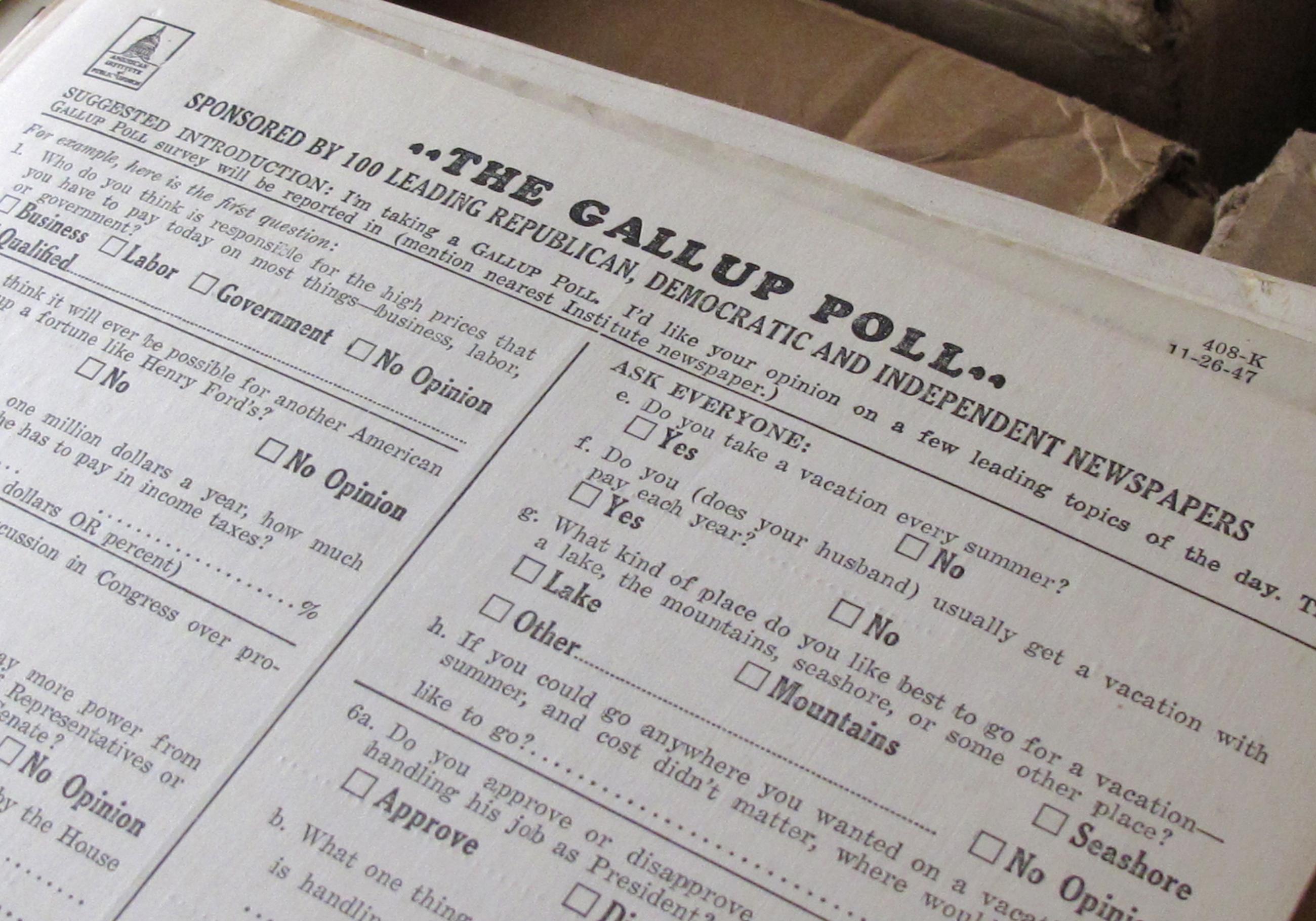
This 2012 photo shows a 1947 survey for the Gallup Poll at the University of Iowa library in Iowa City, Iowa.  (AP Photo/Ryan J. Foley)
This 2012 photo shows a 1947 survey for the Gallup Poll at the University of Iowa library in Iowa City, Iowa. (AP Photo/Ryan J. Foley)
None

Want more stories like this?

Subscribe to our free Sunday Nightcap newsletter, a weekly check-in on the latest in politics & policy with Editor in Chief, Jeff Dufour.

Feb. 17, 2026, 2:04 p.m.

Last week, the legendary polling company Gallup announced it would no longer report presidential job-approval ratings, ending an 88-year trend line. Speculation about political reasons for the decision immediately took over the public and industry conversation, especially since the company’s recent polling showed President Trump’s ratings falling into the upper 30s.

Trump has a history of pressuring organizations to act on his behalf, and we know he dislikes polls and pollsters who show bad numbers for him. But that alone likely does not explain Gallup’s decision. Pollsters like Gallup make decisions based on a larger business context, which includes the political environment, but also the need to turn a profit and the disappearing incentive structure for pollsters to spend a lot of money on public-service polling. A lot has changed for Gallup as a company and for the polling industry over 88 years.

First, some context: Gallup was still conducting its presidential approval polling by telephone, mostly by calling mobile phones, a method still considered one of the highest-quality ways to conduct surveys. It’s also one of the most expensive, because Federal Communications Commission rules ban calling cell phones using autodialers that reduce time and labor costs. Gallup settled a lawsuit for $12 million over this very issue in 2015, despite its insistence that it did not use autodialers.

Unlike many public pollsters who use expensive, high-quality methodologies, Gallup is a for-profit company. This is not your grandparents’ Gallup—it has evolved into a global research consultancy. Its website advertises services for clients with nary a mention of U.S. politics.

It’s worth mentioning Gallup has a lot of federal contracts, which could factor into a business decision about presidential approval with a president who likes to sue pollsters. The benefits of publishing presidential approval numbers might still outweigh the risks if there were money to be made from doing it. Yet that isn’t the case in today’s political polling environment. From a business perspective, it is an expensive money drain.

Other pollsters using expensive methodologies—mostly colleges and universities, media, or nonprofits—are not dependent on turning a profit directly from their polling. They are trying to generate attention, clicks, ratings, or reputational perks, or simply provide a public service. Some private pollsters release data publicly so that they will be listed in aggregates to bolster their name recognition. Gallup doesn’t need to do that.

Presidential approval numbers, in particular, are worth less than they used to be. Every poll gets put into aggregates with dozens of other surveys and is forgotten about within a few hours. Every now and then, Gallup’s numbers get widespread attention as a new high or low, but we are decades past the time when the company was offering something in its approval ratings that couldn’t be found elsewhere—except for the decades’ worth of comparative data going back to the Franklin D. Roosevelt administration.

Gallup’s decision isn’t out of nowhere. The company has pulled back from public political polling over the last decade or so, including its decision in 2015 to no longer survey on the presidential election horse race after underestimating the strength of President Obama’s 2012 reelection win. Pew Research also discontinued releasing horse-race questions for the 2016 race, explicitly saying, “Putting resources toward an already saturated market doesn’t make much sense for us.”

Essentially, both Gallup and Pew made a calculation: Why take on the reputational risk of a miss when so many other polls are out there? By 2015, the prevailing logic had become to ignore individual polls and look at aggregates and forecasts anyway.

While it’s a shame to see an 88-year time series end, I can’t blame Gallup for the business decision. Even if it still runs the phone surveys for other reasons, freeing up questionnaire space for paying clients is a far better business model.

Public polling is a public service. Gallup is not a public-service company, although it does and likely will continue to produce extremely important and useful social and political data for the public. The company produced presidential approval data for 88 years as a public service, which is more than most pollsters will ever do. Maybe there is a political aspect to this decision. Perhaps it wasn’t even due to pressure from Trump, but from internal company forces worried about the political environment.

Either way, don’t let theorizing obscure the obvious: that putting one more approval number in the aggregates isn’t a business model.

Contributing editor Natalie Jackson is a vice president at GQR Research.

Welcome to National Journal!

Enjoy this featured content until February 28, 2026. Interested in exploring more
content and tools available to members and subscribers?

×
×

Welcome to National Journal!

You are currently accessing National Journal from IP access. Please login to access this feature. If you have any questions, please contact your Dedicated Advisor.

Login