
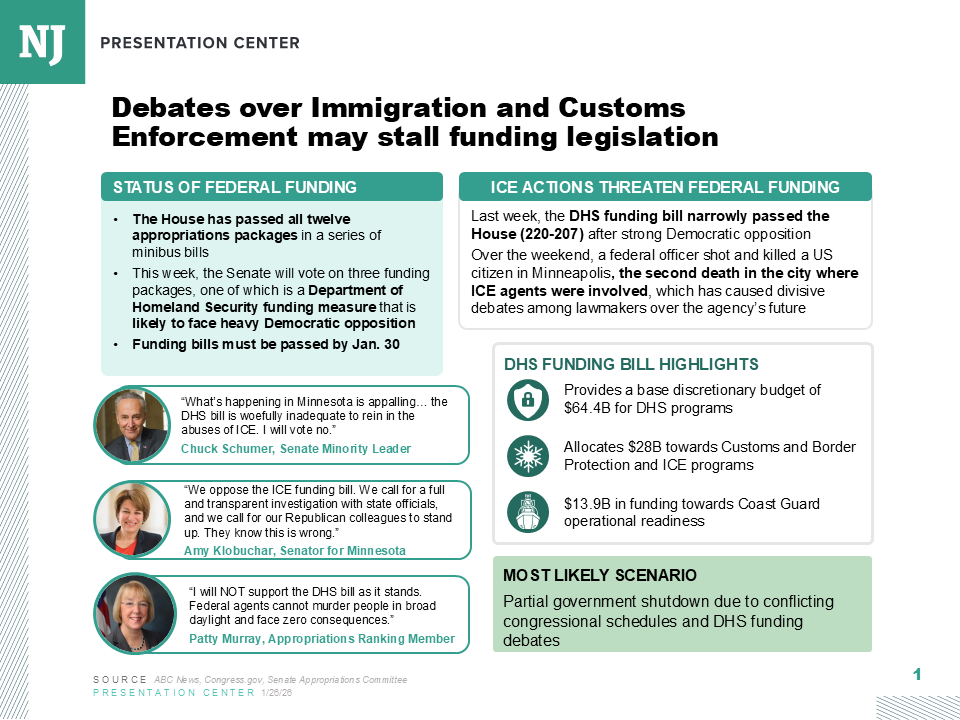
The Homeland Security Department is headed toward a shutdown at midnight Friday—and senators are leaving Washington absent a breakthrough.
Democratic lawmakers have been negotiating with the White House for the last two weeks on immigration reform, following the high-profile killings of two U.S. citizens in Minneapolis by immigration enforcement agents. But with lawmakers in both chambers scheduled for a one-week recess—a number of them are heading to the Munich Security Conference in Germany or set to travel on other CODELs—and both sides still far apart on reaching an agreement, a partial government shutdown starting Saturday appears inevitable.
It would be the third shutdown of at least some government operations since the fiscal year began on Oct. 1. While limited, this shutdown would affect key agencies Americans rely on every day, including the Transportation Security Administration, the Coast Guard, and the Federal Emergency Management Agency.
That fate was sealed Thursday afternoon when the Senate rejected a procedural vote to consider a House-passed funding bill for DHS. The measure failed to clear the legislative filibuster on a vote of 52-47. The vote fell largely on party lines, with the lone exception of Sen. John Fetterman voting with Republicans to support funding DHS.
“Today’s strong vote was a shot across the bow to Republicans: Democrats will not support a blank check for chaos,” Senate Minority Leader Chuck Schumer said in a press conference shortly after the failed vote.
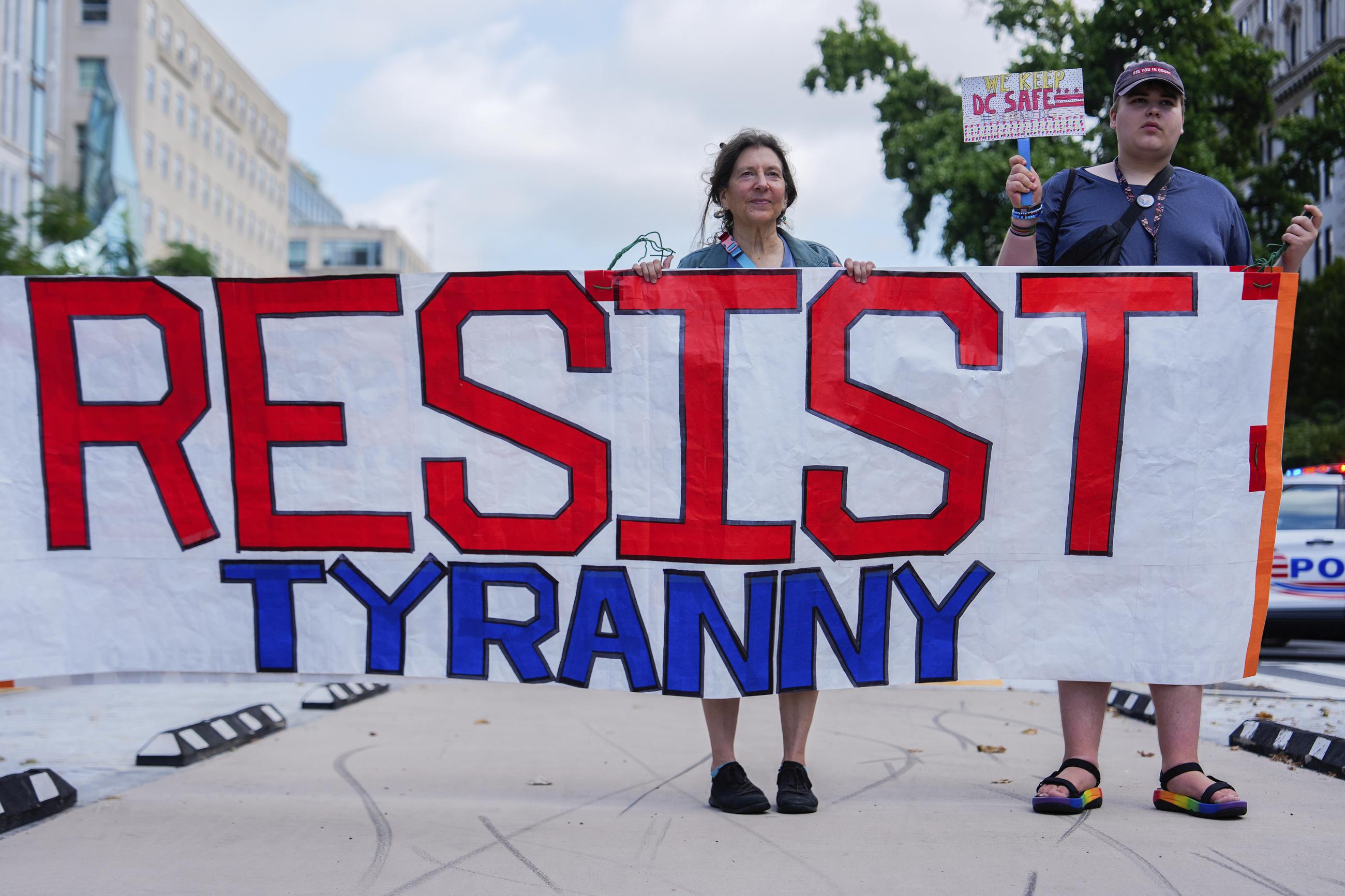
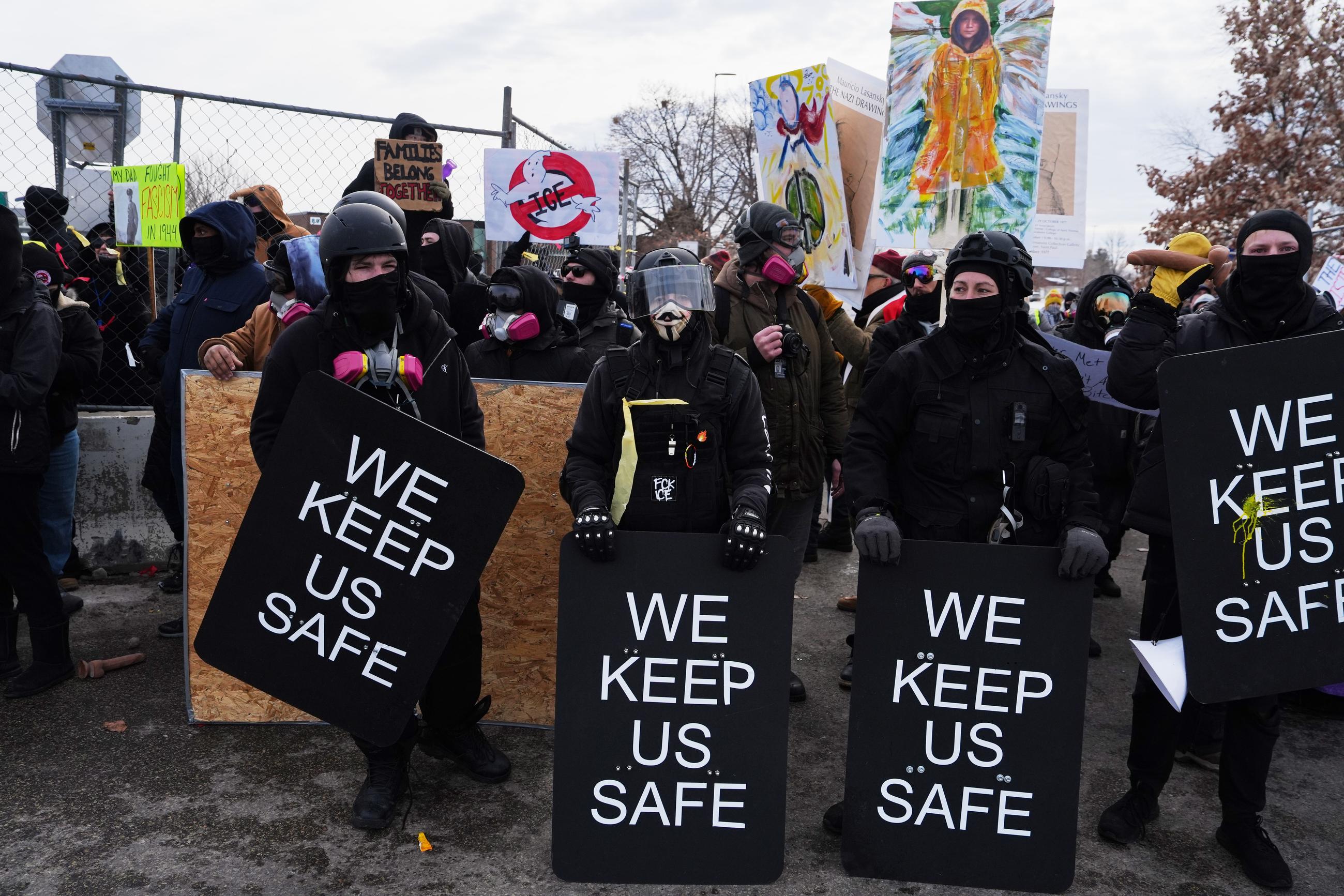
Immigration reform has long been sought by both sides. However, Democrats have been demanding significant changes to the Trump administration’s aggressive tactics following the Minneapolis killings, and amid reports of Immigration and Customs Enforcement agents violently conducting mass deportations across the country. Lawmakers and officials have been far apart in talks as they continue to trade proposals between Senate Democratic leadership and the White House—and that remained the case Thursday afternoon.
The most recent offer was sent from the White House Wednesday night—an offer that Democrats dismissed as unserious, blaming the administration for slow-walking the proposal.
“Right now, they're not hitting the mark,” Sen. Andy Kim said. “[This is] something that is so clearly not what we are demanding in terms of what the American people want.”
The details of the White House’s offer were not made public. However, one of the biggest hurdles, according to Senate Majority Leader John Thune, is the issue of warrants. Democrats have been calling for requiring federal law enforcement officials to obtain judicial warrants—not just agency-issued ones—before entering private property. Democrats also want a ban on masks, a requirement that DHS officers identify themselves, implementation of a reasonable use-of-force policy, and mandatory body cameras.
“The issue of warrants is going to be very hard for the White House or for Republicans, but I think there are a lot of other areas where there has been give, and progress,” Thune said.
The majority leader has consistently expressed optimism about a deal coming together for the last week, suggesting that talks between the two sides are promising—and saying Thursday that the foundation for a “deal space is there.”
Senate Democrats, however, haven’t been as bullish.
“The conversations have been totally unproductive because the Republicans have been so unresponsive,” Sen. Richard Blumenthal said. “I think they are so divided among themselves that they are in chaos.”
The fact that both sides are even talking, however, is a step up from past funding negotiations.
During the government shutdown in November, the White House barely engaged with Senate Democrats on their demands—forcing members of the minority party to negotiate with Senate Republicans. A stalemate continued for weeks until moderate Senate Democrats eventually caved on their demands to renew health care subsidies that help enrollees on the Affordable Care Act marketplace pay for premiums. Although a bipartisan group of senators worked to find a possible agreement after the premium subsidies' expiration in December, Democrats ultimately came up empty-handed.
This time around, the White House is directly negotiating with Senate Democrats—a pointed acknowledgement that the administration’s handling of immigration is falling flat with voters, as protests against ICE raids continue across the country and polls indicate growing dissatisfaction with Trump’s handling of an issue that had propelled him to victory in 2024.
In further signs that Republicans are ready to give in to some Democratic demands, border czar Tom Homan announced Thursday morning that he would end the administration’s immigration operation in Minneapolis, and Homeland Security Secretary Kristi Noem announced two weeks ago that body cameras would be required for DHS agents nationwide once funding for the agency is available.
Senate Republicans, however, want a stopgap funding bill in place to prevent a shutdown as both sides continue to negotiate. Sen. Katie Britt, the chair of the Homeland Security appropriations subcommittee, had offered a measure that would fund the agency at current levels for another two weeks. The move would have required the unanimous consent of all senators to speed up consideration. This, however, was objected to by the subcommittee’s top Democrat, Sen. Chris Murphy.
“I am hopeful that these discussions will continue," Murphy said. "But frankly, we had plenty of time to get a deal in the last two weeks, and the lack of seriousness from the White House and from Republicans—not getting language until last night—has put us in the position we are in today.”
Democratic Sen. Chris Coons also expressed openness to reaching a deal but held firm on his party's demands.
“I remain hopeful that we can actually achieve restraint on the misconduct and overreach of ICE and [Customs and Border Protection]," Coons said. "But I'm not voting for funding ICE and CBP unless and until we've got standards put in place that we can legislate that subject them to the same sorts of rules and standards as every state and local police department.”
Whether or not Democrats will agree to fund the department—either at current or updated levels—after they come back from recess will depend on how negotiations go.
Senators are likely to be given a few days' head's up if a deal is reached between both sides during the recess. But traveling back to D.C. at a moment’s notice could prove difficult as a number of members are traveling abroad this weekend. Sen. Lisa Murkowski told reporters Wednesday night that she had packed two suitcases—one for the Munich Security Conference, and another for Alaska if she ends up staying in the U.S.