National Journal Logo
×

Welcome to National Journal!

Enjoy this premium "unlocked" content until April 30, 2026.

Continue

Inside the GOP mess in Minnesota

Several Republican gubernatorial candidates signal they’ll run in the August primary regardless of who the party nominates at the state convention.

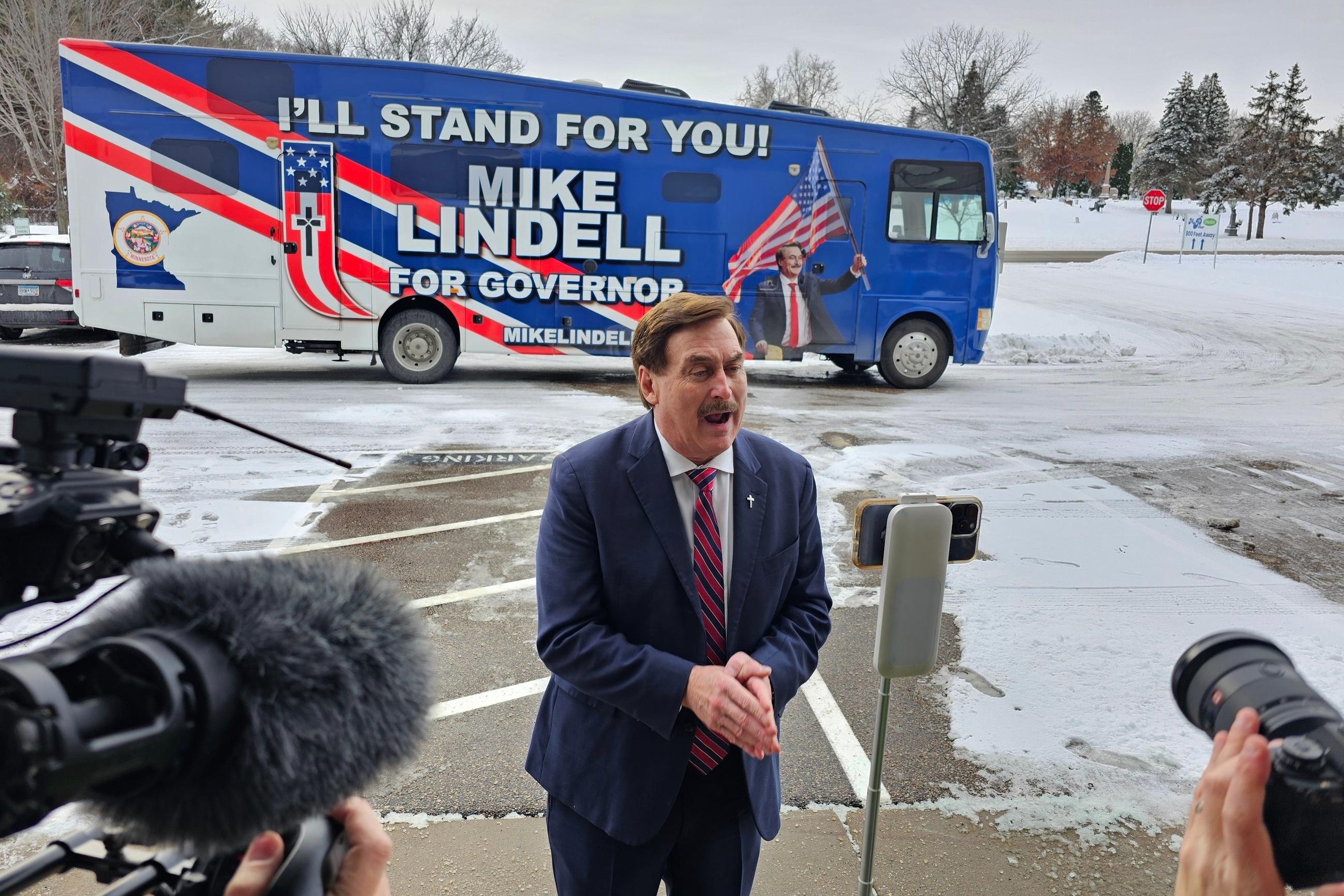
Mike Lindell speaks to reporters at his MyPillow factory in the Minneapolis suburb of Shakopee, Minn., on Dec, 11, as he launches his campaign for Minnesota governor. (AP Photo/Steve Karnowski)
ASSOCIATED PRESS

Want more stories like this?

Subscribe to our free Sunday Nightcap newsletter, a weekly check-in on the latest in politics & policy with Editor in Chief, Jeff Dufour.

Add to Briefcase
Abby Turner
Feb. 9, 2026, 5:19 p.m.

Minnesota Republicans see the open governor’s seat as a rare opportunity to take a statewide office, capitalizing on the social-services-fraud scandal that led to Democratic Gov. Tim Walz dropping his reelection bid.

“It's our best chance that we've had in over 20 years,” Kendall Qualls, a 2022 also-ran back for another bite at the apple, told National Journal.

Walz drew a large field of GOP challengers before he dropped his bid for reelection, and his exit leaves an open seat for the taking.

Candidates are first jockeying for the May party endorsement in one of just a few states where delegates vote on endorsements at a convention before the state-scheduled primary. But that endorsement doesn’t hold the same influence for some candidates in the field who, frustrated with the endorsing process that lends itself to more-extreme candidates, have vowed to run in an August primary that could weaken the eventual nominee.

That field has now pivoted to face Sen. Amy Klobuchar, who unlike her GOP counterparts is expected to run unopposed in her party's primary. Vows from some Republican candidates to run against the party-endorsed candidate could complicate the GOP’s chance against Klobuchar, who can instead set her sights on the general election.

For many years, it was customary for candidates to bow out of the race if they didn’t win the endorsement during rounds of balloting at the state convention. That practice has waned in recent years, and both parties have seen other candidates run against the party-endorsed candidate in the primary, noted David Sturrock, political science professor at Southwest Minnesota State University and longtime Republican activist.

State House Speaker Lisa Demuth has emerged as an early front-runner, winning the precinct-caucus straw poll and hauling in $507,000 in two months after launching her campaign in early November. Qualls came in second in the straw poll. While both say they are confident they’ll snag the party endorsement at the May convention, each has vowed not to run in the August primary if they aren’t party-endorsed.

For GOP primary voters, though, the race is still muddled. A recent poll found 32 percent of voters were still undecided; MyPillow CEO Mike Lindell and Demuth led the field, statistically tied at 18 percent and 17 percent, respectively.

Their opponents aren’t following the same philosophy. Lindell, who placed third in the straw poll, said he won’t commit to the party endorsement. State Rep. Kristin Robbins told National Journal she’ll stay in the race past the convention if she sees herself as the best candidate in the general election. Long-shot primary hopefuls Phillip Parrish and Brad Kohler have also said they will run even without the endorsement.

Robbins, and 2022 nominee Scott Jensen, who had said he might stay in past the convention before dropping his bid this week, cited frustrations with the party endorsements.

Robbins said she’ll stay in the primary if she thinks she has the best shot in the general election, noting that Republicans “have not won a general election in 20 years because they endorse a candidate who cannot win a general election.”

I think you have the potential for different candidates to take a different perspective on Amy Klobuchar. 
—Former Minnesota gubernatorial candidate Scott Jensen (R)

Jensen dropped his bid for governor this week to run instead for state auditor. He said the grassroots nature of the process marginalizes “pragmatic conservatives.” Participation by the most politically active Republicans in the local-level basic political operating units and straw polls create “a false trend line and a premature one, so it generally will favor the established candidates who have delegates in their back pockets,” Jensen told National Journal.

Leaving the large GOP field unsettled until the primary, just three months before the November election, could divert fundraising and organizing resources away from the general-election race against a formidable candidate like Klobuchar.

“I suspect the majority of Republicans would like to see there to be some coalescing and some rallying around, you know, one candidate,” said Gregg Peppin, Minnesota Republican consultant, but he added that robust, competitive primaries can be good for the party.

Jensen also agreed that coalescing around a candidate to face Klobuchar right after the party endorsement “might look like the strategic thing to do,” but added that candidates in a crowded primary can each take on Klobuchar’s weaknesses from different angles.

“I think you have the potential for different candidates to take a different perspective on Amy Klobuchar,” he said.

Qualls, on the other hand, said a crowded GOP primary in August hurts Republicans' chances against Klobuchar, who will likely run unopposed.

Even if Republicans coalesce around the party-endorsed candidate come May, it won’t seal the deal in the race against Klobuchar. Republicans haven’t held statewide office since 2010, when former Gov. Tim Pawlenty decided against running for reelection. Despite the prospect of an open seat this cycle, Republicans are up against midterm headwinds that favor Democrats.

A recent poll testing head-to-head matchups between Klobuchar and GOP candidates found Jensen and Demuth performing the best against the senator, but Klobuchar still led every GOP candidate by double digits.

Federal immigration efforts are also energizing Democrats, Peppin said, as the party saw relatively higher turnout at its precinct caucuses.

Attention on the immigration crackdown and the killings of Renee Good and Alex Pretti have overshadowed the fraud scandal that involved the misuse of federal and state social-service funds intended for child nutrition, housing, and Medicaid programs. The task for Republicans, Sturrock said, is to pivot the spotlight back to the scandal, an issue that can help them win back suburban voters they have struggled with in recent years.

Qualls said the fraud scandal doesn’t go away even though Walz is no longer in the race, arguing that Klobuchar provides a continuation of the policies that Republicans see as responsible.

But others aren’t so sure that the fraud issue will have the same kick to it without Walz. Jensen said pinning the scandal on Klobuchar, who doesn’t oversee state programs, would be like placing blame on House Majority Whip Tom Emmer, a Republican in the state’s congressional delegation.

“Amy Klobuchar, on the other hand, is a juggernaut, I think, in terms of being a well respected politician who's defined herself by being a reasonable person," Jensen said. "Certainly I have doubts about what is the best way for the Republican Party to win in November of 2026.”

Welcome to National Journal!

Enjoy this featured content until April 30, 2026. Interested in exploring more
content and tools available to members and subscribers?

×
×

Welcome to National Journal!

You are currently accessing National Journal from IP access. Please login to access this feature. If you have any questions, please contact your Dedicated Advisor.

Login